Key Laboratory of Trace Elements and Endemic Diseases of National Health and Family Planning Commission, Key Laboratory of Environment and Genes Related to Diseases of Ministry of Education of China, Key Laboratory for Disease Prevention and Control and Health Promotion of Shaanxi Province, School of Public Health, Health Science Center, Xi'an Jiaotong University, Xi'an, China.
Transl Psychiatry. 2024 Aug 6;14(1):323. doi: 10.1038/s41398-024-03044-1.
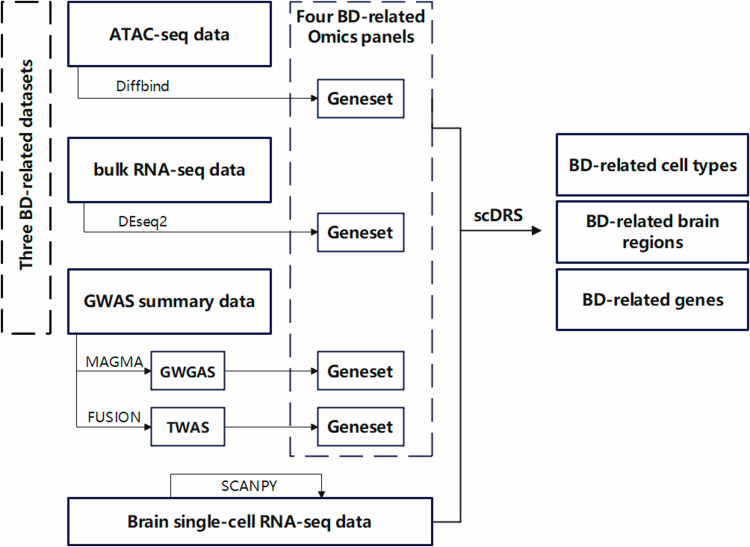
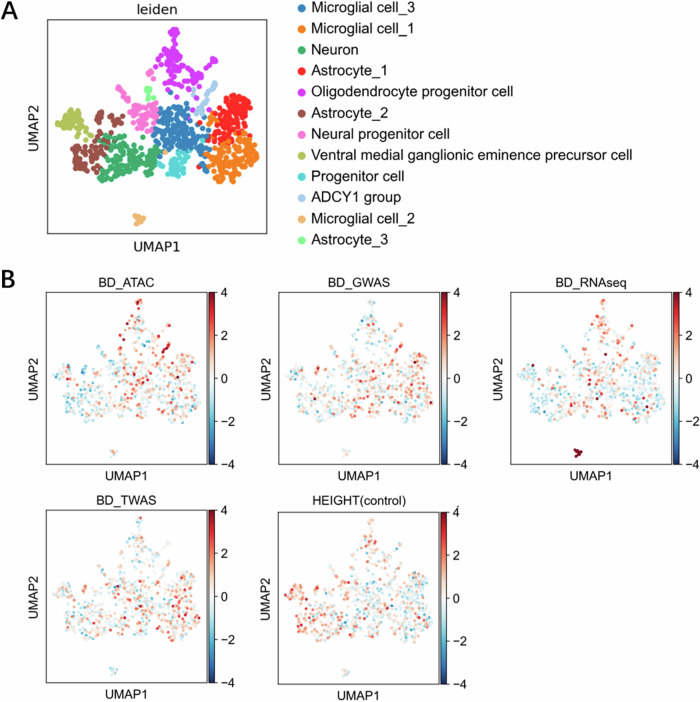
This study investigates the cellular origin and tissue heterogeneity in bipolar disorder (BD) by integrating multiomics data. Four distinct datasets were employed, including single-cell RNA sequencing (scRNA-seq) data (embryonic and fetal brain, n = 8, 1,266 cells), BD Assay for Transposase-Accessible Chromatin using sequencing (ATAC-seq) data (adult brain, n = 210), BD bulk RNA-seq data (adult brain, n = 314), and BD genome-wide association study (GWAS) summary data (n = 413,466). The integration of scRNA-seq data with multiomics data relevant to BD was accomplished using the single-cell disease relevance score (scDRS) algorithm. We have identified a novel brain cell cluster named ADCY1, which exhibits distinct genetic characteristics. From a high-resolution genetic perspective, glial cells emerge as the primary cytopathology associated with BD. Specifically, astrocytes were significantly related to BD at the RNA-seq level, while microglia showed a strong association with BD across multiple panels, including the transcriptome-wide association study (TWAS), ATAC-seq, and RNA-seq. Additionally, oligodendrocyte precursor cells displayed a significant association with BD in both ATAC-seq and RNA-seq panel. Notably, our investigation of brain regions affected by BD revealed significant associations between BD and all three types of glial cells in the dorsolateral prefrontal cortex (DLPFC). Through comprehensive analyses, we identified several BD-associated genes, including CRMP1, SYT4, UCHL1, and ZBTB18. In conclusion, our findings suggest that glial cells, particularly in specific brain regions such as the DLPFC, may play a significant role in the pathogenesis of BD. The integration of multiomics data has provided valuable insights into the etiology of BD, shedding light on potential mechanisms underlying this complex psychiatric disorder.
这项研究通过整合多组学数据来探究双相情感障碍(BD)中的细胞起源和组织异质性。研究使用了四个不同的数据集,包括单细胞 RNA 测序(scRNA-seq)数据(胚胎和胎儿大脑,n=8,1,266 个细胞)、BD 转座酶可及染色质测序(ATAC-seq)数据(成人大脑,n=210)、BD 批量 RNA-seq 数据(成人大脑,n=314)和 BD 全基因组关联研究(GWAS)汇总数据(n=413,466)。使用单细胞疾病相关性评分(scDRS)算法整合 scRNA-seq 数据和与 BD 相关的多组学数据。我们鉴定出一个名为 ADCY1 的新型脑细胞簇,它具有独特的遗传特征。从高分辨率的遗传角度来看,胶质细胞是与 BD 相关的主要细胞学病变。具体来说,星形胶质细胞在 RNA-seq 水平与 BD 显著相关,而小胶质细胞在全转录组关联研究(TWAS)、ATAC-seq 和 RNA-seq 等多个面板上与 BD 强烈相关。此外,少突胶质前体细胞在 ATAC-seq 和 RNA-seq 面板上与 BD 均显著相关。值得注意的是,我们对受 BD 影响的大脑区域的研究发现,BD 与背外侧前额叶皮质(DLPFC)中的三种胶质细胞均显著相关。通过综合分析,我们鉴定出了几个与 BD 相关的基因,包括 CRMP1、SYT4、UCHL1 和 ZBTB18。综上所述,我们的研究结果表明,胶质细胞,特别是在 DLPFC 等特定脑区,可能在 BD 的发病机制中发挥重要作用。多组学数据的整合为 BD 的病因学提供了有价值的见解,揭示了这种复杂精神障碍的潜在机制。