Department of Helminthology, Faculty of Tropical Medicine, Mahidol University, Bangkok, Thailand.
Animal Systematics & Molecular Ecology Laboratory and Applied Animal Science Laboratory, Department of Biology, Faculty of Science, Mahidol University, Bangkok, Thailand.
Parasitol Res. 2024 Aug 7;123(8):294. doi: 10.1007/s00436-024-08308-9.
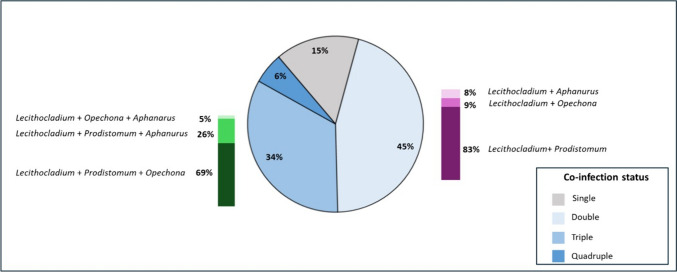
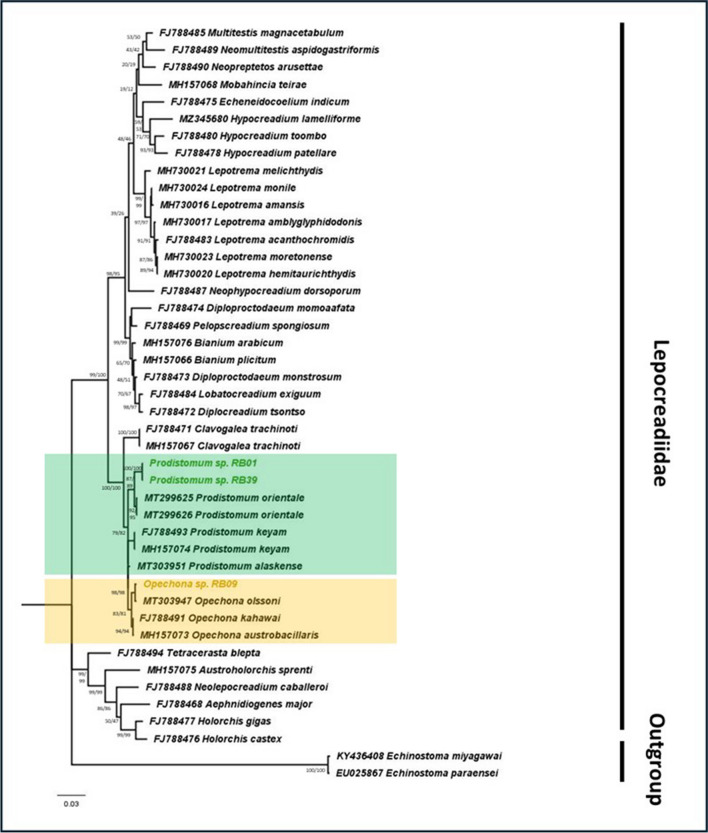
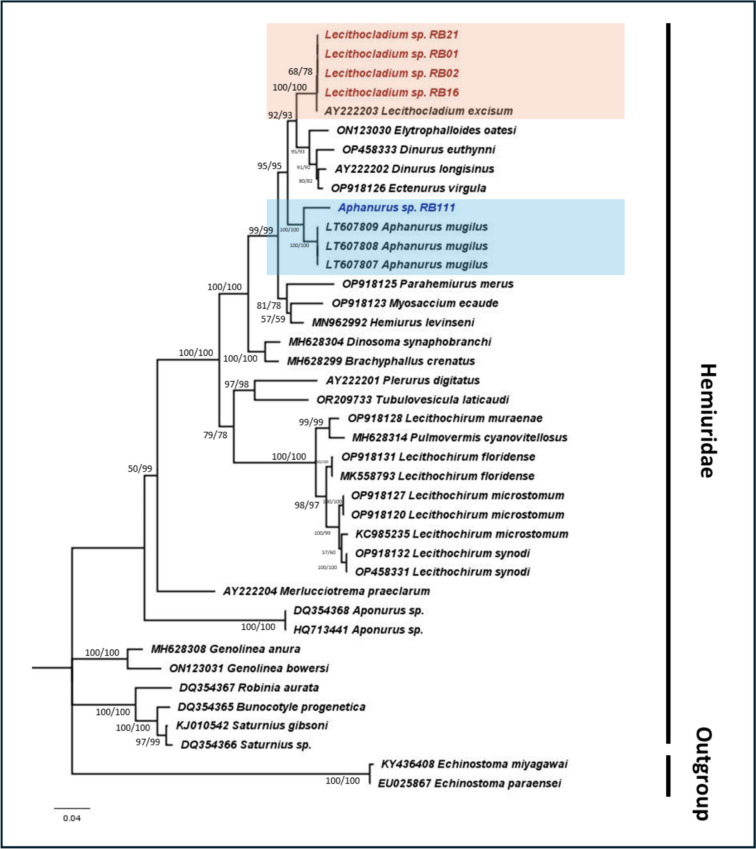
Rastrelliger brachysoma (Bleeker, 1851), the short mackerel, is a dietary staple and of significant economic demand in Southeast Asia and Thailand. However, the demand for short mackerel has precipitated an overfishing crisis, leading to a depletion of fish stocks. Overfishing, coupled with parasitism, may result in a decline in the population of R. brachysoma. Digenetic trematode infection is prevalent in marine fish and has a considerable impact on the overall health of the fish. Here, to identify digenetic trematodes infecting R. brachysoma, we aim to determine the identity, prevalence, and intensity of digenean infections in R. brachysoma from the Gulf of Thailand. A total of 194 short mackerel were obtained from Chon Buri Province, where digeneans were isolated and identified. The molecular identity of the digeneans was confirmed using the nuclear 28S rRNA gene. Of the 194 short mackerel, 100% were found to be infected with digeneans, comprising of Lecithocladium, Prodistomum, Opechona, and Aphanurus. Lecithocladium was the most prevalent (98%) and had the highest intensity of infection (37 mean intensity), followed by Prodistomum (75% prevalence and 17 mean intensity). Our study thus presents the first evidence of digeneans infecting the economically important short mackerel from the Gulf of Thailand. The high infection rate of digenetic trematodes may have implications on the health of R. brachysoma, further driving their population decline. These data underscore the importance of safeguarding fisheries resources in the Gulf of Thailand, and downstream conservation efforts are crucial for evidence-based management decisions to safeguard the long-term sustainability of fish resources.
短尾大眼鲷(Bleeker,1851),又称短鲷,是东南亚和泰国的主要食物来源,具有重要的经济需求。然而,对短尾大眼鲷的需求导致了过度捕捞危机,导致鱼类资源枯竭。过度捕捞加上寄生虫的影响,可能导致短尾大眼鲷数量减少。双壳目吸虫感染在海鱼中很常见,对鱼类的整体健康有很大影响。在这里,为了确定感染短尾大眼鲷的双壳目吸虫,我们旨在确定泰国湾短尾大眼鲷中双壳目吸虫的种类、流行率和感染强度。总共从春武里府获得了 194 条短尾大眼鲷,在那里分离和鉴定了双壳目吸虫。使用核 28S rRNA 基因确认双壳目吸虫的分子身份。在 194 条短尾大眼鲷中,发现 100%的鱼感染了双壳目吸虫,包括 Lecithocladium、Prodistomum、Opechona 和 Aphanurus。Lecithocladium 的流行率最高(98%),感染强度最高(37 个平均强度),其次是 Prodistomum(75%的流行率和 17 个平均强度)。因此,我们的研究首次证明了双壳目吸虫感染了泰国湾具有经济重要性的短尾大眼鲷。双壳目吸虫的高感染率可能对短尾大眼鲷的健康产生影响,进一步导致其数量减少。这些数据强调了保护泰国湾渔业资源的重要性,下游保护努力对于基于证据的管理决策至关重要,以确保鱼类资源的长期可持续性。