Oral and Maxillofacial Prosthodontics Department, Faculty of Dentistry, Ain Shams University, Cairo, Egypt.
BMC Oral Health. 2024 Aug 6;24(1):902. doi: 10.1186/s12903-024-04692-x.
Long-term success of implant restoration depends on many factors one of them is the sufficient implant stability which is lowered in compromised bone density sites such as the maxilla as it is categorized as type III & IV bone, so searching for a new innovation and updates in implant material and features is very mandatory. So, the aim of this study was to compare between two implant materials (roxolid and traditional titanium) on the primary and secondary stability of implant retained maxillary overdenture.
Eighteen completely edentulous patients were selected. All patients received maxillary implant-retained overdentures and lower complete dentures; patients were divided equally into two groups according to the type of implant materials. Group A received a total number of 36 implants made of roxolid material and Group B received a total number of 36 implants made of traditional titanium alloys. Implant stability was assessed using ostell device, the primary implant stability was measured at the day of implant installation however, secondary implant stability was measured after six weeks of implant placement. Paired t-test was used to compare between primary and secondary stability in the same group and an independent t-test was used to compare between the two groups with a significant level < 0.05.
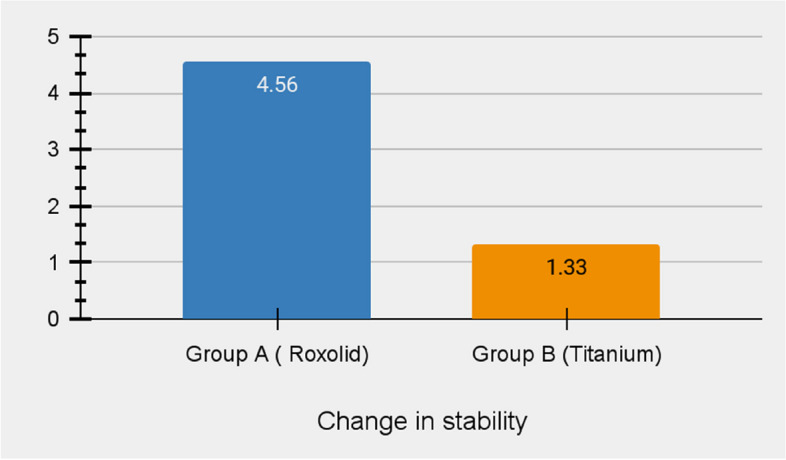
Independent t-test revealed a significant difference between the two groups with p -value = 0.0141 regarding primary stability and p-value < 0.001 regarding secondary stability, as roxolid implant group was statistically higher stability than titanium group in both. Paired t- test showed a statistically significant difference in roxolid implant group with p-value = 0.0122 however, there was non-statistically significant difference in titanium group with p-value = 0.636. Mann Whitney test showed a significant difference between the two groups regarding amount of change in stability with p value = 0.191. roxolid implant group showed a higher amount of change in stability than the titanium implant group.
Within the limitation of this study, it could be concluded that: Roxolid implants showed promising results regarding primary and secondary stability compared to conventional Titanium implants and can be a better alternative in implant retained maxillary overdentures.
Retrospectively NCT06334770 at 26-3-2024.
种植体修复的长期成功取决于许多因素,其中之一是足够的种植体稳定性,而在骨质密度较低的部位,如上颌骨,种植体稳定性会降低,因为上颌骨被归类为 III 型和 IV 型骨。因此,寻找种植体材料和特性的新创新和更新是非常必要的。因此,本研究的目的是比较两种种植体材料(Roxolid 和传统钛)对上颌骨覆盖义齿固位种植体的初始和继发性稳定性的影响。
选择了 18 名完全无牙的患者。所有患者均接受上颌种植体覆盖义齿和下颌全口义齿修复;患者根据种植体材料的类型平均分为两组。A 组共植入 36 颗 Roxolid 材料制成的种植体,B 组共植入 36 颗传统钛合金制成的种植体。使用 Ostell 设备评估种植体稳定性,初始种植体稳定性在种植体植入当天测量,而继发性种植体稳定性在植入后 6 周测量。采用配对 t 检验比较同一组内的初始和继发性稳定性,采用独立 t 检验比较两组间的差异,显著性水平设为<0.05。
独立 t 检验显示,两组间的差异具有统计学意义(p 值=0.0141 ),其中 Roxolid 种植体组的初始稳定性明显高于钛合金组,差异有统计学意义(p 值<0.001 )。配对 t 检验显示,Roxolid 种植体组的差异具有统计学意义(p 值=0.0122 ),而钛合金组的差异无统计学意义(p 值=0.636 )。Mann-Whitney 检验显示,两组间稳定性变化量的差异具有统计学意义(p 值=0.191 ),Roxolid 种植体组的稳定性变化量明显高于钛合金种植体组。
在本研究的限制范围内,可以得出结论:与传统钛合金种植体相比,Roxolid 种植体在初始和继发性稳定性方面表现出良好的效果,可以作为上颌骨覆盖义齿固位种植体的更好选择。
回顾性 NCT06334770 于 2024 年 3 月 26 日。