Cammann Davis B, Lu Yimei, Rotter Jerome I, Wood Alexis C, Chen Jingchun
Nevada Institute of Personalized Medicine, University of Nevada Las Vegas, Las Vegas, NV, United States.
The Lundquist Institute for Biomedical Innovation, Harbor-UCLA Medical Center, Torrance, CA, United States.
Front Neurosci. 2024 Jul 23;18:1404377. doi: 10.3389/fnins.2024.1404377. eCollection 2024.
An increasing body of evidence suggests that neuroinflammation is one of the key drivers of late-onset Alzheimer's disease (LOAD) pathology. Due to the increased permeability of the blood-brain barrier (BBB) in older adults, peripheral plasma proteins can infiltrate the central nervous system (CNS) and drive neuroinflammation through interactions with neurons and glial cells. Because these inflammatory factors are heritable, a greater understanding of their genetic relationship with LOAD could identify new biomarkers that contribute to LOAD pathology or offer protection against it.
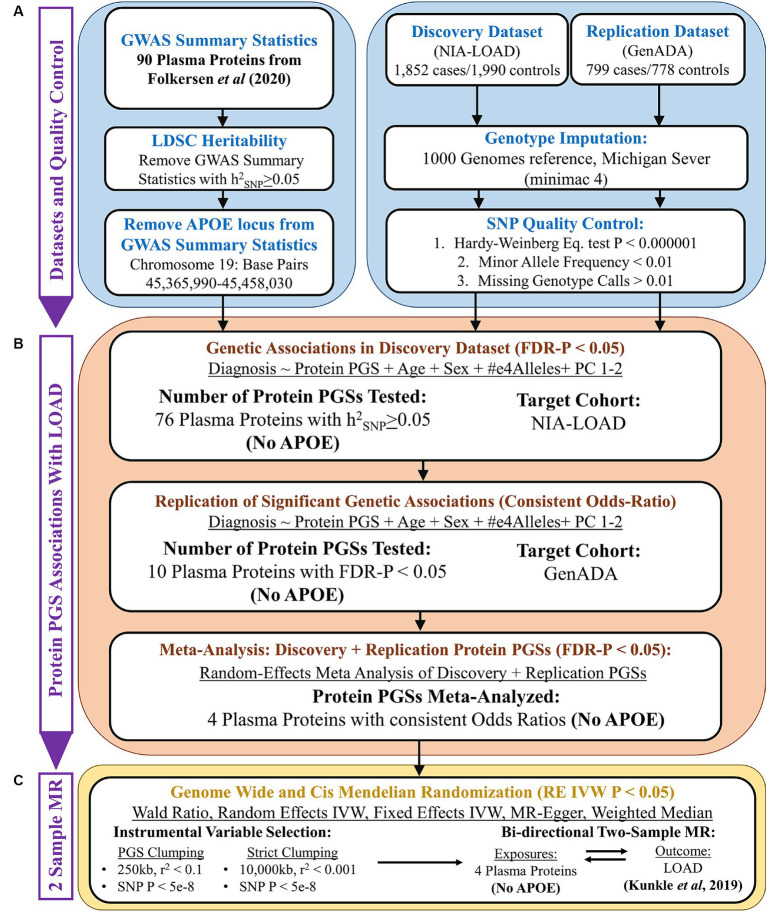
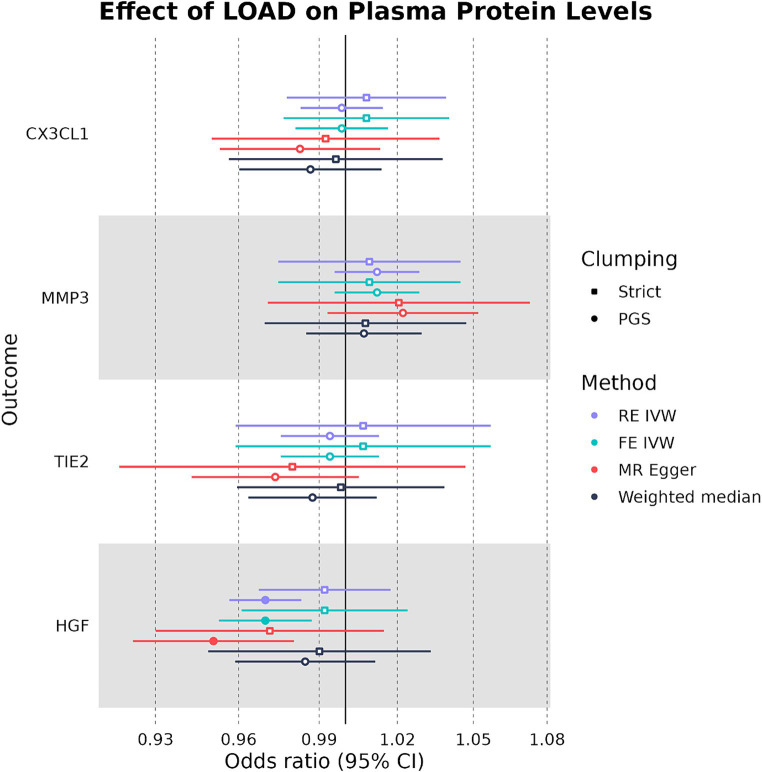
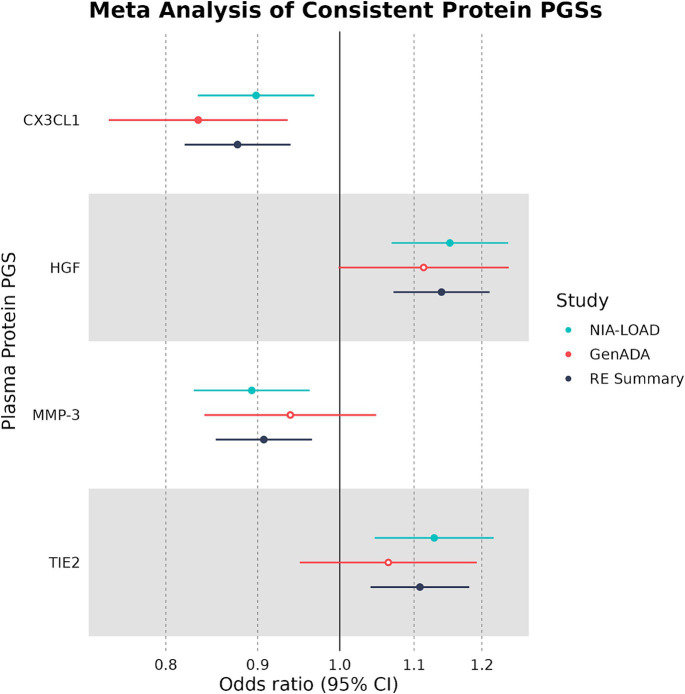
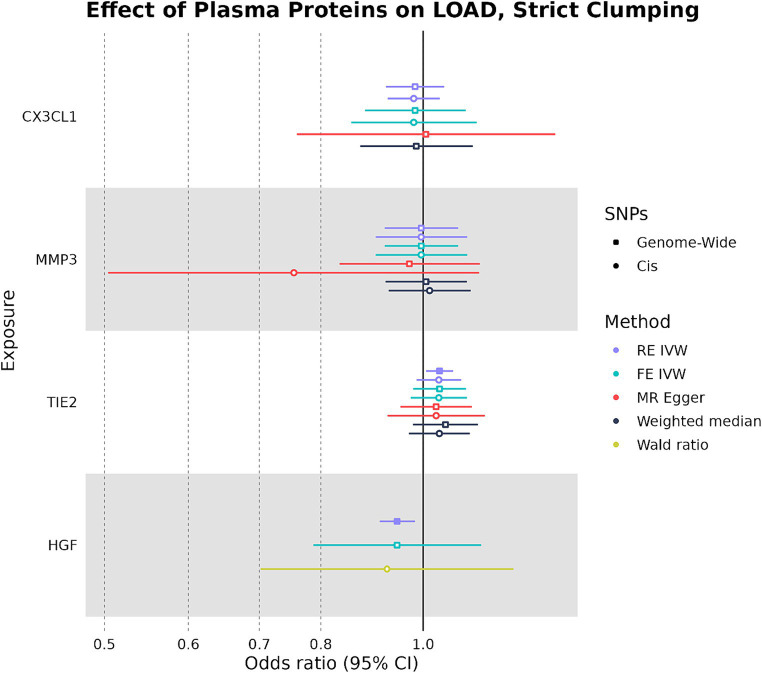
We used a genome-wide association study (GWAS) of 90 different plasma proteins ( = 17,747) to create polygenic scores (PGSs) in an independent discovery (cases = 1,852 and controls = 1,990) and replication (cases = 799 and controls = 778) cohort. Multivariate logistic regression was used to associate the plasma protein PGSs with LOAD diagnosis while controlling for age, sex, principal components 1-2, and the number of -e4 alleles as covariates. After meta-analyzing the PGS-LOAD associations between the two cohorts, we then performed a two-sample Mendelian randomization (MR) analysis using the summary statistics of significant plasma protein level PGSs in the meta-analysis as an exposure, and a GWAS of clinically diagnosed LOAD (cases = 21,982, controls = 41,944) as an outcome to explore possible causal relationships between the two.
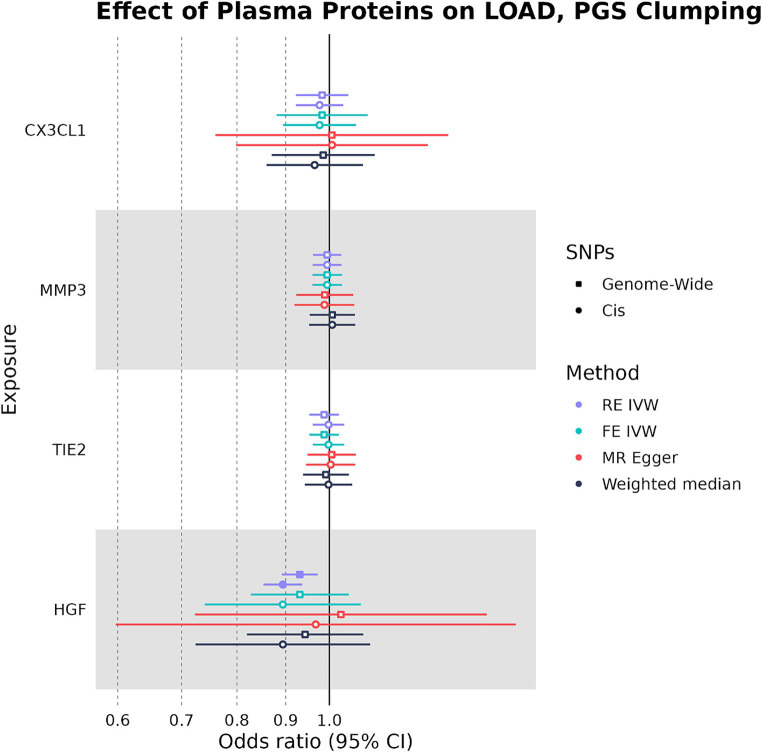
We identified four plasma protein level PGSs that were significantly associated (FDR-adjusted < 0.05) with LOAD in a meta-analysis of the discovery and replication cohorts: CX3CL1, hepatocyte growth factor (HGF), TIE2, and matrix metalloproteinase-3 (MMP-3). When these four plasma proteins were used as exposures in MR with LOAD liability as the outcome, plasma levels of HGF were inferred to have a negative causal relationship with the disease when single-nucleotide polymorphisms (SNPs) used as instrumental variables were not restricted to cis-variants (OR/95%CI = 0.945/0.906-0.984, = 0.005).
Our results show that plasma HGF has a negative causal relationship with LOAD liability that is driven by pleiotropic SNPs possibly involved in other pathways. These findings suggest a low transferability between PGS and MR approaches, and future research should explore ways in which LOAD and the plasma proteome may interact.
越来越多的证据表明,神经炎症是晚发性阿尔茨海默病(LOAD)病理的关键驱动因素之一。由于老年人血脑屏障(BBB)通透性增加,外周血浆蛋白可渗入中枢神经系统(CNS),并通过与神经元和胶质细胞相互作用驱动神经炎症。由于这些炎症因子具有遗传性,更深入了解它们与LOAD的遗传关系,可能会识别出有助于LOAD病理或提供保护的新生物标志物。
我们对90种不同血浆蛋白(n = 17,747)进行全基因组关联研究(GWAS),以在独立的发现队列(病例 = 1,852,对照 = 1,990)和复制队列(病例 = 799,对照 = 778)中创建多基因评分(PGS)。使用多变量逻辑回归将血浆蛋白PGS与LOAD诊断相关联,同时将年龄、性别、主成分1 - 2以及ε4等位基因数量作为协变量进行控制。在对两个队列之间的PGS - LOAD关联进行荟萃分析后,我们随后进行了两样本孟德尔随机化(MR)分析,使用荟萃分析中显著血浆蛋白水平PGS的汇总统计数据作为暴露因素,将临床诊断的LOAD的GWAS(病例 = 21,982,对照 = 41,944)作为结果,以探索两者之间可能的因果关系。
在发现队列和复制队列的荟萃分析中,我们确定了四种血浆蛋白水平PGS与LOAD显著相关(FDR校正P < 0.05):CX3CL1、肝细胞生长因子(HGF)、TIE2和基质金属蛋白酶 - 3(MMP - 3)。当将这四种血浆蛋白用作以LOAD易感性为结果的MR中的暴露因素时,当用作工具变量的单核苷酸多态性(SNP)不限于顺式变体时,推断HGF的血浆水平与疾病存在负因果关系(OR/95%CI = (0.945 / 0.906至0.984),P = 0.005)。
我们的结果表明,血浆HGF与LOAD易感性存在负因果关系,这是由可能参与其他途径的多效性SNP驱动的。这些发现表明PGS和MR方法之间的可转移性较低,未来的研究应探索LOAD与血浆蛋白质组可能相互作用的方式。