Koutroumpakis Efstratios, Patel Rushin, Khadke Sumanth, Bedrosian Aram, Kumar Ashish, Kong Yixin, Connell Brendan, Upadhyay Jagriti, Dani Sourbha S, Hahn Andrew W, Logothetis Christopher J, Al-Kindi Sadeer, Butler Javed, Nohria Anju, Ganatra Sarju, Deswal Anita
The University of Texas MD Anderson Cancer Center.
Lahey Hospital and Medical Center.
Res Sq. 2024 Jul 26:rs.3.rs-4510870. doi: 10.21203/rs.3.rs-4510870/v1.
Studies have reported associations between prostate cancer, type II diabetes mellitus (T2DM) and cardiovascular disease in the context of treatment with hormone therapy (HT). This study aimed to assess the role of Sodium-Glucose Cotransporter-2 Inhibitors (SGLT2i) in preventing adverse cardiovascular and renal outcomes in diabetics with prostate cancer.
Patients ≥ 18 years of age with T2DM and prostate cancer who received HT between August 1, 2013, and August 31, 2021, were identified using the TriNetX research network. Patients were divided into two cohorts based on treatment with SGLT2i or alternative antidiabetic therapies. The primary outcome was the composite of all-cause mortality, new onset heart failure (HF), acute myocardial infarction (MI), and peripheral artery disease over two years from HT initiation.
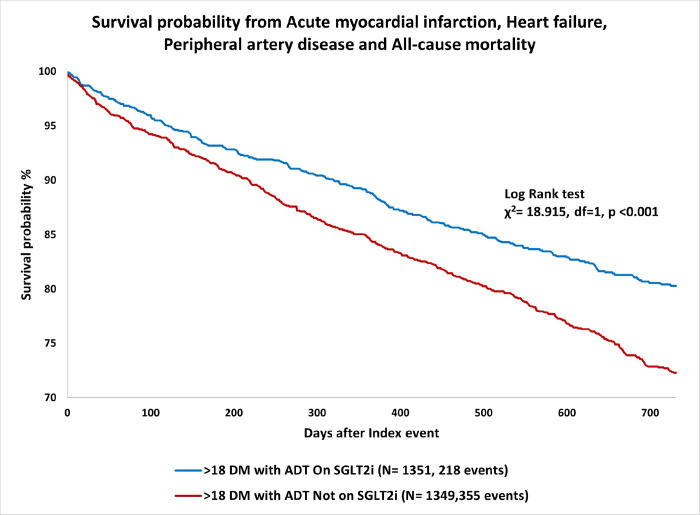
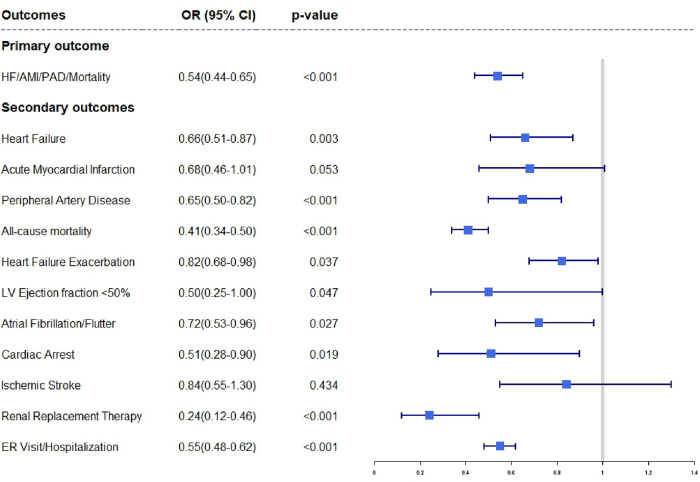
After propensity score matching, 2,155 patients remained in each cohort. The primary composite outcome occurred in 218 patients (16.1%) in the SGLT2i cohort versus 355 patients (26.3%) in the non-SGLT2i cohort (HR 0.689, 95% CI 0.582-0.816; p < 0.001). Furthermore, SGLT2i were associated with significantly lower odds of HF, HF exacerbation, peripheral artery disease, atrial fibrillation/flutter, cardiac arrest, need for renal replacement therapy, overall emergency room visits/hospitalizations and all-cause mortality.
Use of SGLT2i for the treatment of T2DM among patients with prostate cancer on HT is associated with favorable cardiovascular, renal and all-cause mortality outcomes. This observation supports the hypothesis that a therapeutically relevant link exists between HT and cardiovascular disease in the context of prostate cancer.
有研究报道了在激素疗法(HT)治疗背景下前列腺癌、2型糖尿病(T2DM)和心血管疾病之间的关联。本研究旨在评估钠-葡萄糖协同转运蛋白2抑制剂(SGLT2i)在预防前列腺癌糖尿病患者不良心血管和肾脏结局中的作用。
使用TriNetX研究网络识别2013年8月1日至2021年8月31日期间接受HT的年龄≥18岁的T2DM和前列腺癌患者。根据是否使用SGLT2i或其他抗糖尿病疗法将患者分为两个队列。主要结局是从HT开始两年内全因死亡率、新发心力衰竭(HF)、急性心肌梗死(MI)和外周动脉疾病的综合情况。
倾向评分匹配后,每个队列各有2155例患者。SGLT2i队列中有218例患者(16.1%)发生主要复合结局,而非SGLT2i队列中有355例患者(26.3%)发生(风险比0.689,95%置信区间0.582-0.816;p<0.001)。此外,SGLT2i与HF、HF加重、外周动脉疾病、心房颤动/扑动、心脏骤停、肾脏替代治疗需求、总体急诊就诊/住院和全因死亡率的显著较低几率相关。
在接受HT的前列腺癌患者中使用SGLT2i治疗T2DM与良好的心血管、肾脏和全因死亡率结局相关。这一观察结果支持了在前列腺癌背景下HT与心血管疾病之间存在治疗相关联系的假设。