Naeem Fawaz, Leone Teresa C, Petucci Christopher, Shoffler Clarissa, Kodihalli Ravindra C, Hidalgo Tiffany, Tow-Keogh Cheryl, Mancuso Jessica, Tzameli Iphigenia, Bennett Donald, Groarke John D, Flach Rachel J Roth, Rader Daniel J, Kelly Daniel P
Cardiovascular Institute, Department of Medicine, University of Pennsylvania, Philadelphia, PA.
Drug Safety R&D, Pfizer Inc, Groton, CT.
medRxiv. 2024 Jul 25:2024.07.24.24310961. doi: 10.1101/2024.07.24.24310961.
Two general phenotypes of heart failure (HF) are recognized: HF with reduced ejection fraction (HFrEF) and with preserved EF (HFpEF). To develop HF disease phenotype-specific approaches to define and guide treatment, distinguishing biomarkers are needed. The goal of this study was to utilize quantitative metabolomics on a large, diverse population to replicate and extend existing knowledge of the plasma metabolic signatures in human HF.
Quantitative, targeted LC/MS plasma metabolomics was conducted on 787 samples collected by the Penn Medicine BioBank from subjects with HFrEF (n=219), HFpEF (n=357), and matched non-failing Controls (n=211). A total of 90 metabolites were analyzed, comprising 28 amino acids, 8 organic acids, and 54 acylcarnitines. 733 of these samples were also processed via an OLINK protein panel for proteomic profiling.
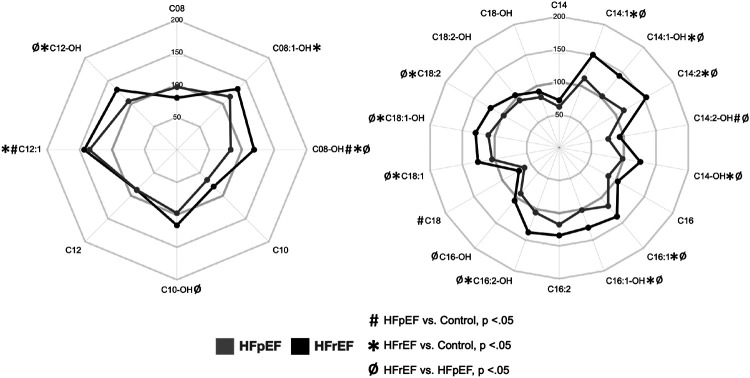
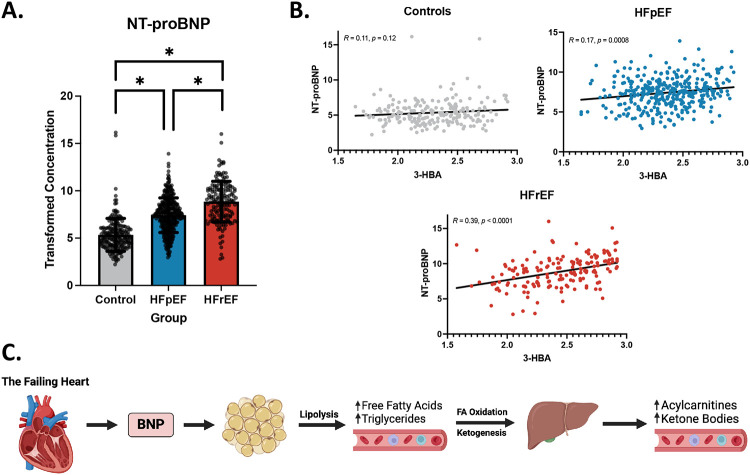
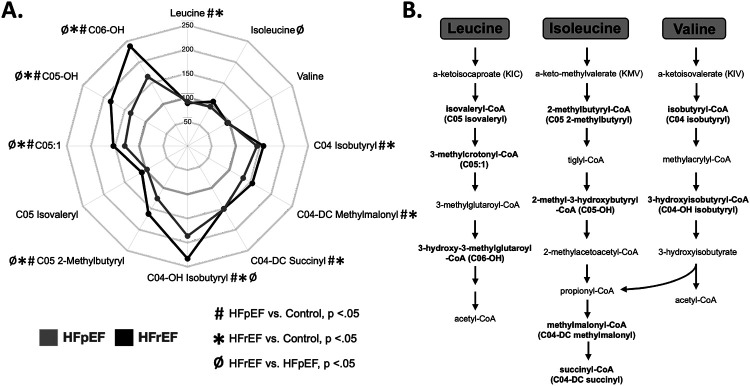
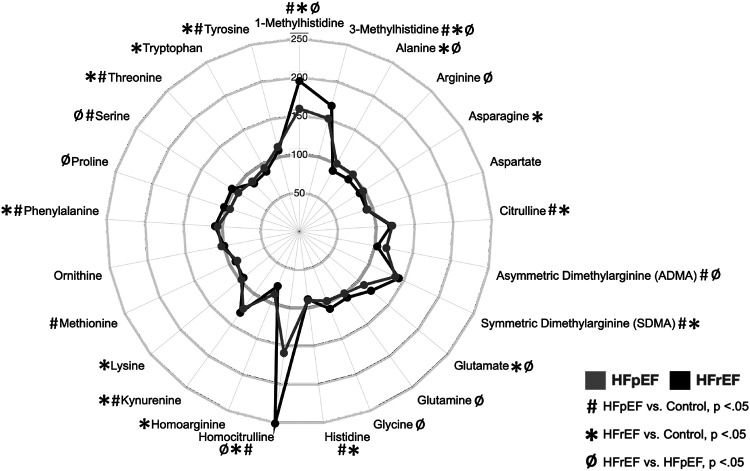
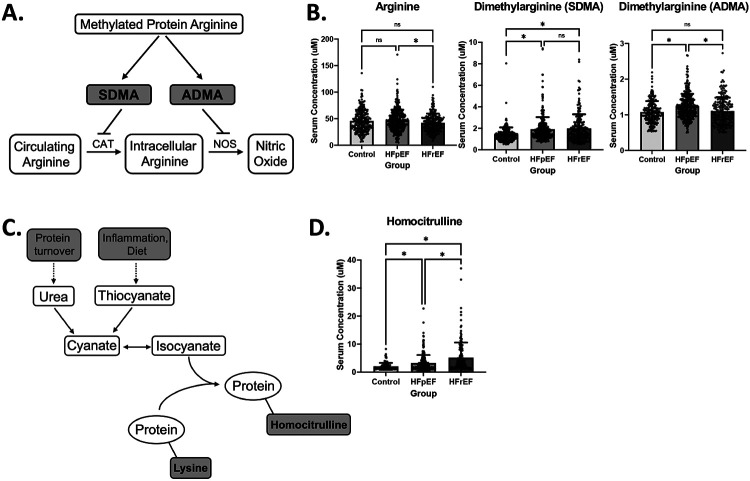
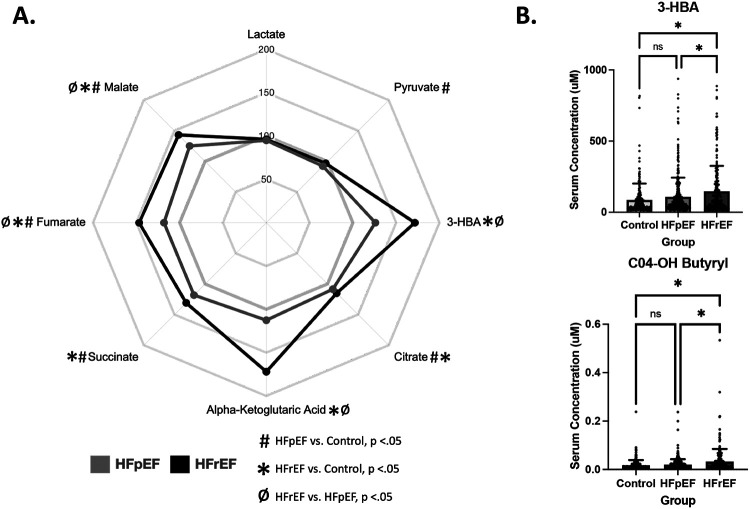
Consistent with previous studies, unsaturated forms of medium/long chain acylcarnitines were elevated in the HFrEF group to a greater extent than the HFpEF group compared to Controls. A number of amino acid derivatives, including 1- and 3-methylhistidine, homocitrulline, and symmetric (SDMA) and asymmetric (ADMA) dimethylarginine were elevated in HF, with ADMA elevated uniquely in HFpEF. Plasma branched-chain amino acids (BCAA) were not different across the groups; however, short-chain acylcarnitine species indicative of BCAA catabolism were significantly elevated in both HF groups. The ketone body 3-hydroxybutyrate (3-HBA) and its metabolite C4-OH carnitine were uniquely elevated in the HFrEF group. Linear regression models demonstrated a significant correlation between plasma 3-HBA and NT-proBNP in both forms of HF, stronger in HFrEF.
These results identify plasma signatures that are shared as well as potentially distinguish between HFrEF and HFpEF. Metabolite markers for ketogenic metabolic reprogramming in extra-cardiac tissues were identified as unique signatures in the HFrEF group, possibly related to the lipolytic action of increased levels of BNP. Future studies will be necessary to further validate these metabolites as HF biosignatures that may guide phenotype-specific therapeutics and provide insight into the systemic metabolic responses to HFpEF and HFrEF.
心力衰竭(HF)有两种常见表型:射血分数降低的心力衰竭(HFrEF)和射血分数保留的心力衰竭(HFpEF)。为了开发针对HF疾病表型的方法来定义和指导治疗,需要有区分性的生物标志物。本研究的目的是对大量不同人群进行定量代谢组学分析,以复制和扩展关于人类HF血浆代谢特征的现有知识。
对宾夕法尼亚大学医学生物样本库收集的787份样本进行了定量靶向液相色谱/质谱血浆代谢组学分析,这些样本来自HFrEF患者(n = 219)、HFpEF患者(n = 357)以及匹配的非心力衰竭对照组(n = 211)。总共分析了90种代谢物,包括28种氨基酸、8种有机酸和54种酰基肉碱。其中733份样本还通过OLINK蛋白质组学检测板进行了蛋白质组分析。
与先前研究一致,与对照组相比,中/长链不饱和酰基肉碱在HFrEF组中的升高程度大于HFpEF组。一些氨基酸衍生物,包括1-甲基组氨酸、3-甲基组氨酸、同型瓜氨酸以及对称二甲基精氨酸(SDMA)和不对称二甲基精氨酸(ADMA)在HF中升高,其中ADMA仅在HFpEF中升高。各组间血浆支链氨基酸(BCAA)无差异;然而,指示BCAA分解代谢的短链酰基肉碱在两个HF组中均显著升高。酮体3-羟基丁酸(3-HBA)及其代谢物C4-OH肉碱在HFrEF组中独特升高。线性回归模型显示,在两种形式的HF中,血浆3-HBA与NT-proBNP之间均存在显著相关性,在HFrEF中更强。
这些结果确定了HFrEF和HFpEF共有的以及可能具有区分性的血浆特征。心脏外组织中酮体代谢重编程的代谢物标志物被确定为HFrEF组中的独特特征,可能与BNP水平升高的脂解作用有关。未来有必要进一步验证这些代谢物作为HF生物标志物,它们可能指导表型特异性治疗,并深入了解对HFpEF和HFrEF的全身代谢反应。