• 文献检索
  • 文档翻译
  • 深度研究
  • 学术资讯
  • Suppr Zotero 插件Zotero 插件
  • 邀请有礼
  • 套餐&价格
  • 历史记录
应用&插件
Suppr Zotero 插件Zotero 插件浏览器插件Mac 客户端Windows 客户端微信小程序
定价
高级版会员购买积分包购买API积分包
服务
文献检索文档翻译深度研究API 文档MCP 服务
关于我们
关于 Suppr公司介绍联系我们用户协议隐私条款
关注我们

Suppr 超能文献

核心技术专利:CN118964589B侵权必究
粤ICP备2023148730 号-1Suppr @ 2026

文献检索

告别复杂PubMed语法,用中文像聊天一样搜索,搜遍4000万医学文献。AI智能推荐,让科研检索更轻松。

立即免费搜索

文件翻译

保留排版,准确专业,支持PDF/Word/PPT等文件格式,支持 12+语言互译。

免费翻译文档

深度研究

AI帮你快速写综述,25分钟生成高质量综述,智能提取关键信息,辅助科研写作。

立即免费体验

基于机器学习的个性化临床评估推荐系统

Individualized Machine-learning-based Clinical Assessment Recommendation System.

作者信息

Setiawan Devin, Wiranto Yumiko, Girard Jeffrey M, Watts Amber, Ashourvan Arian

机构信息

The University of Kansas, Department of Electrical Engineering and Computer Science, 1415 Jayhawk Blvd. Lawrence, KS 66045.

The University of Kansas, Department of Psychology, 1415 Jayhawk Blvd. Lawrence, KS 66045.

出版信息

medRxiv. 2024 Dec 7:2024.07.24.24310941. doi: 10.1101/2024.07.24.24310941.

DOI:10.1101/2024.07.24.24310941
PMID:39108531
原文链接:https://pmc.ncbi.nlm.nih.gov/articles/PMC11302612/
Abstract

BACKGROUND

Traditional clinical assessments often lack individualization, relying on standardized procedures that may not accommodate the diverse needs of patients, especially in early stages where personalized diagnosis could offer significant benefits. We aim to provide a machine-learning framework that addresses the individualized feature addition problem and enhances diagnostic accuracy for clinical assessments.

METHODS

Individualized Clinical Assessment Recommendation System (iCARE) employs locally weighted logistic regression and Shapley Additive Explanations (SHAP) value analysis to tailor feature selection to individual patient characteristics. Evaluations were conducted on synthetic and real-world datasets, including early-stage diabetes risk prediction and heart failure clinical records from the UCI Machine Learning Repository. We compared the performance of iCARE with a Global approach using statistical analysis on accuracy and area under the ROC curve (AUC) to select the best additional features.

FINDINGS

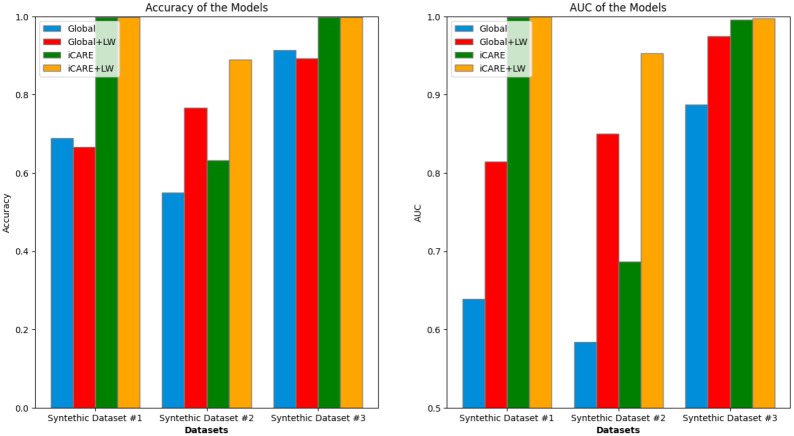
The iCARE framework enhances predictive accuracy and AUC metrics when additional features exhibit distinct predictive capabilities, as evidenced by synthetic datasets 1-3 and the early diabetes dataset. Specifically, in synthetic dataset 1, iCARE achieved an accuracy of 0·999 and an AUC of 1·000, outperforming the Global approach with an accuracy of 0·689 and an AUC of 0·639. In the early diabetes dataset, iCARE shows improvements of 1·5-3·5% in accuracy and AUC across different numbers of initial features. Conversely, in synthetic datasets 4-5 and the heart failure dataset, where features lack discernible predictive distinctions, iCARE shows no significant advantage over global approaches on accuracy and AUC metrics.

INTERPRETATION

iCARE provides personalized feature recommendations that enhance diagnostic accuracy in scenarios where individualized approaches are critical, improving the precision and effectiveness of medical diagnoses.

FUNDING

This work was supported by startup funding from the Department of Psychology at the University of Kansas provided to A.A., and the R01MH125740 award from NIH partially supported J.M.G.'s work.

摘要

背景

传统的临床评估往往缺乏个性化,依赖标准化程序,可能无法满足患者的多样化需求,尤其是在早期阶段,个性化诊断可能带来显著益处。我们旨在提供一个机器学习框架,以解决个性化特征添加问题,并提高临床评估的诊断准确性。

方法

个性化临床评估推荐系统(iCARE)采用局部加权逻辑回归和夏普利值(SHAP)分析,根据个体患者特征定制特征选择。在合成数据集和真实世界数据集上进行评估,包括来自UCI机器学习库的早期糖尿病风险预测和心力衰竭临床记录。我们使用统计分析比较了iCARE与全局方法在准确性和ROC曲线下面积(AUC)方面的性能,以选择最佳的附加特征。

研究结果

当附加特征具有明显的预测能力时,iCARE框架提高了预测准确性和AUC指标,合成数据集1-3和早期糖尿病数据集证明了这一点。具体而言,在合成数据集1中,iCARE的准确率达到0.999,AUC为达到1.000,优于全局方法,全局方法的准确率为0.689,AUC为0.639。在早期糖尿病数据集中,iCARE在不同数量的初始特征下,准确率和AUC提高了1.5%-至3.5%。相反,在合成数据集4-5和心力衰竭数据集中,特征缺乏明显的预测差异,iCARE在准确性和AUC指标上与全局方法相比没有显著优势。

解读

iCARE提供个性化特征推荐,在个性化方法至关重要的情况下提高诊断准确性,提高医学诊断的精度和有效性。

资金支持

这项工作得到了堪萨斯大学心理学系提供给A.A.的启动资金支持,美国国立卫生研究院(NIH)的R01MH125740奖部分支持了J.M.G.的工作。

https://cdn.ncbi.nlm.nih.gov/pmc/blobs/57c3/11639300/d5b05e952fdd/nihpp-2024.07.24.24310941v2-f0012.jpg
https://cdn.ncbi.nlm.nih.gov/pmc/blobs/57c3/11639300/a726555ba970/nihpp-2024.07.24.24310941v2-f0001.jpg
https://cdn.ncbi.nlm.nih.gov/pmc/blobs/57c3/11639300/855dd49a80de/nihpp-2024.07.24.24310941v2-f0002.jpg
https://cdn.ncbi.nlm.nih.gov/pmc/blobs/57c3/11639300/d2649a8b6639/nihpp-2024.07.24.24310941v2-f0003.jpg
https://cdn.ncbi.nlm.nih.gov/pmc/blobs/57c3/11639300/1e9a48aa8b23/nihpp-2024.07.24.24310941v2-f0004.jpg
https://cdn.ncbi.nlm.nih.gov/pmc/blobs/57c3/11639300/e82f1069ee79/nihpp-2024.07.24.24310941v2-f0005.jpg
https://cdn.ncbi.nlm.nih.gov/pmc/blobs/57c3/11639300/ff20107c4626/nihpp-2024.07.24.24310941v2-f0006.jpg
https://cdn.ncbi.nlm.nih.gov/pmc/blobs/57c3/11639300/1aaaa589a917/nihpp-2024.07.24.24310941v2-f0007.jpg
https://cdn.ncbi.nlm.nih.gov/pmc/blobs/57c3/11639300/071fd394ee60/nihpp-2024.07.24.24310941v2-f0008.jpg
https://cdn.ncbi.nlm.nih.gov/pmc/blobs/57c3/11639300/754f03a0e67f/nihpp-2024.07.24.24310941v2-f0009.jpg
https://cdn.ncbi.nlm.nih.gov/pmc/blobs/57c3/11639300/ede4af489b82/nihpp-2024.07.24.24310941v2-f0010.jpg
https://cdn.ncbi.nlm.nih.gov/pmc/blobs/57c3/11639300/933623e4ffaf/nihpp-2024.07.24.24310941v2-f0011.jpg
https://cdn.ncbi.nlm.nih.gov/pmc/blobs/57c3/11639300/d5b05e952fdd/nihpp-2024.07.24.24310941v2-f0012.jpg
https://cdn.ncbi.nlm.nih.gov/pmc/blobs/57c3/11639300/a726555ba970/nihpp-2024.07.24.24310941v2-f0001.jpg
https://cdn.ncbi.nlm.nih.gov/pmc/blobs/57c3/11639300/855dd49a80de/nihpp-2024.07.24.24310941v2-f0002.jpg
https://cdn.ncbi.nlm.nih.gov/pmc/blobs/57c3/11639300/d2649a8b6639/nihpp-2024.07.24.24310941v2-f0003.jpg
https://cdn.ncbi.nlm.nih.gov/pmc/blobs/57c3/11639300/1e9a48aa8b23/nihpp-2024.07.24.24310941v2-f0004.jpg
https://cdn.ncbi.nlm.nih.gov/pmc/blobs/57c3/11639300/e82f1069ee79/nihpp-2024.07.24.24310941v2-f0005.jpg
https://cdn.ncbi.nlm.nih.gov/pmc/blobs/57c3/11639300/ff20107c4626/nihpp-2024.07.24.24310941v2-f0006.jpg
https://cdn.ncbi.nlm.nih.gov/pmc/blobs/57c3/11639300/1aaaa589a917/nihpp-2024.07.24.24310941v2-f0007.jpg
https://cdn.ncbi.nlm.nih.gov/pmc/blobs/57c3/11639300/071fd394ee60/nihpp-2024.07.24.24310941v2-f0008.jpg
https://cdn.ncbi.nlm.nih.gov/pmc/blobs/57c3/11639300/754f03a0e67f/nihpp-2024.07.24.24310941v2-f0009.jpg
https://cdn.ncbi.nlm.nih.gov/pmc/blobs/57c3/11639300/ede4af489b82/nihpp-2024.07.24.24310941v2-f0010.jpg
https://cdn.ncbi.nlm.nih.gov/pmc/blobs/57c3/11639300/933623e4ffaf/nihpp-2024.07.24.24310941v2-f0011.jpg
https://cdn.ncbi.nlm.nih.gov/pmc/blobs/57c3/11639300/d5b05e952fdd/nihpp-2024.07.24.24310941v2-f0012.jpg

相似文献

1
Individualized Machine-learning-based Clinical Assessment Recommendation System.基于机器学习的个性化临床评估推荐系统
medRxiv. 2024 Dec 7:2024.07.24.24310941. doi: 10.1101/2024.07.24.24310941.
2
Predictive model and risk analysis for peripheral vascular disease in type 2 diabetes mellitus patients using machine learning and shapley additive explanation.基于机器学习和 Shapley 加法解释的 2 型糖尿病患者外周血管疾病预测模型和风险分析。
Front Endocrinol (Lausanne). 2024 Feb 28;15:1320335. doi: 10.3389/fendo.2024.1320335. eCollection 2024.
3
An interpretable machine learning model based on optimal feature selection for identifying CT abnormalities in patients with mild traumatic brain injury.一种基于最优特征选择的可解释机器学习模型,用于识别轻度创伤性脑损伤患者的CT异常。
EClinicalMedicine. 2025 Apr 3;82:103192. doi: 10.1016/j.eclinm.2025.103192. eCollection 2025 Apr.
4
Prediction and validation of pathologic complete response for locally advanced rectal cancer under neoadjuvant chemoradiotherapy based on a novel predictor using interpretable machine learning.基于可解释机器学习的新预测因子预测局部晚期直肠癌新辅助放化疗后病理完全缓解并验证。
Eur J Surg Oncol. 2024 Dec;50(12):108738. doi: 10.1016/j.ejso.2024.108738. Epub 2024 Oct 6.
5
SHAP based predictive modeling for 1 year all-cause readmission risk in elderly heart failure patients: feature selection and model interpretation.基于 SHAP 的预测模型对老年心力衰竭患者 1 年全因再入院风险的预测:特征选择和模型解释。
Sci Rep. 2024 Jul 31;14(1):17728. doi: 10.1038/s41598-024-67844-7.
6
Integrating SHAP analysis with machine learning to predict postpartum hemorrhage in vaginal births.将SHAP分析与机器学习相结合以预测阴道分娩中的产后出血。
BMC Pregnancy Childbirth. 2025 May 3;25(1):529. doi: 10.1186/s12884-025-07633-w.
7
Evaluating Outcome Prediction via Baseline, End-of-Treatment, and Delta Radiomics on PET-CT Images of Primary Mediastinal Large B-Cell Lymphoma.通过基线、治疗结束时以及PET-CT图像上原发性纵隔大B细胞淋巴瘤的放射组学变化评估预后预测
Cancers (Basel). 2024 Mar 8;16(6):1090. doi: 10.3390/cancers16061090.
8
Advanced Prediction of Heart Failure Risk in Elderly Diabetic and Hypertensive Patients Using Nine Machine Learning Models and Novel Composite Indices: Insights from NHANES 2003-2016.使用九种机器学习模型和新型复合指标对老年糖尿病和高血压患者心力衰竭风险的高级预测:来自2003 - 2016年美国国家健康与营养检查调查(NHANES)的见解
Eur J Prev Cardiol. 2025 Feb 27. doi: 10.1093/eurjpc/zwaf081.
9
Enhancing predictive accuracy for urinary tract infections post-pediatric pyeloplasty with explainable AI: an ensemble TabNet approach.使用可解释人工智能提高小儿肾盂成形术后尿路感染的预测准确性:一种集成TabNet方法。
Sci Rep. 2025 Jan 19;15(1):2455. doi: 10.1038/s41598-024-82282-1.
10
Application of information theoretic feature selection and machine learning methods for the development of genetic risk prediction models.信息论特征选择和机器学习方法在遗传风险预测模型开发中的应用。
Sci Rep. 2021 Dec 2;11(1):23335. doi: 10.1038/s41598-021-00854-x.

本文引用的文献

1
A Robust Personalized Classification Method for Breast Cancer Metastasis Prediction.一种用于乳腺癌转移预测的稳健个性化分类方法。
Cancers (Basel). 2022 Oct 29;14(21):5327. doi: 10.3390/cancers14215327.
2
Personalized Care and Treatment Compliance in Chronic Conditions.慢性病的个性化护理与治疗依从性
J Pers Med. 2022 May 1;12(5):737. doi: 10.3390/jpm12050737.
3
The Relationship of ε4, Race, and Sex on the Age of Onset and Risk of Dementia.ε4、种族和性别与痴呆症发病年龄及风险的关系
Front Neurol. 2021 Oct 20;12:735036. doi: 10.3389/fneur.2021.735036. eCollection 2021.
4
Race, APOE genotypes, and cognitive decline among middle-aged urban adults.种族、载脂蛋白 E 基因型与中年城市成年人认知能力下降。
Alzheimers Res Ther. 2021 Jun 30;13(1):120. doi: 10.1186/s13195-021-00855-y.
5
Race, APOEɛ4, and Long-Term Cognitive Trajectories in a Biracial Population Sample.在一个多种族人群样本中,种族、APOEɛ4 与长期认知轨迹。
J Alzheimers Dis. 2019;72(1):45-53. doi: 10.3233/JAD-190538.
6
The growing role of precision and personalized medicine for cancer treatment.精准医学和个性化医学在癌症治疗中日益重要的作用。
Technology (Singap World Sci). 2018 Sep-Dec;6(3-4):79-100. doi: 10.1142/S2339547818300020. Epub 2019 Jan 11.
7
Personalized Diagnosis for Alzheimer's Disease.阿尔茨海默病的个性化诊断
Med Image Comput Comput Assist Interv. 2017 Sep;10435:205-213. doi: 10.1007/978-3-319-66179-7_24. Epub 2017 Sep 4.
8
A Distance-Based Weighted Undersampling Scheme for Support Vector Machines and its Application to Imbalanced Classification.一种基于距离的支持向量机加权欠采样方案及其在不平衡分类中的应用。
IEEE Trans Neural Netw Learn Syst. 2018 Sep;29(9):4152-4165. doi: 10.1109/TNNLS.2017.2755595. Epub 2017 Oct 25.
9
Personalized medicine: motivation, challenges, and progress.个性化医学:动机、挑战与进展。
Fertil Steril. 2018 Jun;109(6):952-963. doi: 10.1016/j.fertnstert.2018.05.006.
10
Longitudinal screening algorithm that incorporates change over time in CA125 levels identifies ovarian cancer earlier than a single-threshold rule.纳入 CA125 水平随时间变化的纵向筛查算法比单一阈值规则更早识别卵巢癌。
J Clin Oncol. 2013 Jan 20;31(3):387-92. doi: 10.1200/JCO.2012.43.6691. Epub 2012 Dec 17.