Zhu Sheng, Wei Xue-Fen, Lu Yu-Xin, Zhang Dao-Wu, Wang Ze-Fu, Ge Jing, Li Sheng-Lian, Song Yan-Feng, Yang Yong, Yi Xian-Gui, Zhang Min, Xue Jia-Yu, Duan Yi-Fan
Co-innovation Center for Sustainable Forestry in Southern China, College of Life Sciences, Nanjing Forestry University, Nanjing 210037, China.
College of Horticulture, Bioinformatics Center, Academy for Advanced Interdisciplinary Studies, Nanjing Agricultural University, Nanjing 210095, China.
Hortic Res. 2024 Jun 18;11(8):uhae166. doi: 10.1093/hr/uhae166. eCollection 2024 Aug.
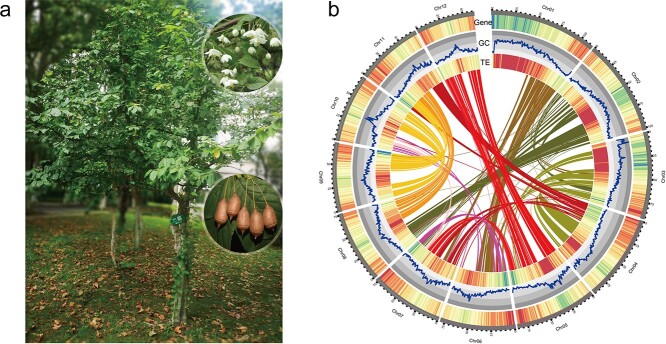
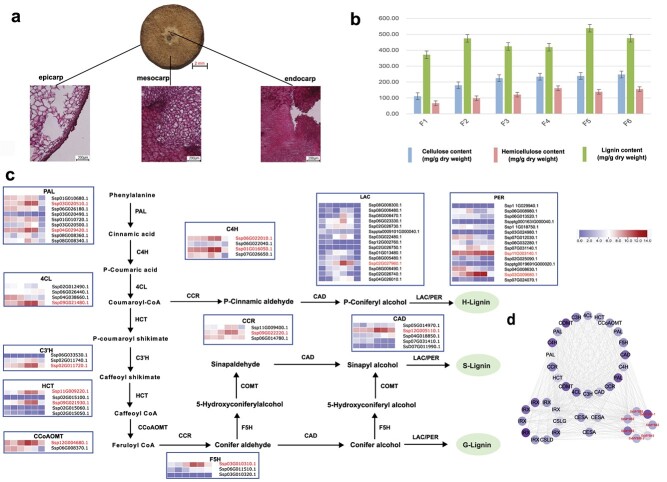
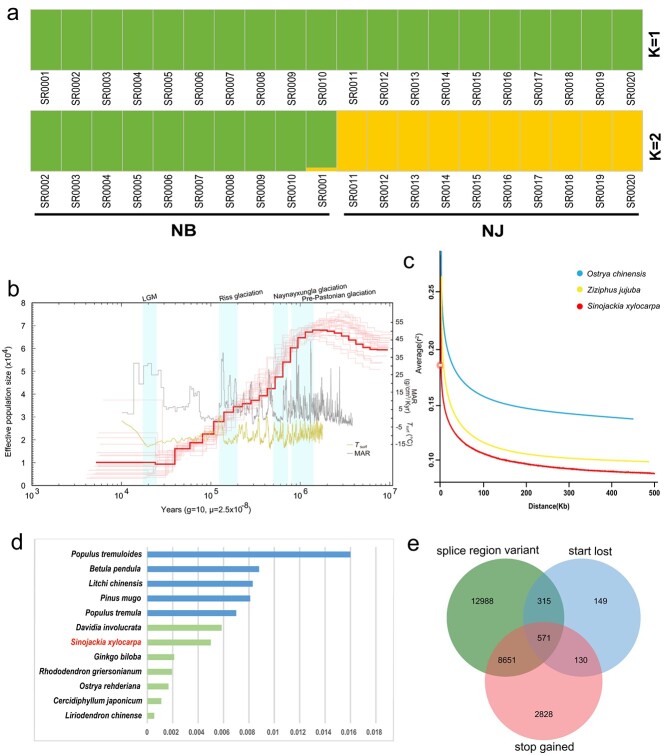
Hu represents the first woody genus described by Chinese botanists, with all species classified as endangered ornamental plants endemic to China. Their characteristic spindle-shaped fruits confer high ornamental value to the plants, making them favored in gardens and parks. Nevertheless, the fruits likely pose a germination obstacle, contributing to the endangered status of this lineage. Here we report the chromosome-scale genome of , and explore the mechanisms underlying its endangered status, as well as its population dynamics throughout evolution. Population genomic analysis has indicated that experienced a bottleneck effect following the recent glacial period, leading to a continuous population reduction. Examination of the pericarp composition across six stages of fruit development revealed a consistent increase in the accumulation of lignin and fiber content, responsible for the sturdiness of mature fruits' pericarps. At molecular level, enhanced gene expression in the biosynthesis of lignin, cellulose and hemicellulose was detected in pericarps. Therefore, we conclude that the highly lignified and fibrotic pericarps of , which inhibit its seed germination, should be its threatening mechanism, thus proposing corresponding strategies for improved conservation and restoration. This study serves as a seminal contribution to conservation biology, offering valuable insights for the study of other endangered ornamental plants.
胡颓子属是中国植物学家描述的首个木本属,所有物种均被列为中国特有的濒危观赏植物。其特有的纺锤形果实赋予了植株较高的观赏价值,使其在园林和公园中备受青睐。然而,这些果实可能构成了发芽障碍,导致该谱系处于濒危状态。在此,我们报告了[胡颓子属某物种]的染色体级基因组,并探究其濒危状态背后的机制以及其在整个进化过程中的种群动态。种群基因组分析表明,[该物种]在最近一次冰期后经历了瓶颈效应,导致种群持续减少。对果实发育六个阶段的果皮成分进行检测发现,木质素和纤维含量的积累持续增加,这使得成熟果实的果皮变得坚韧。在分子水平上,在果皮中检测到木质素、纤维素和半纤维素生物合成过程中的基因表达增强。因此,我们得出结论,[该物种]高度木质化和纤维化的果皮抑制了其种子萌发,这应该是其致危机制,进而提出了相应的保护和恢复策略。本研究为保护生物学做出了开创性贡献,为其他濒危观赏植物的研究提供了有价值的见解。