Drouyer Matthieu, Merjane Jessica, Nedelkoska Teodora, Westhaus Adrian, Scott Suzanne, Lee Scott, Burke Peter G R, McMullan Simon, Lanciego Jose L, Vicente Ana F, Bugallo Ricardo, Unzu Carmen, González-Aseguinolaza Gloria, Gonzalez-Cordero Anai, Lisowski Leszek
Translational Vectorology Research Unit, Children's Medical Research Institute, Faculty of Medicine and Health, The University of Sydney, Westmead, NSW 2145, Australia.
Macquarie Medical School, Faculty of Medicine, Health & Human Sciences, Macquarie University, Sydney, NSW 2109, Australia.
Mol Ther Nucleic Acids. 2024 Jun 28;35(3):102264. doi: 10.1016/j.omtn.2024.102264. eCollection 2024 Sep 10.
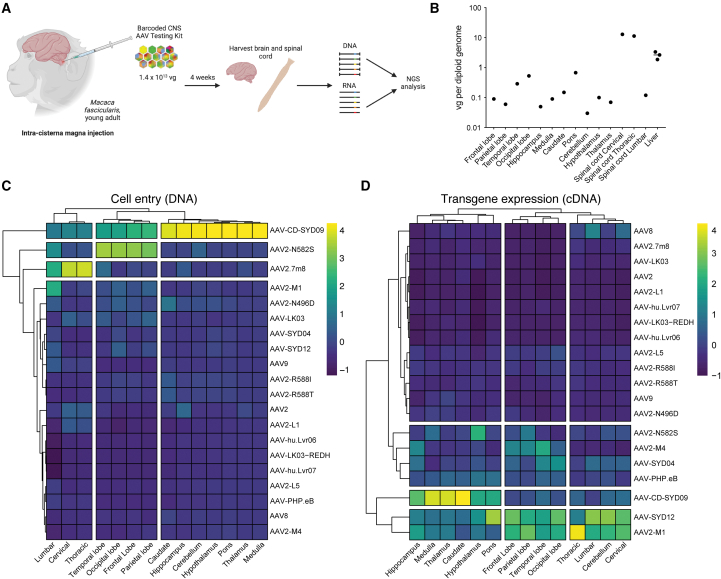
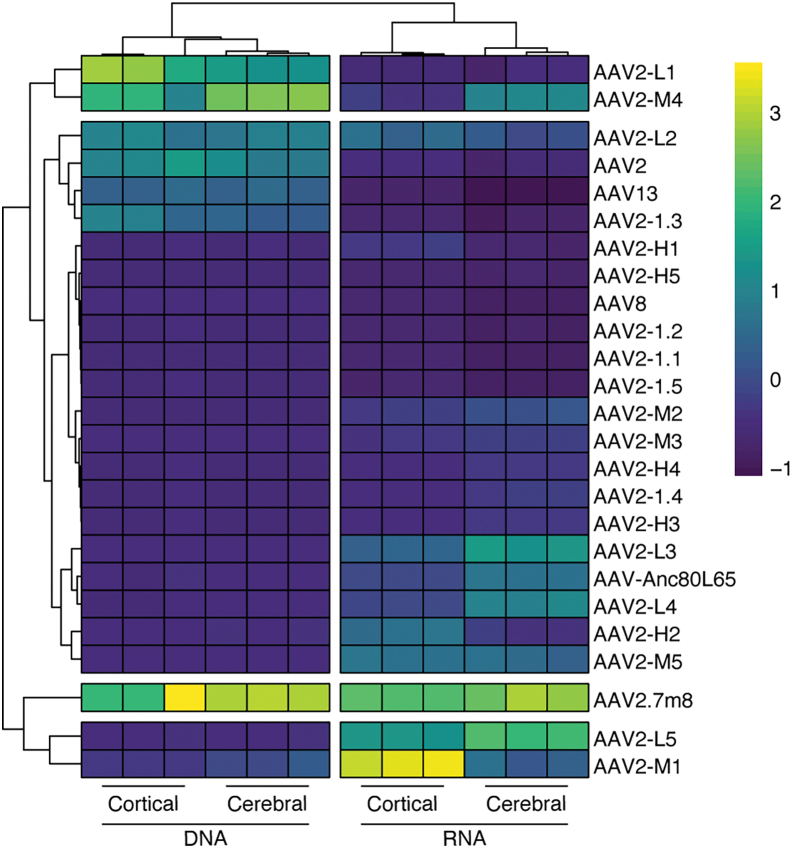
Viral vectors based on recombinant adeno-associated virus (rAAV) have become the most widely used system for therapeutic gene delivery in the central nervous system (CNS). Despite clinical safety and efficacy in neurological applications, a barrier to adoption of the current generation of vectors lies in their limited efficiency, resulting in limited transduction of CNS target cells. To address this limitation, researchers have bioengineered fit-for-purpose AAVs with improved CNS tropism and tissue penetration. While the preclinical assessment of these novel AAVs is primarily conducted in animal models, human induced pluripotent stem cell (hiPSC)-derived organoids offer a unique opportunity to functionally evaluate novel AAV variants in a human context. In this study, we performed a comprehensive and unbiased evaluation of a large number of wild-type and bioengineered AAV capsids for their transduction efficiency in hiPSC-derived brain organoids. We demonstrate that efficient AAV transduction observed in organoids was recapitulated in both mouse and non-human primate models after cerebrospinal fluid (CSF) delivery. In summary, our study showcases the use of brain organoid systems for the pre-screening of novel AAV vectors. Additionally, we report data for novel AAV variants that exhibit improved CNS transduction efficiency when delivered via the CSF in preclinical models.
基于重组腺相关病毒(rAAV)的病毒载体已成为中枢神经系统(CNS)中治疗性基因递送应用最为广泛的系统。尽管在神经学应用中具有临床安全性和有效性,但当前一代载体的应用障碍在于其效率有限,导致CNS靶细胞的转导受限。为解决这一局限性,研究人员已对腺相关病毒进行生物工程改造,使其具备更适合的特性,从而改善了对CNS的嗜性和组织穿透能力。虽然这些新型腺相关病毒的临床前评估主要在动物模型中进行,但人诱导多能干细胞(hiPSC)衍生的类器官为在人体环境中对新型腺相关病毒变体进行功能评估提供了独特的机会。在本研究中,我们对大量野生型和生物工程改造的腺相关病毒衣壳在hiPSC衍生的脑类器官中的转导效率进行了全面且无偏倚的评估。我们证明,在通过脑脊液(CSF)递送后,在类器官中观察到的高效腺相关病毒转导在小鼠和非人类灵长类动物模型中均得到了重现。总之,我们的研究展示了脑类器官系统在新型腺相关病毒载体预筛选中的应用。此外,我们报告了新型腺相关病毒变体的数据,这些变体在临床前模型中通过脑脊液递送时表现出改善的CNS转导效率。