Namiki Takahiro, Takada Kazuhide, Hayakawa Satoshi, Komine-Aizawa Shihoko
Division of Haematology and Oncology, Department of Internal Medicine, Nihon University Itabashi Hospital, Tokyo, Japan.
Division of Microbiology, Department of Pathology and Microbiology, Nihon University School of Medicine, Tokyo, Japan.
Heliyon. 2024 Jul 9;10(14):e34347. doi: 10.1016/j.heliyon.2024.e34347. eCollection 2024 Jul 30.
Vaccines against severe acute respiratory syndrome coronavirus 2 (SARS-CoV-2) are crucial for ending the pandemic of coronavirus disease 2019 (COVID-19). Currently, the cumulative effect of booster shots of mRNA vaccines on adverse events is not sufficiently characterized.
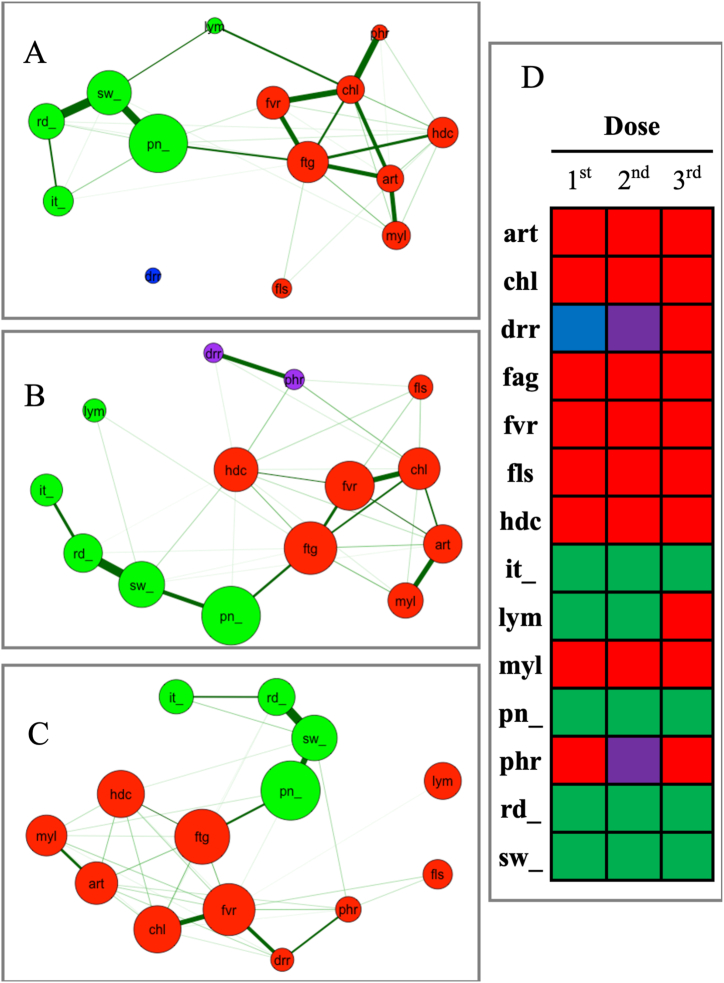
A survey-based study on vaccine adverse events was conducted in a Japanese medical institute after the third dose of Pfizer BNT162b2. Adverse events were grouped using network analysis, and a heteroscedastic probit model was built to analyse adverse events.
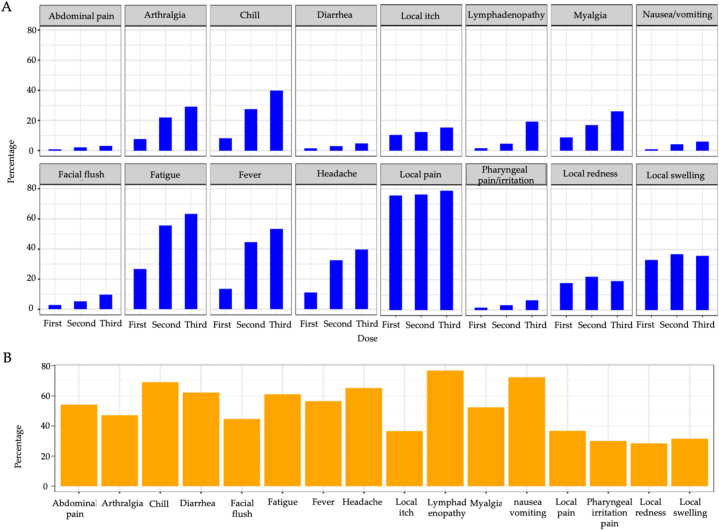
There were two main clusters of adverse events, systemic and local injection site-associated events. Subject background and the experience of previous vaccine-related adverse events were variably associated with the occurrence and intensity of adverse events following the third dose. Among adverse events, only lymphadenopathy increased prominently following the third dose, while the largest increase in other systemic adverse events occurred generally following the second dose.
The effect of repeated booster vaccines on the frequency and intensity of adverse events differs depending on the kind of adverse event.
针对严重急性呼吸综合征冠状病毒2(SARS-CoV-2)的疫苗对于终结2019冠状病毒病(COVID-19)大流行至关重要。目前,mRNA疫苗加强针在不良事件方面的累积效应尚未得到充分描述。
在日本一家医疗机构接种第三剂辉瑞BNT162b2后,开展了一项基于调查的疫苗不良事件研究。使用网络分析对不良事件进行分组,并建立异方差概率模型来分析不良事件。
不良事件主要分为两类,即全身性和局部注射部位相关事件。受试者背景以及先前疫苗相关不良事件的经历与第三剂疫苗接种后不良事件的发生和严重程度存在不同程度的关联。在不良事件中,仅淋巴结病在第三剂后显著增加,而其他全身性不良事件的最大增幅通常发生在第二剂之后。
重复接种加强疫苗对不良事件发生频率和严重程度的影响因不良事件类型而异。