Blanco Christian O, Ramos Castellanos Richard, Fogg Deryn E
Center for Catalysis Research & Innovation, and Department of Chemistry and Biomolecular Sciences, University of Ottawa, Ottawa, Ontario, K1N 6N5, Canada.
Department of Chemistry, University of Bergen, Allégaten 41, N-5007 Bergen, Norway.
ACS Catal. 2024 Jul 11;14(15):11147-11152. doi: 10.1021/acscatal.4c02811. eCollection 2024 Aug 2.
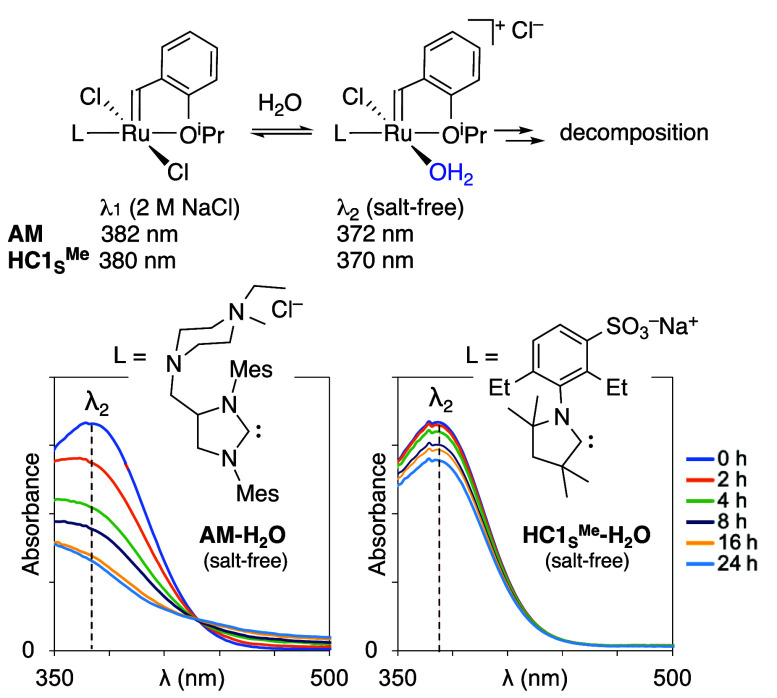
Stability problems have limited the uptake of cationic olefin metathesis catalysts in chemical biology. Described herein are anionic catalysts that improve water-solubility, robustness, and compatibility with biomolecules such as DNA. A sulfonate tag is installed on the cyclic (alkyl)(amino) carbene (CAAC) ligand platform, chosen for resistance to degradation by nucleophiles, base, water, and β-elimination. Hoveyda-Grubbs catalysts bearing the sulfonated CAAC ligands deliver record productivity in metathesis of unprotected carbohydrates and nucleosides at neutral pH. Decomposed catalyst has negligible impact on metathesis selectivity, whereas N-heterocyclic carbene (NHC) catalysts degrade rapidly in water and cause extensive C=C migration.
稳定性问题限制了阳离子烯烃复分解催化剂在化学生物学中的应用。本文描述了一种阴离子催化剂,它提高了水溶性、稳定性以及与DNA等生物分子的兼容性。在环状(烷基)(氨基)卡宾(CAAC)配体平台上安装了一个磺酸酯标签,该平台因其对亲核试剂、碱、水和β-消除的降解具有抗性而被选用。带有磺化CAAC配体的霍维达-格鲁布斯催化剂在中性pH条件下对未保护的碳水化合物和核苷进行复分解反应时,展现出创纪录的反应活性。分解后的催化剂对复分解反应的选择性影响可忽略不计,而N-杂环卡宾(NHC)催化剂在水中会迅速降解,并导致大量C=C迁移。