Zertal Amel, Alami Marrouni Kanza, Arbour Nathalie, Jutras-Aswad Didier, Pomey Marie-Pascale, Rouleau Isabelle, Prat Alexandre, Larochelle Catherine, Beaulieu Pierre, Chamelian Laury, Sylvestre Marie-Pierre, Morin Danielle, Ouellette Jean-Sylvain, Fréjeau Nathalie, Duquette Pierre
Centre de Recherche du Centre Hospitalier de l'Université de Montréal (CRCHUM), Montreal, QC, Canada.
Département de Neurosciences, Faculté de Médecine, Université de Montréal, Montreal, QC, Canada.
Front Neurol. 2024 Jul 24;15:1440678. doi: 10.3389/fneur.2024.1440678. eCollection 2024.
Multiple sclerosis (MS) is an inflammatory and degenerative disease of the central nervous system. More than 90,000 Canadians are affected; a cure is yet to be found. Available treatments to manage the disease course are only partially effective. For many years, persons with MS (PwMS) have used cannabis to relax, to reduce pain and spasticity, or to improve sleep and daily functioning, despite the lack of scientific evidence on the efficacy of specific cannabinoids [i.e., tetrahydrocannabinol (THC) and cannabidiol (CBD)] on these MS symptoms. The purpose of this clinical trial is to assess the effectiveness of different doses of these cannabinoids, alone or combined, on spasticity relief, compared to placebo. Moreover, we aim to determine which treatment is best effective to address other key MS conditions.
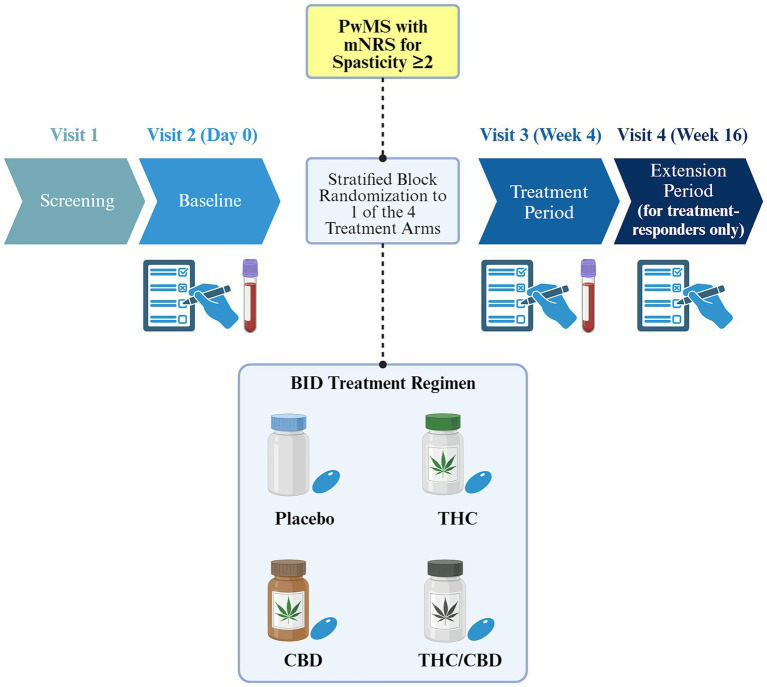
A double-blinded, randomized, factorial, placebo-controlled trial will be performed. We intend to include up to 250 PwMS aged over 21 recruited from the Centre hospitalier de l'Université de Montréal MS Clinic. PwMS will be randomly assigned on a 1:1:1:1 ratio to one of the trial arms: THC alone, CBD alone, THC/CBD combination, or placebo, using stratified blocked randomization, with random blocks within each stratum. The primary outcome is a self-assessment of spasticity using the mean Numeric Rating Scale score over 7 days. The main outcome will be the difference in this score at 4 weeks compared to baseline. Secondary outcomes include assessments of spasticity as measured by a clinician, pain, fatigue, sleep, bowel, bladder, and sexual dysfunction, restless legs syndrome, mental health, quality of life, mobility, cognitive functioning, and adverse events. Treatment responders are eligible for a 12-week extension phase, using the same treatment allocation and assessments.
Previous clinical studies examined the efficacy of cannabis-based medicines in PwMS, mostly using products with 1:1 THC/CBD ratio. The major barrier to effectively use cannabis in real-world clinical settings is the lack of evidence on benefits of specific cannabinoids and information on possible related risks. The CANSEP study will contribute to overcome these limitations and identify the risks and benefits of cannabis-based treatments in PwMS.
ClinicalTrials.Gov, NCT05092191.
多发性硬化症(MS)是一种中枢神经系统的炎症性和退行性疾病。超过9万加拿大人受到影响;目前尚未找到治愈方法。现有的控制疾病进程的治疗方法仅部分有效。多年来,尽管缺乏关于特定大麻素[即四氢大麻酚(THC)和大麻二酚(CBD)]对这些MS症状疗效的科学证据,但MS患者(PwMS)仍使用大麻来放松、减轻疼痛和痉挛,或改善睡眠及日常功能。本临床试验的目的是评估不同剂量的这些大麻素单独或联合使用时,与安慰剂相比,对缓解痉挛的有效性。此外,我们旨在确定哪种治疗方法对解决其他关键的MS病症最有效。
将进行一项双盲、随机、析因、安慰剂对照试验。我们计划纳入最多250名年龄在21岁以上、从蒙特利尔大学中心医院MS诊所招募的PwMS。PwMS将以1:1:1:1的比例随机分配到试验组之一:单独使用THC、单独使用CBD、THC/CBD组合或安慰剂,采用分层区组随机化,每个层内有随机区组。主要结局是使用7天内的平均数字评定量表评分对痉挛进行自我评估。主要结果将是4周时该评分与基线相比的差异。次要结局包括临床医生测量的痉挛评估、疼痛、疲劳、睡眠、肠道、膀胱和性功能障碍、不安腿综合征、心理健康、生活质量、活动能力、认知功能和不良事件。治疗有反应者有资格进入为期12周的延长期,采用相同的治疗分配和评估方法。
先前的临床研究检查了基于大麻的药物对PwMS的疗效,大多使用THC/CBD比例为1:1的产品。在现实世界的临床环境中有效使用大麻的主要障碍是缺乏关于特定大麻素益处的证据以及关于可能相关风险的信息。CANSEP研究将有助于克服这些限制,并确定基于大麻的治疗方法在PwMS中的风险和益处。
ClinicalTrials.Gov,NCT05092191。