Ausman Christine, Almatar Dawoud, Kiepek Niki
Dalhousie University, Nova Scotia, Canada.
Can Med Educ J. 2024 Jul 12;15(3):73-96. doi: 10.36834/cmej.75973. eCollection 2024 Jul.
The responsibility for addressing the healthcare needs of PWUS is the responsibility of all physicians. Within the healthcare system, research consistently reveals inequitable experiences in healthcare with people who use substances (PWUS) reporting stigmatization, marginalization, and a lack of compassion.
The aim of this scoping review was to find and describe competencies being taught, developed, and fostered within medical education and then to provide recommendations to improve care for this population of patients.
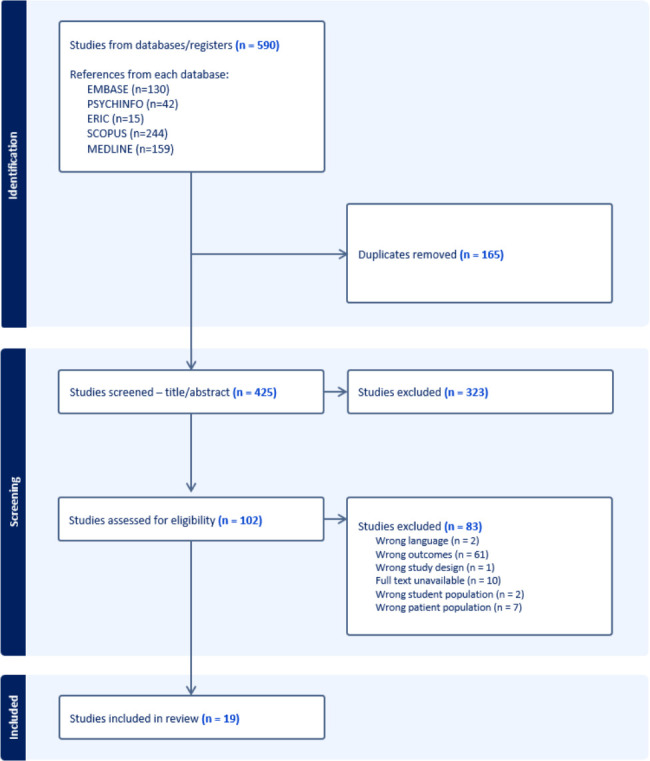
Nineteen articles were included. Recommended knowledge competencies tend to promote understanding neurophysiological changes caused by substances, alongside knowing how to evaluate of 'risky' behaviours. Commonly recommended skills relate to the screening and management of substance use disorders. Recommended attitude competencies include identifying personal bias and establishing a patient-centered culture among practice teams. The disease model of addiction informed all papers, with no acknowledgement of potential beneficial or non-problematic experiences of substance use. To enhance knowledge-type competencies, medical education programs are advised to include addiction specialists as educators and prevent stigmatization through the hidden curriculum.
To reduce experiences of stigmatization and marginalization among patients who use illicit substances and to improve quality of care, knowledge, skills, and attitudes competencies can be more effectively taught in medical education programs.Résumé.
满足药物使用障碍患者(PWUS)的医疗需求是所有医生的责任。在医疗系统中,研究一直表明,药物使用障碍患者在医疗保健方面经历不公平对待,他们遭受污名化、边缘化,且缺乏同情。
本范围综述的目的是找出并描述医学教育中所教授、培养和促进的能力,然后提出改善对这类患者护理的建议。
纳入了19篇文章。推荐的知识能力倾向于促进对物质引起的神经生理变化的理解,同时了解如何评估“危险”行为。常见的推荐技能涉及物质使用障碍的筛查和管理。推荐的态度能力包括识别个人偏见并在实践团队中建立以患者为中心的文化。成瘾的疾病模型贯穿所有论文,未提及物质使用潜在的有益或无问题体验。为增强知识型能力,建议医学教育项目纳入成瘾专家作为教育工作者,并通过隐性课程防止污名化。
为减少非法药物使用者患者的污名化和边缘化经历并提高护理质量,知识、技能和态度能力可在医学教育项目中更有效地教授。摘要。