Schmitz Kathryn H, Brown Justin C, Irwin Melinda L, Robien Kim, Scott Jessica M, Berger Nathan A, Caan Bette, Cercek Andrea, Crane Tracy E, Evans Scott R, Ligibel Jennifer A, Meyerhardt Jeffrey A, Agurs-Collins Tanya, Basen-Engquist Karen, Bea Jennifer W, Cai Sheng F, Cartmel Brenda, Chinchilli Vernon M, Demark-Wahnefried Wendy, Dieli-Conwright Christina M, DiPietro Loretta, Doerksen Shawna E, Edelstein Sharon L, Elena Joanne, Evans William, Ferrucci Leah M, Foldi Julia, Freylersythe Sarah, Furberg Helena, Jones Lee W, Levine Ross, Moskowitz Chaya S, Owusu Cynthia, Penedo Frank, Rabin Borsika A, Ratner Elena, Rosenzweig Margaret, Salz Talya, Sanft Tara, Schlumbrecht Matthew, Spielmann Guillaume, Thomson Cynthia A, Tjaden Ashley H, Weiser Martin R, Yang Shengping, Yu Anthony F, Perna Frank M
Hematology and Oncology, University of Pittsburgh, UPMC Hillman Cancer Center, Pittsburgh, PA, USA.
Department of Cancer Energetics, Pennington Biomedical Research Center, Baton Rouge, LA, USA.
J Natl Cancer Inst. 2025 Jan 1;117(1):9-19. doi: 10.1093/jnci/djae177.
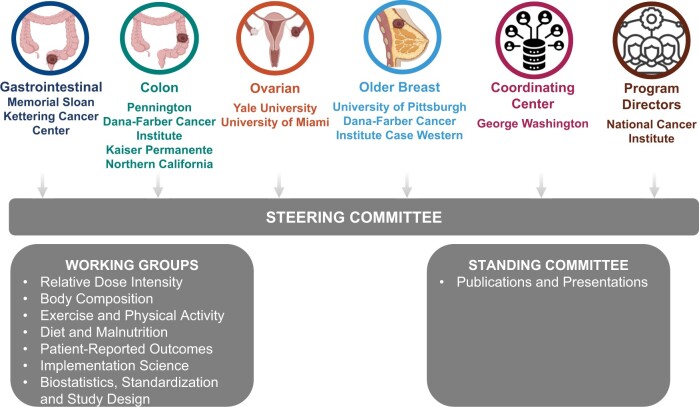
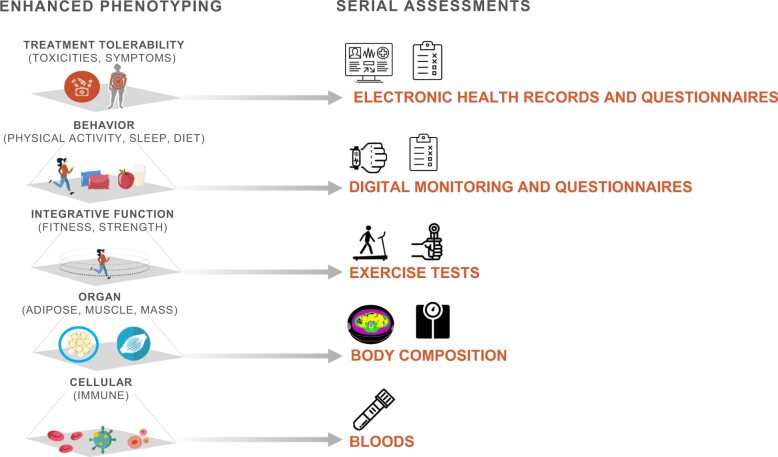
Chemotherapy treatment-related side effects are common and increase the risk of suboptimal outcomes. Exercise interventions during cancer treatment improve self-reported physical functioning, fatigue, anxiety, and depression, but it is unclear whether these interventions improve important clinical outcomes, such as chemotherapy relative dose intensity. The National Cancer Institute funded the Exercise and Nutrition to Improve Cancer Treatment-Related Outcomes (ENICTO) Consortium to address this knowledge gap. This article describes the mechanisms hypothesized to underpin intervention effects on clinically relevant treatment outcomes, briefly outlines each project's distinct research aims, summarizes the scope and organizational structure of ENICTO, and provides an overview of the integrated common data elements used to pursue research questions collectively. In addition, the article includes a description of consortium-wide activities and broader research community opportunities for collaborative research. Findings from the ENICTO Consortium have the potential to accelerate a paradigm shift in oncology care such that patients with cancer could receive exercise and nutrition programming as the standard of care in tandem with chemotherapy to improve relative dose intensity for a curative outcome.
化疗相关的副作用很常见,会增加出现不理想治疗结果的风险。癌症治疗期间的运动干预可改善自我报告的身体机能、疲劳、焦虑和抑郁,但尚不清楚这些干预措施是否能改善重要的临床结果,如化疗相对剂量强度。美国国立癌症研究所资助了“运动与营养改善癌症治疗相关结果”(ENICTO)联盟,以填补这一知识空白。本文描述了被认为是干预对临床相关治疗结果产生影响的潜在机制,简要概述了每个项目独特的研究目标,总结了ENICTO的范围和组织结构,并概述了用于共同研究问题的综合通用数据元素。此外,本文还介绍了联盟范围内的活动以及更广泛的研究社区合作研究机会。ENICTO联盟的研究结果有可能加速肿瘤护理领域的范式转变,使癌症患者在接受化疗的同时,能够将运动和营养规划作为标准护理措施,以提高相对剂量强度,实现治愈效果。