British American Tobacco (Investments) Limited, Research and Development, Regents Park Road, Southampton, SO15 8TL, UK.
Reynolds American Inc., Winston Salem, NC, USA.
Sci Rep. 2023 Jun 29;13(1):10563. doi: 10.1038/s41598-023-37539-6.
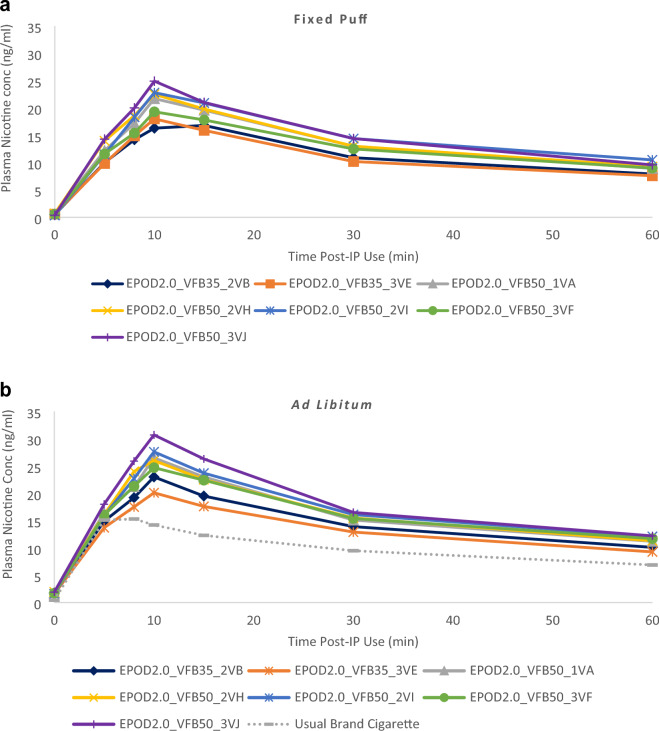
The addition of protonating acids to e-cigarette liquid formulations (e-liquids) enhances nicotine bioavailability in e-cigarette use. However, little is known about the impact of different combinations of protonating acid on nicotine pharmacokinetics. The objectives of this study were to compare pharmacokinetics of nicotine absorption following use of a closed-system e-cigarette, containing e-liquids with two different nicotine levels and with different ratios of three common protonating acids-lactic, benzoic and levulinic. In a randomised, controlled, crossover study, nicotine pharmacokinetics and product liking were assessed for prototype e-liquids used in a Vuse e-cigarette containing either 3.5% or 5% nicotine and varying ratios of lactic, benzoic and/or levulinic acid. During an 8-day confinement period, 32 healthy adult current cigarette smokers/e-cigarette dual users used a single study e-liquid each day during 10-min fixed and ad libitum use periods after overnight nicotine abstinence. For most comparisons, C and AUC following both fixed and ad libitum puffing were significantly higher for e-liquids containing 5% nicotine compared with 3.5% nicotine. However, C and AUC were not statistically different for 5% nicotine e-liquids containing varying ratios of lactic, levulinic and benzoic acid when compared to an e-liquid containing lactic acid only. Mean scores for product liking were similar for all e-liquid formulations assessed, regardless of nicotine concentration, acid content, and whether the product was used in a fixed or ad libitum puffing regimen. While e-liquid nicotine concentration significantly affected users' nicotine uptake, the different combinations of benzoic, levulinic and lactic acid in the e-liquids assessed had limited impact on nicotine pharmacokinetics and product liking scores.
电子香烟液配方(电子烟液)中添加质子化酸可提高电子烟使用过程中尼古丁的生物利用度。然而,对于不同质子化酸组合对尼古丁药代动力学的影响知之甚少。本研究的目的是比较使用含有两种不同尼古丁水平和三种常见质子化酸(乳酸、苯甲酸和乙酰丙酸)不同比例的封闭式电子烟后尼古丁吸收的药代动力学。在一项随机、对照、交叉研究中,评估了用于 Vuse 电子烟的原型电子烟液的尼古丁药代动力学和产品喜好性,该电子烟液含有 3.5%或 5%尼古丁,以及乳酸、苯甲酸和/或乙酰丙酸的不同比例。在 8 天的禁闭期内,32 名健康成年当前吸烟/电子烟双重使用者在一夜尼古丁戒断后,在 10 分钟固定和随意使用期内每天使用一种研究电子烟液。对于大多数比较,固定和随意抽吸后 C 和 AUC 均显著更高,因为含有 5%尼古丁的电子烟液与含有 3.5%尼古丁的电子烟液相比。然而,当与仅含有乳酸的电子烟液相比时,含有不同比例的乳酸、乙酰丙酸和苯甲酸的 5%尼古丁电子烟液的 C 和 AUC 没有统计学差异。无论尼古丁浓度、酸含量以及产品是在固定还是随意抽吸方案中使用,所有电子烟液配方的产品喜好评分均相似。虽然电子烟液尼古丁浓度显著影响使用者的尼古丁摄取量,但评估的电子烟液中苯甲酸、乙酰丙酸和乳酸的不同组合对尼古丁药代动力学和产品喜好评分的影响有限。