Luo Zhengwei, Pei Chao, Zhang Haonan, Wang Yichen, Zhang Baofeng, Hu Defu
School of Ecology and Nature Conservation, Beijing Forestry University, Beijing 100083, China.
Animals (Basel). 2024 Jul 30;14(15):2205. doi: 10.3390/ani14152205.
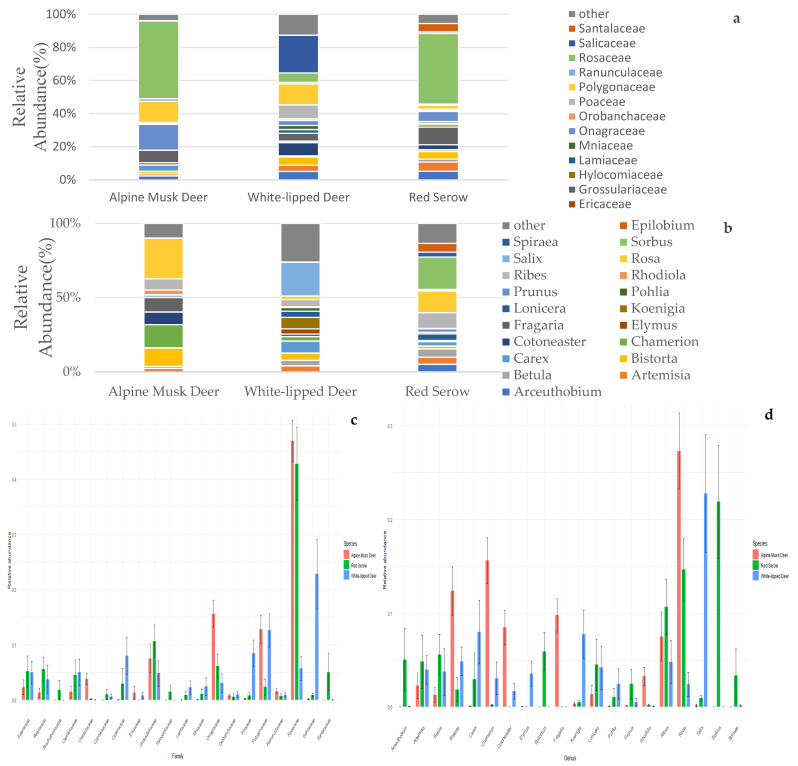
Wild ungulates play crucial roles in maintaining the structure and function of local ecosystems. The alpine musk deer (), white-lipped deer (), and red serow () are widely distributed throughout the Nyenchen Tanglha Mountains of Tibet. However, research on the mechanisms underlying their coexistence in the same habitat remains lacking. This study aimed to investigate the mechanisms underlying the coexistence of these species based on their dietary preferences through DNA barcoding using the fecal samples of these animals collected from the study area. These species consume a wide variety of food types. Alpine musk deer, white-lipped deer, and red serow consume plants belonging to 74 families and 114 genera, 62 families and 122 genera, and 63 families and 113 genera, respectively. Furthermore, significant differences were observed in the nutritional ecological niche among these species, primarily manifested in the differentiation of food types and selection of food at the genus level. Owing to differences in social behavior, body size, and habitat selection, these three species further expand their differentiation in resource selection, thereby making more efficient use of environmental resources. Our findings indicate these factors are the primary reasons for the stable coexistence of these species.
野生有蹄类动物在维持当地生态系统的结构和功能方面发挥着关键作用。高山麝()、白唇鹿()和赤斑羚()广泛分布于西藏念青唐古拉山脉。然而,关于它们在同一栖息地共存的潜在机制的研究仍然缺乏。本研究旨在通过对从研究区域收集的这些动物的粪便样本进行DNA条形码分析,基于它们的饮食偏好来探究这些物种共存的机制。这些物种食用多种食物类型。高山麝、白唇鹿和赤斑羚分别食用属于74科114属、62科122属和63科113属的植物。此外,这些物种在营养生态位上存在显著差异,主要表现为食物类型的分化以及在属水平上对食物的选择。由于社会行为、体型和栖息地选择的差异,这三个物种在资源选择上进一步扩大了分化,从而更有效地利用环境资源。我们的研究结果表明,这些因素是这些物种稳定共存的主要原因。