Xiao Jianghao, Chen Dengkai, Yu Suihuai, Wang Hui, Sun Yiwei, Wang Hanyu, Gou Zhiming, Wang Jingping
Key Laboratory of Industrial Design and Ergonomics, Ministry of Industry and Information Technology, Northwestern Polytechnical University, Xi'an, 710072, People's Republic of China.
Nat Sci Sleep. 2024 Aug 6;16:1179-1200. doi: 10.2147/NSS.S472988. eCollection 2024.
Exposure to artificial light influences human performance, which is essential for maintaining healthy work and sleep. However, existing research has not explored the intrinsic links between sleep performance and human states over time under prebedtime light exposure interventions (LEIs).
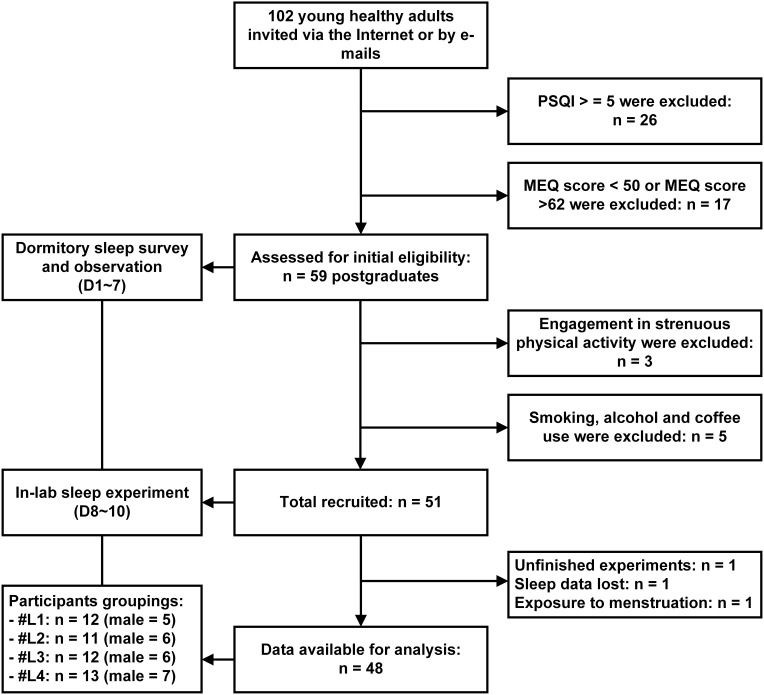
To investigate the time-dependent effects of altered prebedtime light exposure, four LEI groupings (#L1 - #L4) and a Time factor (D8, D9, and D10) were chosen for sleep experiments in enclosed spaces. Forty-eight young adults recruited were available for data analysis. Subjective alertness (SA), negative affect (NA), subjective sleep, and objective sleep were measured via the Karolinska Sleepiness Scale, Positive and Negative Affect Schedule, Next-day Self-assessment Sleep Quality, and joint assessment of wrist actigraphy and sleep diaries, respectively. Statistical analysis was used for the effects of light exposure on the human states (corresponding to the SA and NA) and sleep performance, while the process model helped construct the associations between the two.
The statistical effects revealed that the Time had a significant main effect on subjective sleep and changes in prebedtime alertness; the LEI had a significant main effect only on sleep onset latency (SOL). After undergoing altered prebedtime light exposure, the mean SA increased at prebedtime of D9 (p = 0.022) and D10 (p = 0.044); No significant effect on the NA was observed; Mean subjective sleep had a significant increase from D8 to D10. Moreover, five actigraphy-estimated sleep parameters were interrelated. In light of this, a chained pathway relationship was identified. The SOL played a mediating predictor between prebedtime state and objective sleep, which was linked to the awakening state through subjective sleep.
Our study suggests that time-dependent effects of altered prebedtime light exposure on sleep performance are associated with human states at prebedtime and awakening, with implications for its prediction of sleep health.
接触人造光会影响人类的表现,而这对于维持健康的工作和睡眠至关重要。然而,现有研究尚未探讨睡前光照干预(LEIs)下睡眠表现与人类状态随时间的内在联系。
为了研究改变睡前光照的时间依赖性影响,选择了四个光照干预组(#L1 - #L4)和一个时间因素(D8、D9和D10)在封闭空间进行睡眠实验。招募的48名年轻成年人可用于数据分析。分别通过卡罗林斯卡嗜睡量表、正负情绪量表、次日自我评估睡眠质量以及手腕活动记录仪和睡眠日记的联合评估来测量主观警觉性(SA)、消极情绪(NA)、主观睡眠和客观睡眠。采用统计分析来研究光照对人类状态(对应于SA和NA)和睡眠表现的影响,同时使用过程模型来构建两者之间的关联。
统计结果显示,时间对主观睡眠和睡前警觉性变化有显著的主效应;光照干预仅对入睡潜伏期(SOL)有显著的主效应。在经历改变的睡前光照后,D9(p = 0.022)和D10(p = 0.044)睡前的平均SA增加;未观察到对NA有显著影响;主观睡眠均值从D8到D10有显著增加。此外,五个通过活动记录仪估计的睡眠参数相互关联。据此,确定了一种链式通路关系。SOL在睡前状态和客观睡眠之间起中介预测作用,它通过主观睡眠与觉醒状态相关联。
我们的研究表明,改变睡前光照对睡眠表现的时间依赖性影响与睡前和觉醒时的人类状态相关,这对其预测睡眠健康具有启示意义。