Kariyama Kazuya, Kawanaka Miwa, Nouso Kazuhiro, Hiraoka Atsushi, Toyoda Hidenori, Tada Toshifumi, Ishikawa Toru, Wakuta Akiko, Miyake Nozomi, Murakami Shiho, Shiota Shohei, Kumada Takashi
Department of Gastroenterology and Liver Disease Center, Okayama City Hospital, Okayama City, Okayama, Japan.
Department of General Internal Medicine 2, General Medical Center, Kawasaki Medical School, Okayma City, Okayama, Japan.
Gastro Hep Adv. 2022 Aug 2;1(6):1108-1113. doi: 10.1016/j.gastha.2022.07.012. eCollection 2022.
The Fibrosis-4 (FIB-4) index has been used to predict liver fibrosis in various liver diseases, including nonalcoholic fatty liver disease (NAFLD). Because the FIB-4 formula uses age, different cutoff values may be required for different age groups, making the interpretation difficult. To avoid the influence of age, we attempted to create a new score, the Fibrosis-3 (FIB-3) index.
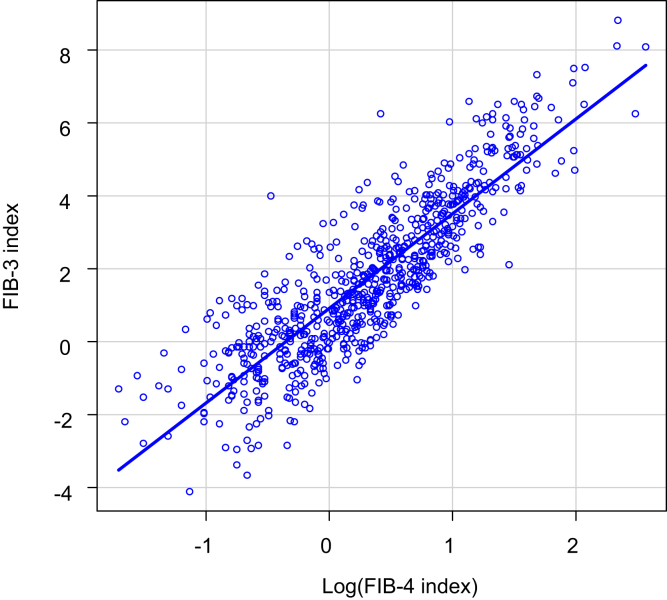
The FIB-3 index was created using a training cohort of 735 NAFLD cases using aspartate aminotransferase, alanine amino transferase, and platelet for predicting fibrosis. The abilities of the FIB-3 and FIB-4 indices were compared among different age groups in the training cohort and validation cohort with 324 patients. The FIB-3 index was also compared with other liver fibrosis indices.
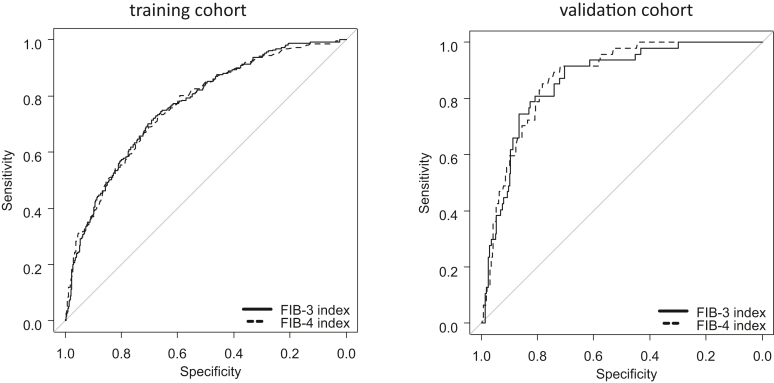
The area under the receiver operating characteristic curve (AUROC) values of the FIB-3 and FIB-4 indices for predicting F3-F4 fibrosis were 0.764 and 0.762, respectively, in the training cohort. No difference in the AUROC values was observed between the 2 indices in the validation cohort. The differences in the accuracies of FIB-3 between elderly and nonelderly patients were 0.140 and 0.178, respectively, in each cohort and were smaller than those of FIB-4 index (0.199 and 0.336, respectively). Analysis using a joined cohort revealed that the AUROC of FIB-3 for predicting F3-F4 fibrosis (0.774) was the highest among the 5 fibrosis scores examined and was comparable to that of FIB-4.
The FIB-3 index is an improved version of the FIB-4 index and can effectively predict liver fibrosis in patients with NAFLD.
纤维化-4(FIB-4)指数已被用于预测包括非酒精性脂肪性肝病(NAFLD)在内的各种肝脏疾病中的肝纤维化。由于FIB-4公式使用了年龄,不同年龄组可能需要不同的截断值,这使得解读变得困难。为避免年龄的影响,我们试图创建一个新的评分,即纤维化-3(FIB-3)指数。
使用735例NAFLD病例的训练队列,以天冬氨酸转氨酶、丙氨酸转氨酶和血小板来创建FIB-3指数以预测纤维化。在训练队列和324例患者的验证队列中,比较了不同年龄组中FIB-3和FIB-4指数的预测能力。还将FIB-3指数与其他肝纤维化指数进行了比较。
在训练队列中,FIB-3和FIB-4指数预测F3-F4纤维化的受试者工作特征曲线下面积(AUROC)值分别为0.764和0.762。在验证队列中,这两个指数的AUROC值未观察到差异。在每个队列中,老年和非老年患者之间FIB-3准确性的差异分别为0.140和0.178,小于FIB-4指数的差异(分别为0.199和0.336)。使用联合队列进行的分析显示,在检查的5种纤维化评分中,FIB-3预测F3-F4纤维化的AUROC(0.774)最高,且与FIB-4相当。
FIB-3指数是FIB-4指数的改进版本,可有效预测NAFLD患者的肝纤维化。