McKenzie Sam, Sommer Alexandra L, Donaldson Tia N, Pimentel Infania, Kakani Meenakshi, Choi Irene Jungyeon, Newman Ehren L, English Daniel F
Department of Neurosciences, University of New Mexico Health Science Center, Albuquerque, NM 87106.
Department of Mechanical Engineering, Tufts School of Engineering, Medford MA 02155.
bioRxiv. 2024 Aug 31:2024.07.30.605900. doi: 10.1101/2024.07.30.605900.
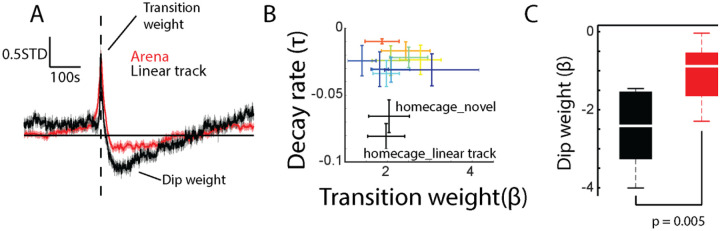
Episodic memories are temporally segmented around event boundaries that tend to coincide with moments of environmental change. During these times, the state of the brain should change rapidly, or reset, to ensure that the information encountered before and after an event boundary is encoded in different neuronal populations. Norepinephrine (NE) is thought to facilitate this network reorganization. However, it is unknown whether event boundaries drive NE release in the hippocampus and, if so, how NE release relates to changes in hippocampal firing patterns. The advent of the new GRAB sensor now allows for the measurement of NE binding with sub-second resolution. Using this tool in mice, we tested whether NE is released into the dorsal hippocampus during event boundaries defined by unexpected transitions between spatial contexts and presentations of novel objections. We found that NE binding dynamics were well explained by the time elapsed after each of these environmental changes, and were not related to conditioned behaviors, exploratory bouts of movement, or reward. Familiarity with a spatial context accelerated the rate in which phasic NE binding decayed to baseline. Knowing when NE is elevated, we tested how hippocampal coding of space differs during these moments. Immediately after context transitions we observed relatively unique patterns of neural spiking which settled into a modal state at a similar rate in which NE returned to baseline. These results are consistent with a model wherein NE release drives hippocampal representations away from a steady-state attractor. We hypothesize that the distinctive neural codes observed after each event boundary may facilitate long-term memory and contribute to the neural basis for the primacy effect.
情景记忆在事件边界周围按时间分段,这些边界往往与环境变化的时刻相吻合。在这些时候,大脑状态应迅速改变或重置,以确保在事件边界前后遇到的信息被编码到不同的神经元群体中。去甲肾上腺素(NE)被认为有助于这种网络重组。然而,尚不清楚事件边界是否会驱动海马体中NE的释放,如果是,NE释放与海马体放电模式的变化有何关系。新型GRAB传感器的出现现在允许以亚秒级分辨率测量NE结合。在小鼠中使用这个工具,我们测试了在由空间背景和新物体呈现之间的意外转换定义的事件边界期间,NE是否释放到背侧海马体中。我们发现,NE结合动力学可以很好地用这些环境变化中的每一个之后经过的时间来解释,并且与条件行为、探索性运动发作或奖励无关。对空间背景的熟悉加快了阶段性NE结合衰减到基线的速度。知道NE何时升高后,我们测试了在这些时刻海马体对空间的编码有何不同。在背景转换后立即,我们观察到相对独特的神经放电模式,这些模式以与NE恢复到基线相似的速度稳定到一种模态状态。这些结果与一个模型一致,在该模型中,NE释放驱动海马体表征远离稳态吸引子。我们假设在每个事件边界后观察到的独特神经编码可能有助于长期记忆,并为首位效应的神经基础做出贡献。