Rogers Everett, Torres Christian, Rao Sunil V, Donatelle Marissa, Beohar Nirat
Department of Internal Medicine, Mount Sinai Medical Center, Miami Beach, Florida.
Columbia University Division of Cardiology, Mount Sinai Medical Center, Miami Beach, Florida.
J Soc Cardiovasc Angiogr Interv. 2022 Jun 29;1(5):100395. doi: 10.1016/j.jscai.2022.100395. eCollection 2022 Sep-Oct.
Type 2 myocardial infarction (T2MI) was first established as a unique entity in 2007. However, its clinical features are not well characterized. This study aimed to determine the clinical characteristics, predictors of mortality, and hospitalization trends of patients with T2MI.
The National Inpatient Sample database was queried for patients hospitalized in the United States with T2MI (January 2018 to December 2019). Data were used to assess baseline characteristics, primary diagnoses, predictors of mortality, and hospitalization and mortality trends of T2MI.
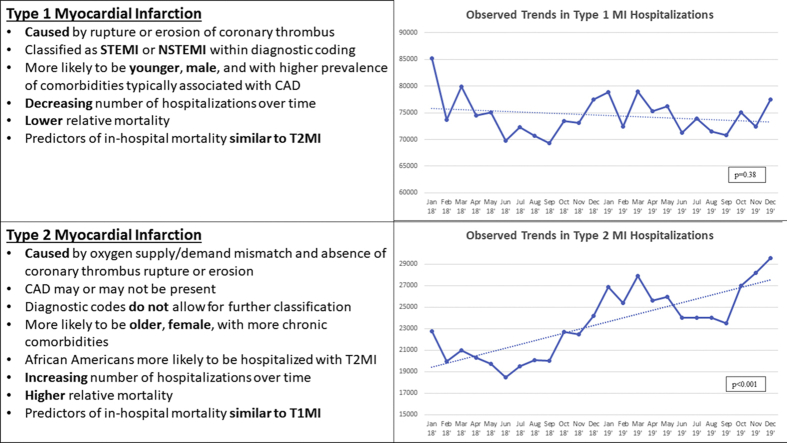
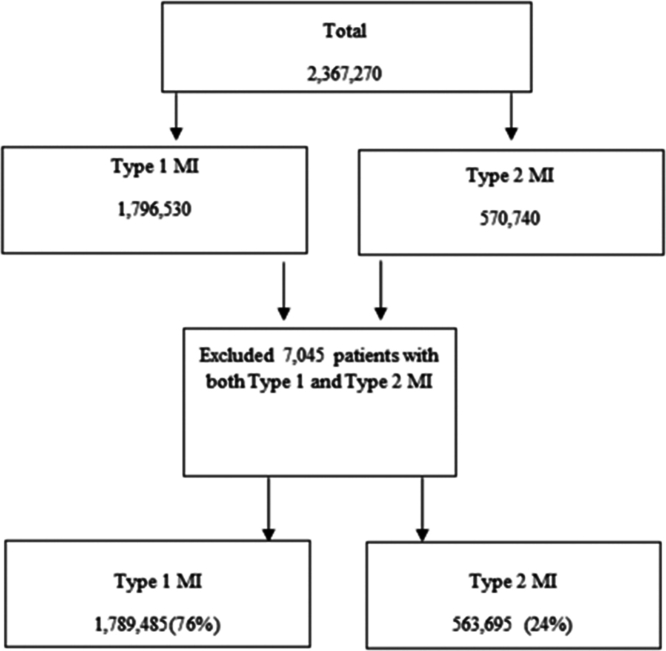
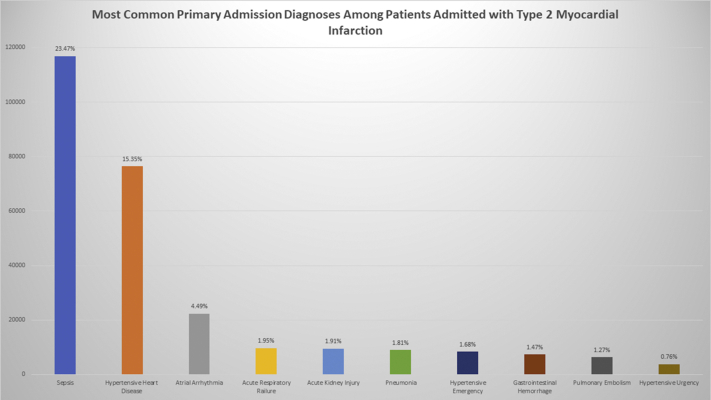
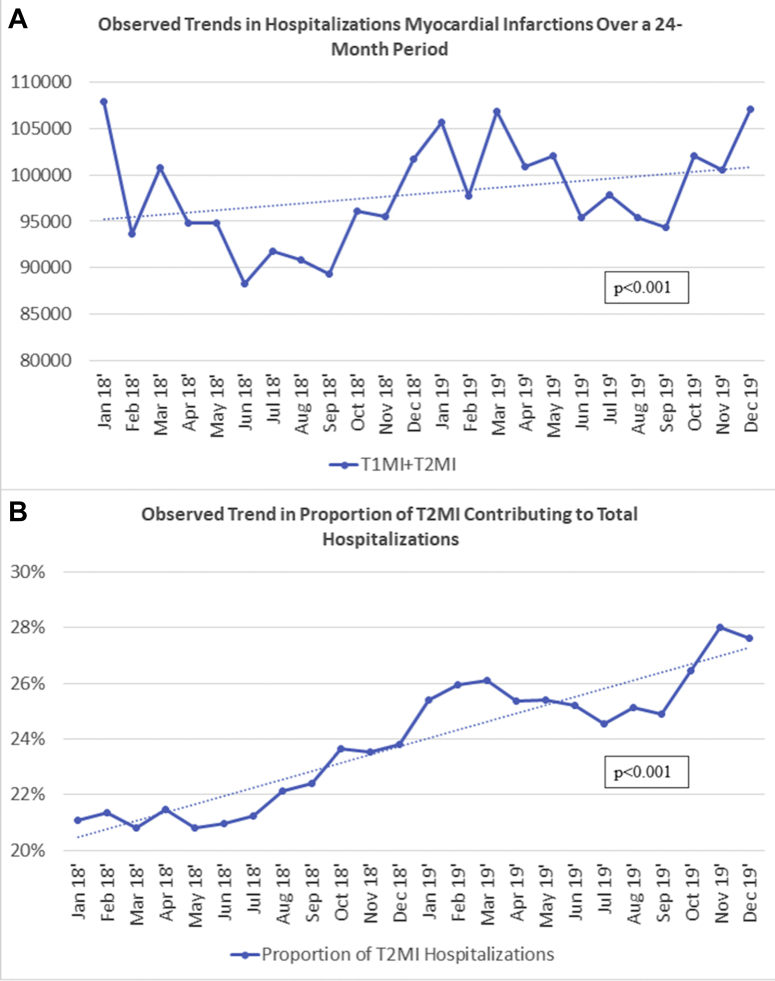
During the 24-month study period, 1,789,485 (76%) patients were admitted with type 1 myocardial infarction (T1MI) and 563,695 (24%) were admitted with T2MI. Patients with T2MI were more likely to be older (71 vs 68 years; < .001) and female (47.5% vs 38.3%; < .001), with fewer comorbidities related to coronary atherosclerosis. African Americans were the only race with a significantly higher rate of hospitalization for T2MI (15.9% vs 11.6%; < .001). The predictors of mortality were similar in both the T2MI and T1MI cohorts. Sepsis (23.47%), hypertensive heart disease (15.35%), and atrial arrhythmias (4.49%) were the most common principal diagnoses for T2MI. T2MI hospitalizations trended consistently upward during the study period. Monthly in-hospital mortality rates were consistently higher for T2MI versus T1MI ( < .001).
T2MI is a unique and heterogeneous clinical entity. Despite increased awareness, there is a lack of standardization of medical management and timing for revascularization, even as mortality rates remain persistently elevated compared with T1MI. Certain demographics, including African Americans, may be disproportionately affected.
2型心肌梗死(T2MI)于2007年首次被确立为一种独特的疾病实体。然而,其临床特征尚未得到充分描述。本研究旨在确定T2MI患者的临床特征、死亡率预测因素及住院趋势。
查询美国国家住院样本数据库中2018年1月至2019年12月因T2MI住院的患者。数据用于评估T2MI患者的基线特征、主要诊断、死亡率预测因素以及住院和死亡趋势。
在24个月的研究期间,1,789,485名(76%)患者因1型心肌梗死(T1MI)入院,563,695名(24%)患者因T2MI入院。T2MI患者更可能年龄较大(71岁对68岁;P <.001)且为女性(47.5%对38.3%;P <.001),与冠状动脉粥样硬化相关的合并症较少。非裔美国人是T2MI住院率显著较高的唯一种族(15.9%对11.6%;P <.001)。T2MI和T1MI队列的死亡率预测因素相似。脓毒症(23.47%)、高血压性心脏病(15.35%)和房性心律失常(4.49%)是T2MI最常见的主要诊断。在研究期间,T2MI住院人数呈持续上升趋势。T2MI的每月住院死亡率始终高于T1MI(P <.001)。
T2MI是一种独特且异质性的临床实体。尽管认识有所提高,但在医疗管理和血运重建时机方面缺乏标准化,即便与T1MI相比死亡率仍持续升高。包括非裔美国人在内的某些人群可能受到的影响更大。