Gabriel André F, Costa Marina C, Caldeira Daniel, Plácido Rui, Rigueira Joana, Carrilho-Ferreira Pedro, Gonçalves Susana, Ferreira Ricardo, Nobre Ângelo, Pinto Fausto J, Enguita Francisco J, Almeida Ana G
Instituto de Medicina Molecular João Lobo Antunes, Faculty of Medicine, Lisbon University, Av. Prof. Egas Moniz, 1649-028 Lisbon, Portugal.
Heart and Vessels Department, University Hospital ULS Santa Maria, CCUL@RISE, Faculty of Medicine, Lisbon University, Av. Prof. Egas Moniz, 1649-028 Lisbon, Portugal.
Eur Heart J Open. 2024 Jul 24;4(4):oeae060. doi: 10.1093/ehjopen/oeae060. eCollection 2024 Jul.
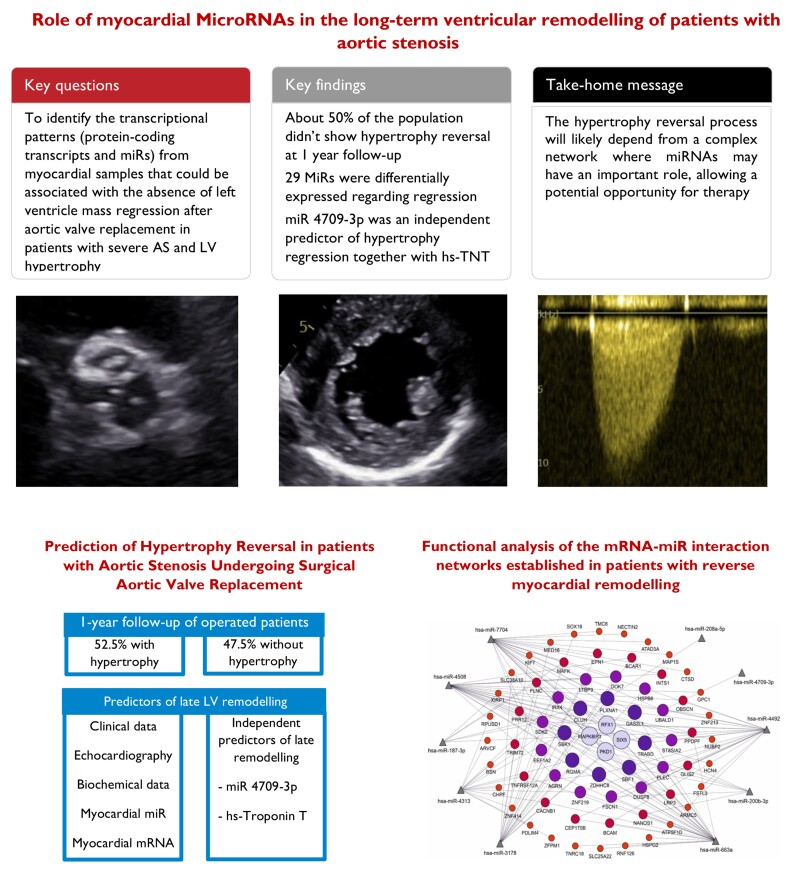
We hypothesize that miRs are key players in the dynamics of the hypertrophy phenotype in aortic stenosis (AS) patients. In our study, we aimed to identify the transcriptional patterns (protein-coding transcripts and miRs) from myocardial sample biopsies that could be associated with the absence of left ventricular (LV) mass regression after aortic valve replacement (AVR) in patients with severe AS and LV hypertrophy.
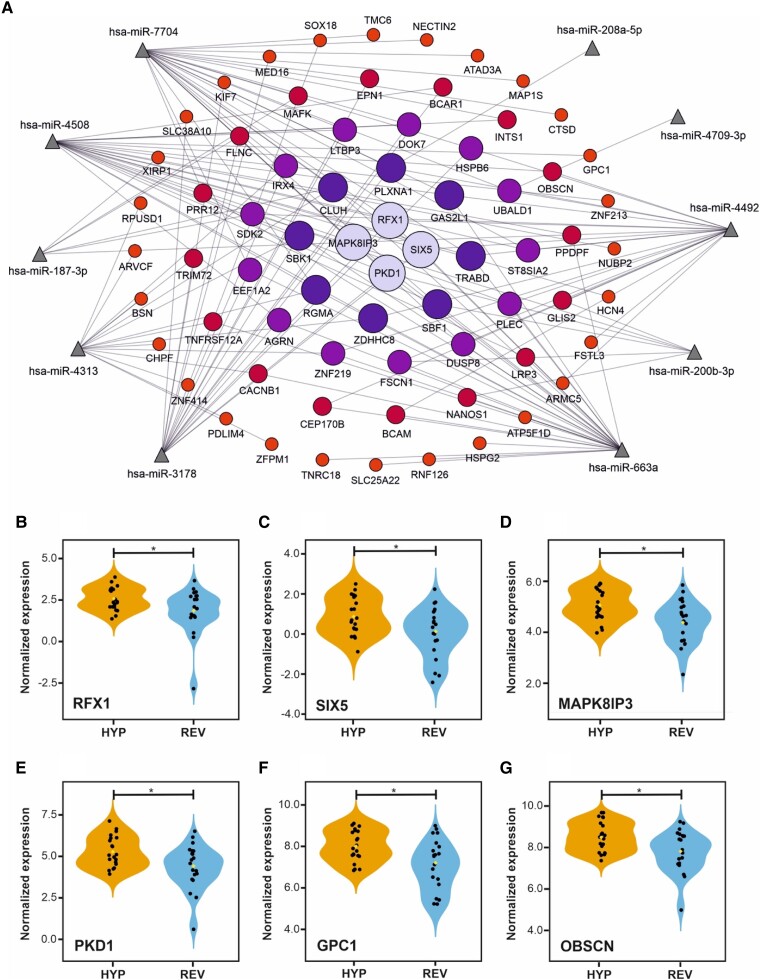
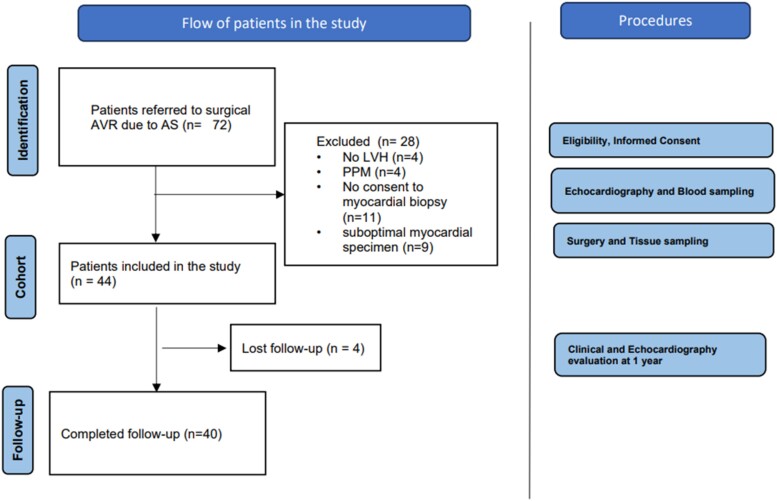
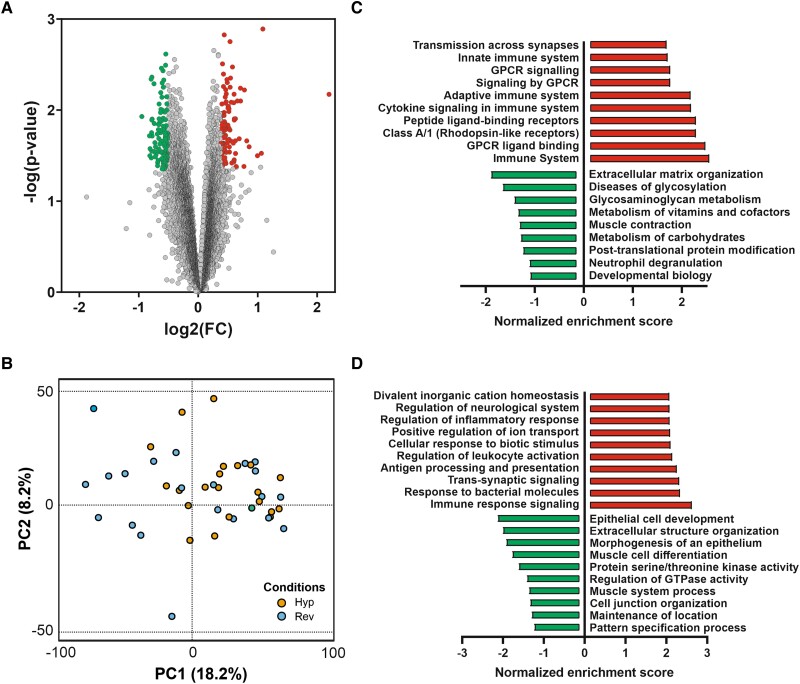
We prospectively included 40 patients with severe AS, LV hypertrophy, and preserved ejection fraction undergoing AVR. Myocardial biopsies obtained during surgery were analysed for transcriptomic analysis performed by next-generation sequencing. At a 1-year follow-up, no hypertrophy reversal was observed in about half of the patients in the absence of patient-prosthesis mismatch and prosthesis dysfunction of uncontrolled hypertension. Predictors of mass regression were assessed from clinical, echocardiographic, and biochemical variables as well as from 300 miRs obtained from myocardial specimens, allowing the identification 29 differentially expressed. miR-4709-3p was found as a positive independent predictor of hypertrophy regression together with high-sensitivity troponin T (cTNT-hs) as a negative predictor. Gene transcripts RFX1, SIX5, MAPK8IF3, and PKD1 were predicted as simultaneous targets of five upregulated miRs suggesting its importance in LV hypertrophy.
In our cohort, tissue miR-4709-3p and cTNT-hs were independent predictors of hypertrophy regression. The hypertrophy reversal process will likely depend from a complex network where miRNAs may have an important role, allowing a potential opportunity for therapy.
我们假设微小RNA(miR)是主动脉瓣狭窄(AS)患者肥厚表型动态变化的关键因素。在我们的研究中,我们旨在确定心肌样本活检中的转录模式(蛋白质编码转录本和miR),这些模式可能与重度AS和左心室(LV)肥厚患者主动脉瓣置换(AVR)后左心室质量未消退有关。
我们前瞻性纳入了40例重度AS、LV肥厚且射血分数保留并接受AVR的患者。对手术期间获取的心肌活检组织进行下一代测序以进行转录组分析。在1年的随访中,在不存在患者-假体不匹配和未控制高血压的假体功能障碍的情况下,约一半的患者未观察到肥厚逆转。从临床、超声心动图和生化变量以及从心肌标本中获得的300种miR评估质量消退的预测因子,从而鉴定出29种差异表达的miR。发现miR-4709-3p是肥厚消退的阳性独立预测因子,而高敏肌钙蛋白T(cTNT-hs)是阴性预测因子。基因转录本RFX1、SIX5、MAPK8IF3和PKD1被预测为五种上调miR的同时靶点,表明其在LV肥厚中的重要性。
在我们的队列中,组织miR-4709-3p和cTNT-hs是肥厚消退的独立预测因子。肥厚逆转过程可能取决于一个复杂的网络,其中miRNA可能起重要作用,这为治疗提供了潜在机会。