Griffioen Alexander M, van den Oord Stijn C H, Teerenstra Steven, Damman Peter, van Royen Niels, van Geuns Robert Jan M
Department of Cardiology, Radboud University Medical Center, Nijmegen, the Netherlands.
Department of Cardiology, Rijnstate Hospital, Arnhem, the Netherlands.
J Soc Cardiovasc Angiogr Interv. 2022 Sep 8;1(6):100448. doi: 10.1016/j.jscai.2022.100448. eCollection 2022 Nov-Dec.
Despite the optimal angiographic result of percutaneous coronary intervention (PCI), residual disease at the site of the culprit lesion can lead to major adverse cardiac events. Post-PCI physiological assessment can identify residual stenosis. This meta-analysis aims to investigate data of studies examining post-PCI physiological assessment in relation to long-term outcomes.
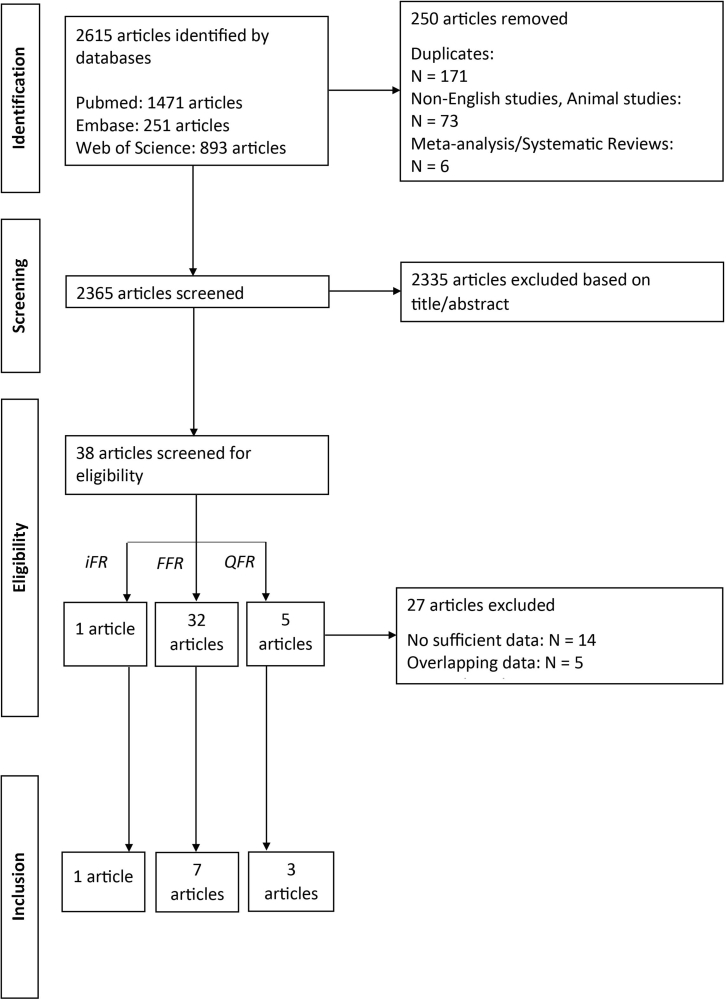
Studies were included in the meta-analysis after performing a systematic literature search on July 1, 2022. The primary end point was the incidence of major adverse cardiac events, vessel-orientated cardiac events, or target vessel failure.
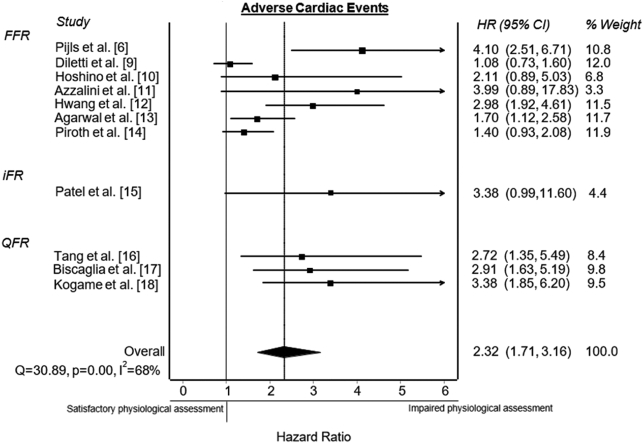
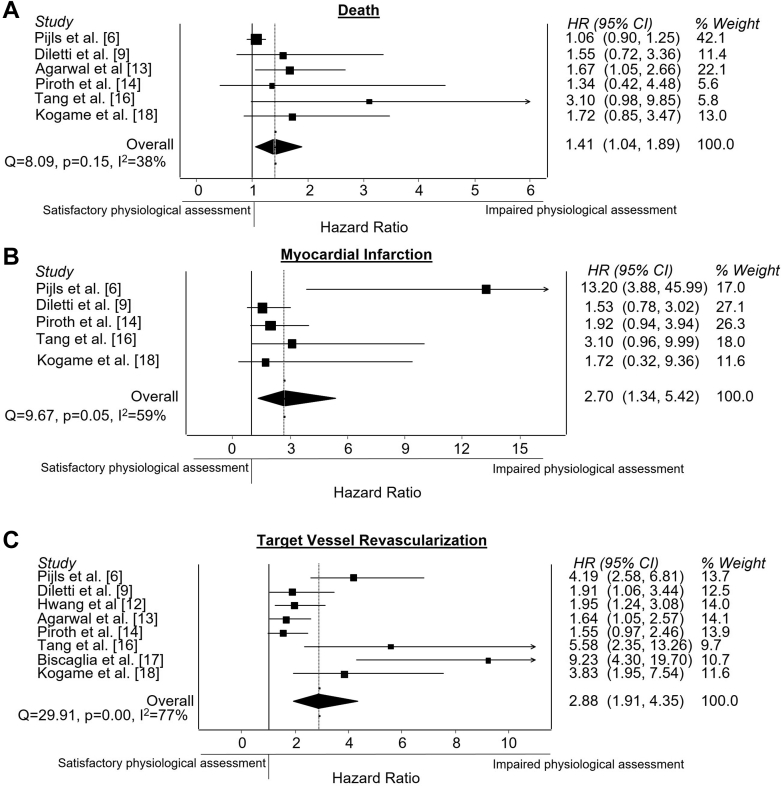
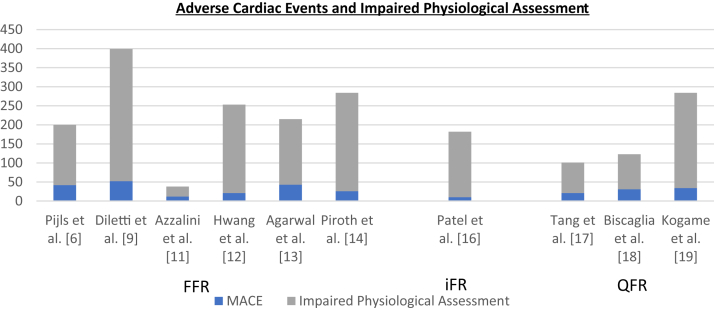
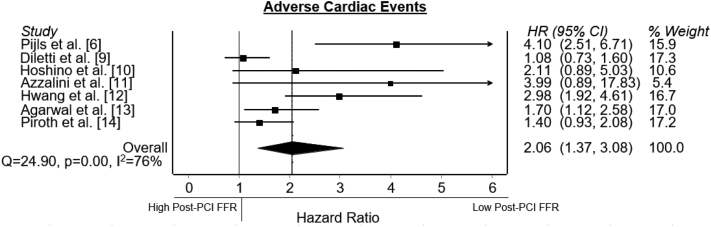
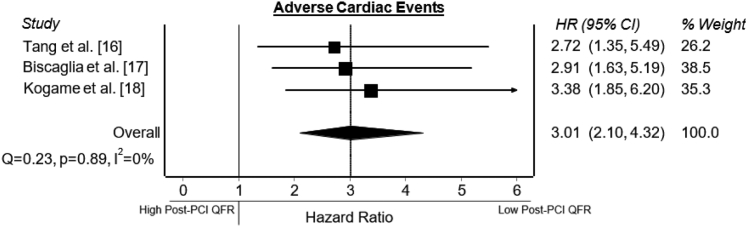
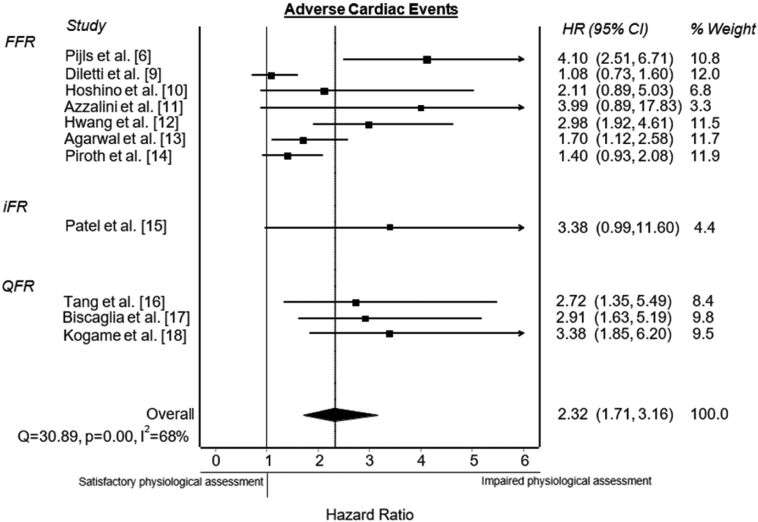
Low post-PCI fractional flow reserve, reported in 7 studies with fractional flow reserve cutoff values between 0.84 and 0.90, including 4017 patients, was associated with an increased rate of the primary end point (hazard ratio [HR], 2.06; 95% CI, 1.37-3.08). One study reported about impaired post-PCI instantaneous wave-free ratio with instantaneous wave-free ratio cutoff value of 0.95 in relation to major adverse cardiac events, showing a significant association (HR, 3.38; 95% CI, 0.99-11.6; = .04). Low post-PCI quantitative flow ratio, reported in 3 studies with quantitative flow ratio cutoff value between 0.89 and 0.91, including 1181 patients, was associated with an increased rate of vessel-orientated cardiac events (HR, 3.01; 95% CI, 2.10-4.32). Combining data of all modalities, impaired physiological assessment showed an increased rate of the primary end point (HR, 2.32; 95% CI, 1.71-3.16) and secondary end points, including death (HR, 1.41; 95% CI, 1.04-1.89), myocardial infarction (HR, 2.70; 95% CI, 1.34-5.42) and target vessel revascularization (HR, 2.88; 95% CI, 1.91-4.35).
Impaired post-PCI physiological assessment is associated with increased adverse cardiac events and individual end points, including death, myocardial infarction, and target vessel revascularization. Therefore, prospective studies are awaited on whether physiology-based optimization of PCI results in better clinical outcomes.
尽管经皮冠状动脉介入治疗(PCI)在血管造影方面取得了最佳效果,但罪犯病变部位的残余病变仍可导致主要不良心脏事件。PCI术后的生理评估可识别残余狭窄。本荟萃分析旨在研究有关PCI术后生理评估与长期预后关系的研究数据。
在2022年7月1日进行系统文献检索后,将研究纳入荟萃分析。主要终点是主要不良心脏事件、血管相关心脏事件或靶血管失败的发生率。
7项研究报告了PCI术后低血流储备分数,其血流储备分数临界值在0.84至0.90之间,包括4017例患者,这与主要终点发生率增加相关(风险比[HR],2.06;95%置信区间,1.37 - 3.08)。一项研究报告了PCI术后瞬时无波比值受损,其瞬时无波比值临界值为0.95与主要不良心脏事件相关,显示出显著关联(HR,3.38;95%置信区间,0.99 - 11.6;P = 0.04)。3项研究报告了PCI术后低定量血流比,其定量血流比临界值在0.89至0.91之间,包括1181例患者,这与血管相关心脏事件发生率增加相关(HR,3.01;95%置信区间,2.10 - 4.32)。综合所有模式的数据,生理评估受损显示主要终点发生率增加(HR,2.32;95%置信区间,1.71 - 3.16)以及次要终点发生率增加,包括死亡(HR,1.41;95%置信区间,1.04 - 1.89)、心肌梗死(HR,2.70;95%置信区间,1.34 - 5.42)和靶血管血运重建(HR,2.88;95%置信区间,1.91 - 4.35)。
PCI术后生理评估受损与不良心脏事件及个体终点增加相关,包括死亡、心肌梗死和靶血管血运重建。因此,期待有关基于生理学优化PCI是否能带来更好临床结果的前瞻性研究。