Division of Clinical Physiology, Department of Laboratory Medicine, Karolinska Institutet, Stockholm, Sweden.
Centre for Physical Activity Research, Copenhagen University Hospital-Rigshospitalet, Copenhagen, Denmark.
PLoS One. 2024 Aug 12;19(8):e0308676. doi: 10.1371/journal.pone.0308676. eCollection 2024.
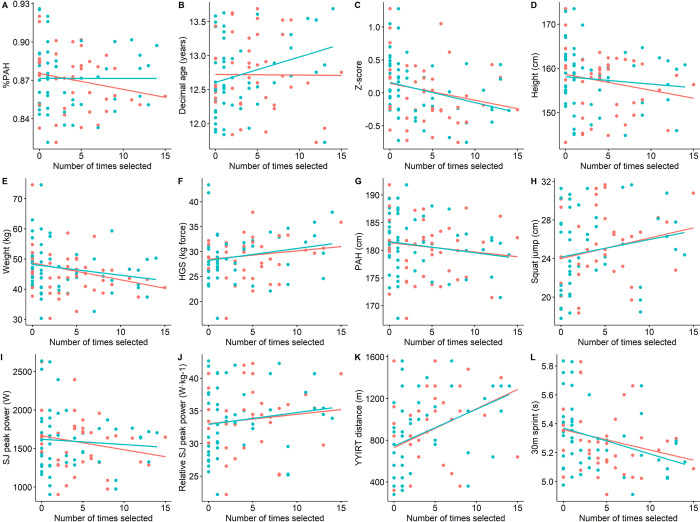
Classifying athletes based on estimates of biological maturation (i.e., bio-banding) as a supplement to traditional age grouping has been shown to be a potential tool for enriching player development in team sports; however, bio-banding has not yet been evaluated in ice hockey. The primary aim was to investigate player experiences and coaches' selection preferences in bio-banding versus age-banding in a group of 12-13-year-old (early growth spurt) male elite players (n = 69). We also examined the relationship between somatic maturity, expressed as a % predicted adult height (%PAH), and fitness performance. Bio-banding was assessed using a questionnaire and 29 coaches selected their top players in each game based on age or bio-bands. %PAH correlated with grip strength (r = .57, p>0.001) and jumping power (r = .63, p<0.001), but not with vertical jump height, sprint time or endurance. Players who played against more mature players in bio-bands than in age groups experienced higher demands, while players who played against less mature players were able to utilize their skills to a greater extent. Coaches generally favored later-than-average maturing players who performed better on performance tests and chronologically older players in bio-banding. We conclude that bio-banding in youth ice hockey has some promising effects and warrants further evaluation.
基于生物学成熟度(即生物分期)对运动员进行分类,作为传统年龄分组的补充,已被证明是丰富团队运动中运动员发展的潜在工具;然而,在冰球中尚未对生物分期进行评估。主要目的是在一组 12-13 岁(生长突增早期)的男性精英运动员(n = 69)中调查生物分期与年龄分组相比运动员的体验和教练的选择偏好。我们还检查了作为 %预测成人身高的(%PAH)的身体成熟度与体能表现之间的关系。使用问卷评估生物分期,29 名教练根据年龄或生物分期在每场比赛中选择最佳球员。%PAH 与握力(r =.57,p>0.001)和跳跃力(r =.63,p<0.001)相关,但与垂直跳跃高度、冲刺时间或耐力无关。与生物分组中比年龄分组更成熟的运动员比赛的运动员面临更高的要求,而与较不成熟的运动员比赛的运动员能够更大程度地利用自己的技能。教练通常更喜欢在体能测试中表现更好的晚熟球员和生物分期中年龄较大的球员。我们的结论是,青少年冰球中的生物分期具有一些有希望的效果,值得进一步评估。