Department of Neurosurgery, Gachon University Gil Medical Center, Incheon, 21565, Republic of Korea.
Department of Preventive Medicine, Gachon University College of Medicine, Incheon, 21565, Republic of Korea.
Sci Rep. 2021 Apr 13;11(1):8046. doi: 10.1038/s41598-021-87357-x.
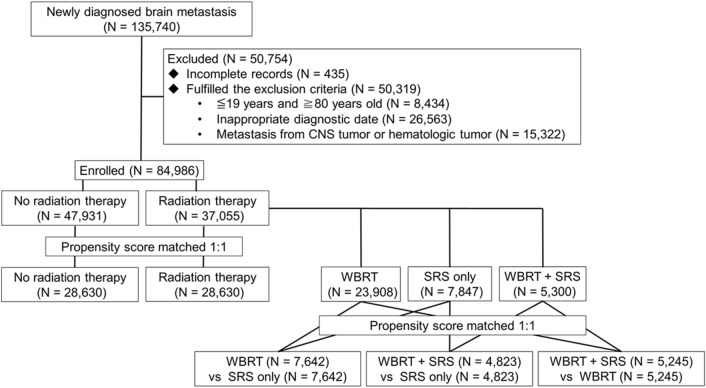
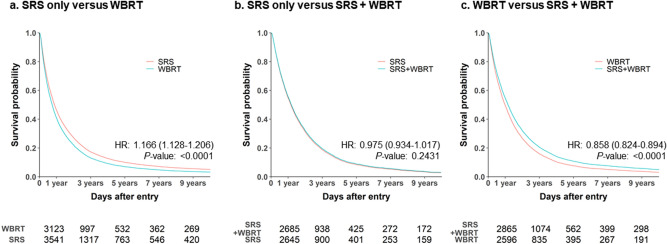
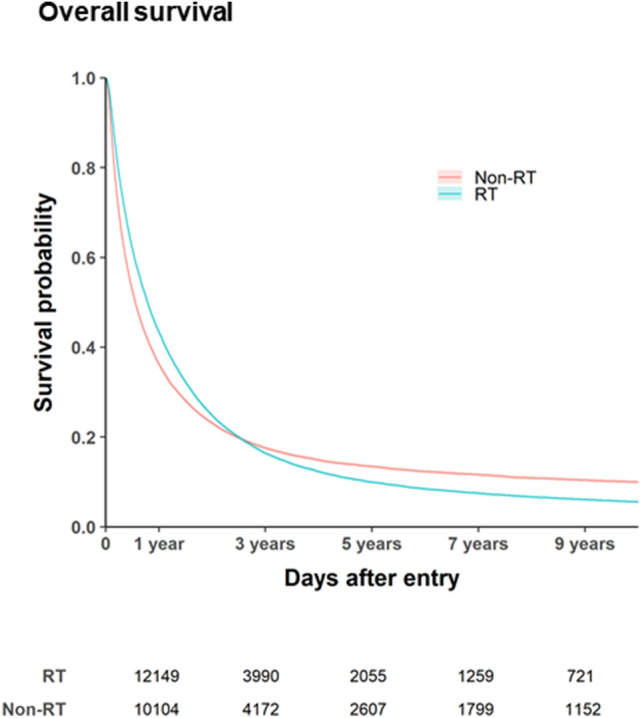
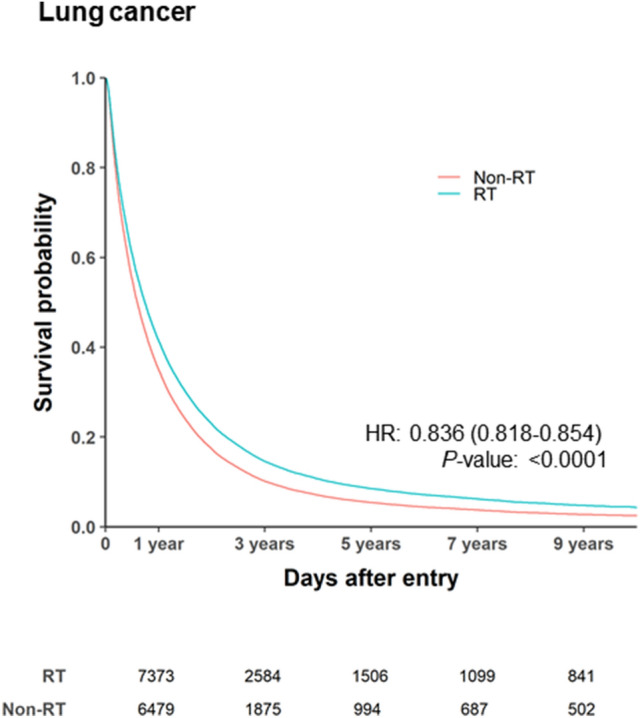
Patients with brain metastases (BM) can benefit from radiotherapy (RT), although the long-term benefits of RT remain unclear. We searched a Korean national health insurance claims database and identified 135,740 patients with newly diagnosed BM during 2002-2017. Propensity score matching (PSM) was used to evaluate survival according to RT modality, which included whole-brain radiotherapy (WBRT) and/or stereotactic radiosurgery (SRS). The 84,986 eligible patients were followed for a median interval of 6.6 months, and 37,046 patients underwent RT (43.6%). After the PSM, patients who underwent RT had significantly better overall survival after 1 year (42.4% vs. 35.3%, P < 0.001), although there was no significant difference at 2.6 years, and patients who did not undergo RT had better survival after 5 years. Among patients with BM from lung cancer, RT was also associated with a survival difference after 1 year (57.3% vs. 32.8%, P < 0.001) and a median survival increase of 3.7 months. The 1-year overall survival rate was significantly better for SRS than for WBRT (46.4% vs. 38.8%, P < 0.001). Among Korean patients with BM, especially patients with primary lung cancer, RT improved the short-term survival rate, and SRS appears to be more useful than WBRT in this setting.
患者有脑转移(BM)可以受益于放射治疗(RT),尽管 RT 的长期获益仍不清楚。我们检索了韩国国家健康保险索赔数据库,并在 2002-2017 年期间确定了 135740 例新诊断的 BM 患者。使用倾向评分匹配(PSM)根据 RT 方式评估生存情况,包括全脑放疗(WBRT)和/或立体定向放射外科(SRS)。84986 名符合条件的患者中位随访时间为 6.6 个月,37046 名患者接受了 RT(43.6%)。在 PSM 后,接受 RT 的患者在 1 年后的总生存率显著提高(42.4% vs. 35.3%,P<0.001),尽管 2.6 年后无显著差异,而未接受 RT 的患者在 5 年后的生存率更高。在肺癌脑转移患者中,RT 也与 1 年后的生存差异相关(57.3% vs. 32.8%,P<0.001),中位生存时间增加 3.7 个月。SRS 的 1 年总生存率明显优于 WBRT(46.4% vs. 38.8%,P<0.001)。在韩国 BM 患者中,尤其是原发性肺癌患者中,RT 提高了短期生存率,SRS 在这种情况下似乎比 WBRT 更有用。