Department of Radiotherapy, General Hospital of Lippe, GmbH Rintelner Straße 85 |, Lemgo, Lippe, Germany.
Department of Radiotherapy, The First Affiliated Hospital of Xinxiang Medical University, Weihui, Henan, China.
Radiat Oncol. 2019 Mar 11;14(1):41. doi: 10.1186/s13014-019-1245-9.
Radiotherapy plays a major role in the management of brain metastases. This study aimed to identify the subset of patients with multiple brain metastases who may not benefit from whole brain irradiation (WBI) due to a short survival time regardless of treatment.
We analyzed a total of 339 patient records with brain metastases treated with whole brain radiotherapy from January 2009 to January 2016. External beam radiotherapy techniques were used to deliver 33 Gy in 11 fractions (4 fractions per week) to the whole brain. Eight clinical factors with a potential influence on survival were investigated using the Kaplan-Meier method. All factors with a P < 0.05 in univariate analysis were entered into multivariate analysis using Cox regression.
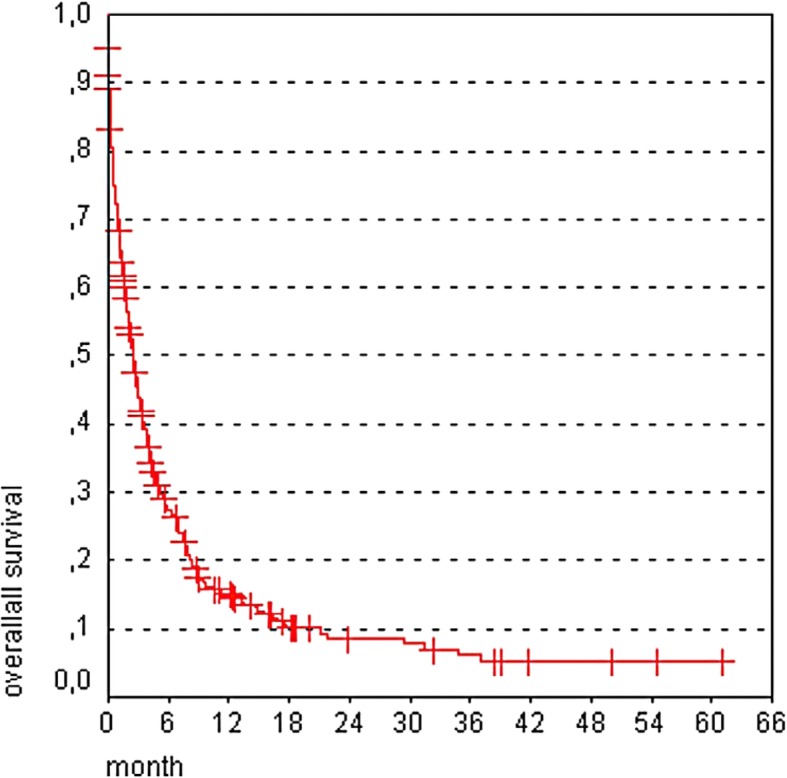
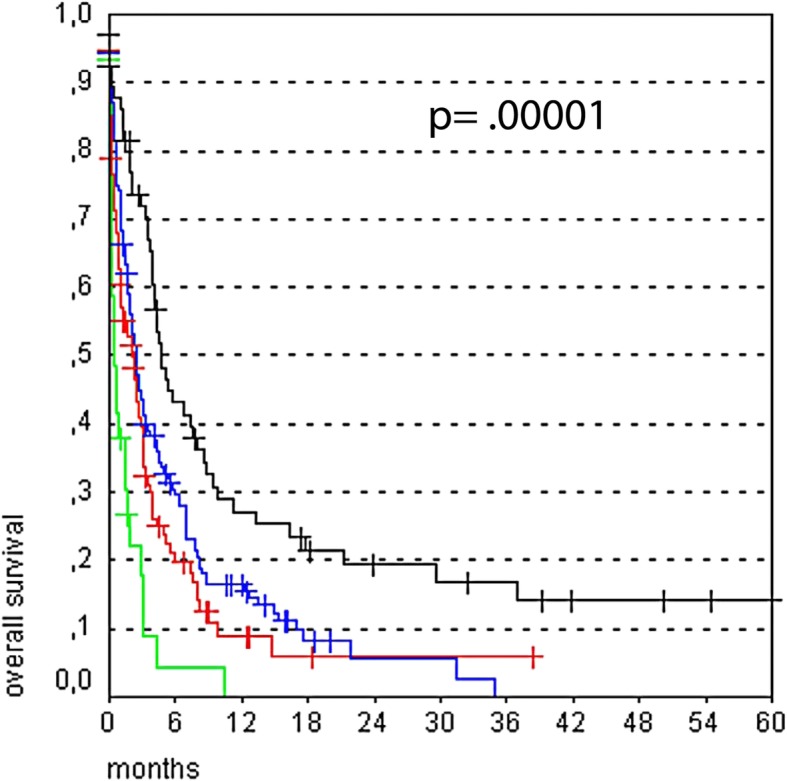
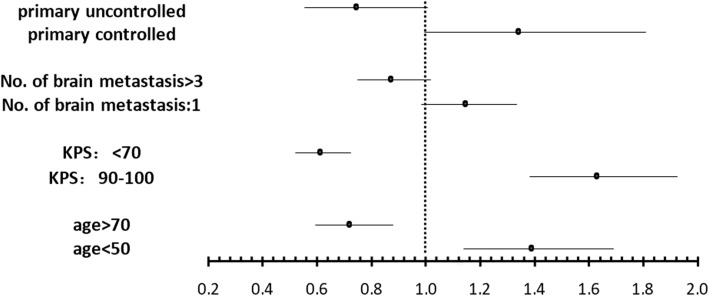
In the present series of 339 patients, median survival time was 2.5 months (M; range, 0-61 months). Four risk factors Karnofsky Performance Score (KPS) < 70, age > 70, > 3 of metastases intracranial, uncontrolled primary tumor) were identified that were significant and negatively correlated with median survival time. Patients with no risk factors had a median survival of 4.7 M; one risk factor, 2.5 M; two risk factors, 2.3 M; and 3-4 risk factors, 0.4 M (p < 0.00001).
Patients with identified risk factors might have a negatively impacted overall survival after WBI. Accordingly, patients who will not benefit from WBI can be easily predicted if they have 3-4 of these risk factors.
放射治疗在脑转移瘤的治疗中起着重要作用。本研究旨在确定一组患者,尽管接受了治疗,但由于生存时间短,即使不进行全脑照射(WBI)也不会从中获益。
我们分析了 2009 年 1 月至 2016 年 1 月间接受全脑放疗的 339 例脑转移患者的病历。采用外照射放疗技术,对全脑进行 33Gy 的 11 次分割(每周 4 次)。使用 Kaplan-Meier 法对 8 个可能影响生存的临床因素进行了研究。单因素分析中 P<0.05 的所有因素均采用 Cox 回归进行多因素分析。
在本系列 339 例患者中,中位生存时间为 2.5 个月(M;范围,0-61 个月)。确定了 4 个危险因素,卡氏功能状态评分(KPS)<70、年龄>70、颅内转移灶>3 个、未控制的原发性肿瘤)与中位生存时间呈显著负相关。无危险因素的患者中位生存时间为 4.7 个月;有 1 个危险因素的患者为 2.5 个月;有 2 个危险因素的患者为 2.3 个月;有 3-4 个危险因素的患者为 0.4 个月(p<0.00001)。
有确定危险因素的患者在接受 WBI 后总体生存可能受到负面影响。因此,如果这些患者有 3-4 个危险因素,那么可以很容易地预测他们不会从 WBI 中受益。