
全球 COVID-19 发病率和病死率趋势(2019-2023 年):回顾性分析。
Global trends in COVID-19 incidence and case fatality rates (2019-2023): a retrospective analysis.
机构信息
Department of General Medicine, Chengdu Second People's Hospital, Chengdu, China.
Department of Geriatrics, Chengdu Second People's Hospital, Chengdu, China.
出版信息
Front Public Health. 2024 Jul 29;12:1355097. doi: 10.3389/fpubh.2024.1355097. eCollection 2024.
OBJECTIVES
Analyzing and comparing COVID-19 infection and case-fatality rates across different regions can help improve our response to future pandemics.
METHODS
We used public data from the WHO to calculate and compare the COVID-19 infection and case-fatality rates in different continents and income levels from 2019 to 2023.
RESULTS
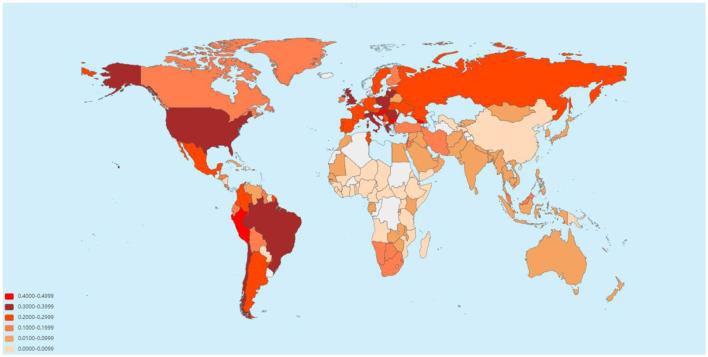
The Global prevalence of COVID-19 increased from 0.011 to 0.098, while case fatality rates declined from 0.024 to 0.009. Europe reported the highest cumulative infection rate (0.326), with Africa showing the lowest (0.011). Conversely, Africa experienced the highest cumulative case fatality rates (0.020), with Oceania the lowest (0.002). Infection rates in Asia showed a steady increase in contrast to other continents which observed initial rises followed by decreases. A correlation between economic status and infection rates was identified; high-income countries had the highest cumulative infection rate (0.353) and lowest case fatality rate (0.006). Low-income countries showed low cumulative infection rates (0.006) but the highest case fatality rate (0.016). Initially, high and upper-middle-income countries experienced elevated initial infection and case fatality rates, which subsequently underwent significant reductions.
CONCLUSIONS
COVID-19 rates varied significantly by continent and income level. Europe and the Americas faced surges in infections and low case fatality rates. In contrast, Africa experienced low infection rates and higher case fatality rates, with lower- and middle-income nations exceeding case fatality rates in high-income countries over time.
目的
分析和比较不同地区的 COVID-19 感染率和病死率有助于改进我们对未来大流行的应对措施。
方法
我们使用世界卫生组织的公开数据,计算和比较了 2019 年至 2023 年不同大洲和收入水平的 COVID-19 感染率和病死率。
结果
全球 COVID-19 患病率从 0.011 增加到 0.098,而病死率从 0.024 下降到 0.009。欧洲报告的累计感染率最高(0.326),非洲最低(0.011)。相反,非洲的累计病死率最高(0.020),大洋洲最低(0.002)。亚洲的感染率呈稳步上升趋势,而其他大陆则呈先上升后下降的趋势。还发现了经济状况与感染率之间的相关性;高收入国家的累计感染率最高(0.353),病死率最低(0.006)。低收入国家的累计感染率较低(0.006),但病死率最高(0.016)。最初,高收入和中高收入国家的初始感染率和病死率较高,随后显著下降。
结论
COVID-19 率在大洲和收入水平上差异显著。欧洲和美洲的感染人数和病死率都有所上升。相比之下,非洲的感染率较低,病死率较高,随着时间的推移,中低收入国家的病死率超过了高收入国家。




 Zotero 插件