National Key Laboratory of Intelligent Tracking and Forecasting for Infectious Diseases, Chinese Center for Disease Control and Prevention, Beijing, China.
School of Public Health, Southern Medical University, Guangzhou, China.
Epidemiol Infect. 2024 Oct 17;152:e124. doi: 10.1017/S0950268824000852.
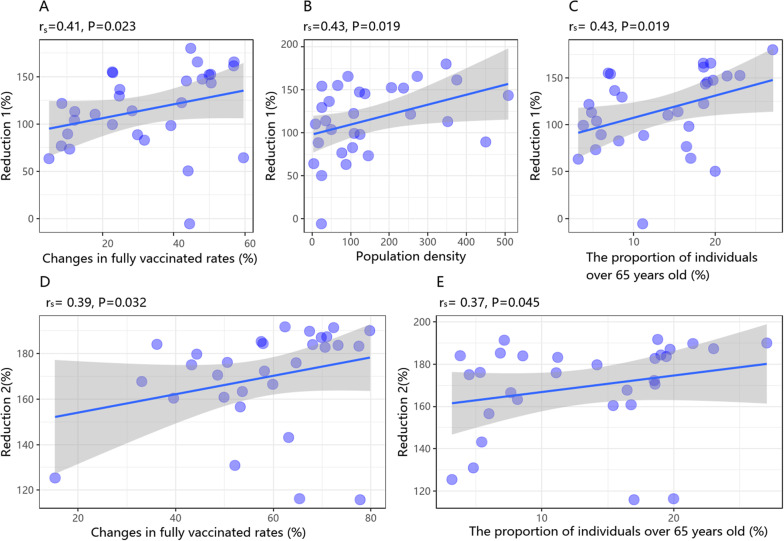
To evaluate the variations in COVID-19 case fatality rates (CFRs) across different regions and waves, and the impact of public health interventions, social and economic characteristics, and demographic factors on COVID-19 CFRs, we collected data from 30 countries with the highest incidence rate in three waves. We summarized the CFRs of different countries and continents in each wave through meta-analysis. Spearman's correlation and multiple linear regression were employed to estimate the correlation between influencing factors and reduction rates of CFRs. Significant differences in CFRs were observed among different regions during the three waves ( < 0.001). An association was found between the changes in fully vaccinated rates ( = 0.41), population density ( = 0.43), the proportion of individuals over 65 years old ( = 0.43), and the reduction rates of case fatality rate. Compared to Wave 1, the reduction rates in Wave 2 were associated with population density ( = 0.19, 95%: 0.05-0.33) and smoking rates ( = -4.66, 95%: -8.98 - -0.33), while in Wave 3 it was associated with booster vaccine rates ( = 0.60, 95%: 0.11-1.09) and hospital beds per thousand people ( = 4.15, 95%: 1.41-6.89). These findings suggest that the COVID-19 CFRs varied across different countries and waves, and promoting booster vaccinations, increasing hospital bed capacity, and implementing tobacco control measures can help reduce CFRs.
为了评估不同地区和波次的 COVID-19 病死率(CFR)变化,以及公共卫生干预、社会经济特征和人口因素对 COVID-19 CFR 的影响,我们从三个波次中发病率最高的 30 个国家收集了数据。我们通过荟萃分析总结了每个波次中不同国家和大洲的 CFR。采用 Spearman 相关和多元线性回归估计影响因素与 CFR 降低率之间的相关性。在三个波次中,不同地区的 CFR 存在显著差异(<0.001)。我们发现,完全接种率的变化( = 0.41)、人口密度( = 0.43)、65 岁以上人口比例( = 0.43)与 CFR 降低率之间存在关联。与第 1 波相比,第 2 波的 CFR 降低率与人口密度( = 0.19,95%置信区间:0.05-0.33)和吸烟率( = -4.66,95%置信区间:-8.98 - -0.33)相关,而在第 3 波中,它与加强疫苗接种率( = 0.60,95%置信区间:0.11-1.09)和每千人口的病床数( = 4.15,95%置信区间:1.41-6.89)相关。这些发现表明,COVID-19 CFR 在不同国家和波次中存在差异,推广加强疫苗接种、增加医院床位容量和实施烟草控制措施有助于降低 CFR。