Department of Pathology and Cell Biology, Columbia University Irving Medical Center, New York, New York, United States of America.
Institute of Immunity and Transplantation, Division of Infection and Immunity, UCL, Royal Free Hospital, London, United Kingdom.
PLoS Biol. 2024 Aug 13;22(8):e3002380. doi: 10.1371/journal.pbio.3002380. eCollection 2024 Aug.
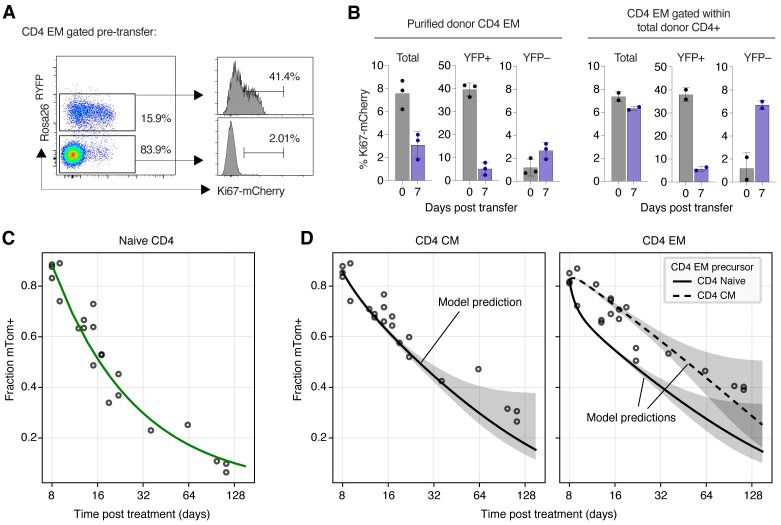
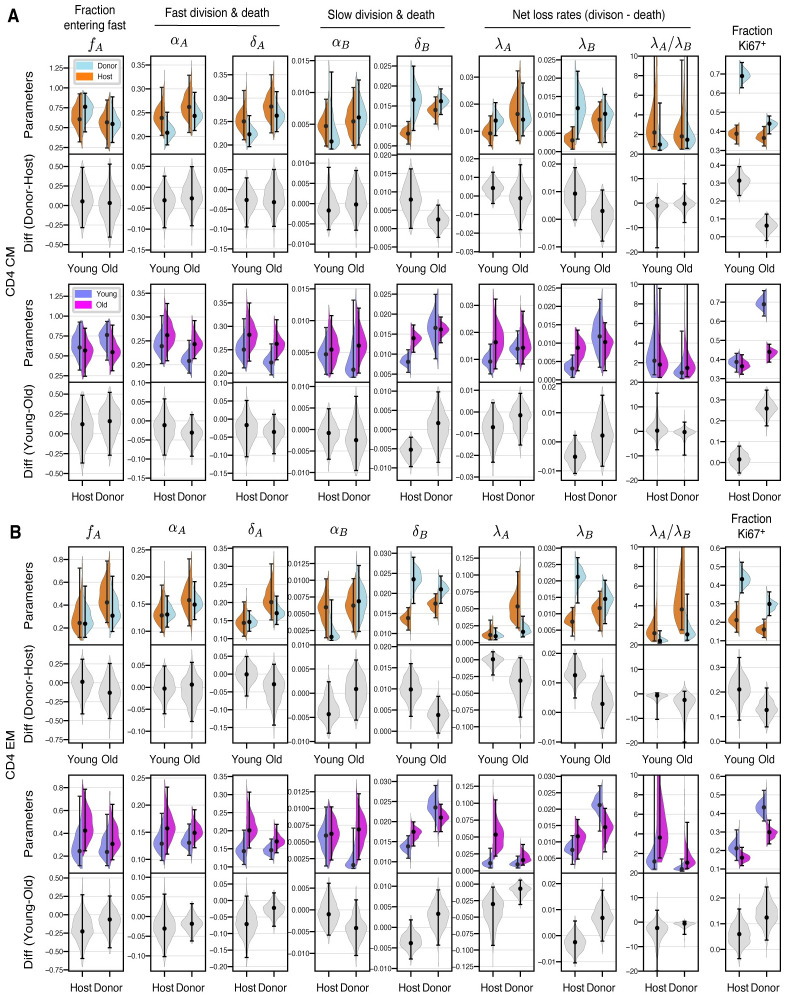
Quantifying the kinetics with which memory T cell populations are generated and maintained is essential for identifying the determinants of the duration of immunity. The quality and persistence of circulating CD4 effector memory (TEM) and central memory (TCM) T cells in mice appear to shift with age, but it is unclear whether these changes are driven by the aging host environment, by cell age effects, or both. Here, we address these issues by combining DNA labelling methods, established fate-mapping systems, a novel reporter mouse strain, and mathematical models. Together, these allow us to quantify the dynamics of both young and established circulating memory CD4 T cell subsets, within both young and old mice. We show that that these cells and their descendents become more persistent the longer they reside within the TCM and TEM pools. This behaviour may limit memory CD4 T cell diversity by skewing TCR repertoires towards clones generated early in life, but may also compensate for functional defects in new memory cells generated in old age.
量化记忆 T 细胞群体产生和维持的动力学对于确定免疫持续时间的决定因素至关重要。在小鼠中,循环 CD4 效应记忆 (TEM) 和中央记忆 (TCM) T 细胞的质量和持久性似乎随着年龄的增长而发生变化,但尚不清楚这些变化是由衰老的宿主环境驱动的,还是由细胞年龄效应驱动的,或者两者兼而有之。在这里,我们通过结合 DNA 标记方法、已建立的命运映射系统、新型报告小鼠品系和数学模型来解决这些问题。这些方法使我们能够在年轻和老年小鼠中定量检测年轻和成熟的循环记忆 CD4 T 细胞亚群的动力学。我们表明,这些细胞及其后代在 TCM 和 TEM 池中停留的时间越长,其持久性就越高。这种行为可能通过将 TCR 库偏向于生命早期产生的克隆来限制记忆 CD4 T 细胞的多样性,但也可能补偿老年时产生的新记忆细胞的功能缺陷。