Abedin Imon, Mukherjee Tanoy, Kim Ah Ran, Lee Soo Rin, Kim Hyun-Woo, Kundu Shantanu
Agricultural and Ecological Research Unit Indian Statistical Institute Kolkata India.
Research Center for Marine Integrated Bionics Technology Pukyong National University Busan Republic of Korea.
Ecol Evol. 2024 Aug 14;14(8):e70160. doi: 10.1002/ece3.70160. eCollection 2024 Aug.
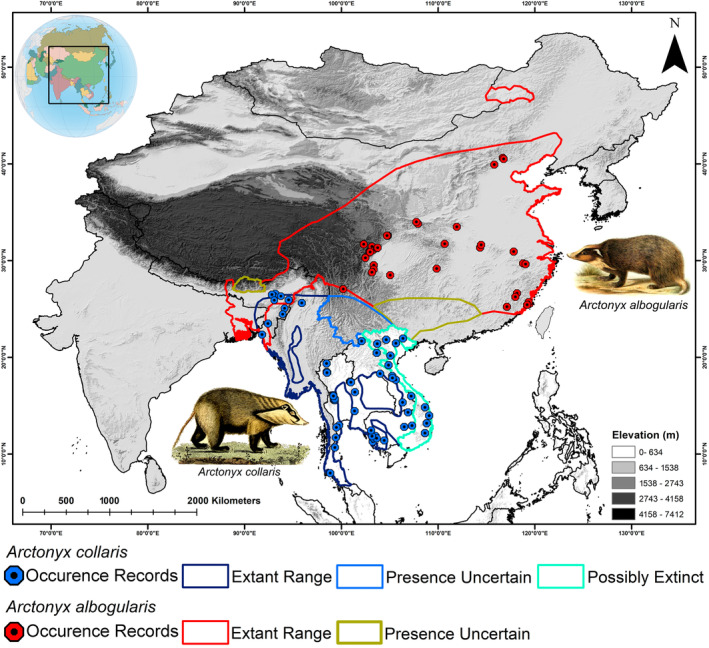
The small mammalian fauna plays pivotal roles in ecosystem dynamics and as crucial biodiversity indicators. However, recent research has raised concerns about the decline of mammalian species due to climate change. Consequently, significant attention is directed toward studying various big flagship mammalian species for conservation. However, small mammals such as the hog badgers (Mustelidae: ) remain understudied regarding the impacts of climate change in Asia. The present study offers a comprehensive analysis of climate change effects on two mainland hog badger species, utilizing ensemble species distribution modeling. Findings reveal concerning outcomes, as only 52% of the IUCN extent is deemed suitable for the Great Hog Badger () and a mere 17% is ideal for the Northern Hog Badger (). Notably, projections suggest a potential reduction of over 26% in suitable areas for both species under future climate scenarios, with the most severe decline anticipated in the high-emission scenario of SSP585. These declines translate into evident habitat fragmentation, particularly impacting , whose patches shrink substantially, contrasting with the relatively stable patches of . However, despite their differences, niche overlap analysis reveals an intriguing increase in overlap between the two species, indicating potential ecological shifts. The study underscores the importance of integrating climate change and habitat fragmentation considerations into conservation strategies, urging a reassessment of the IUCN status of . The insights gained from this research are crucial for improving protection measures by ensuring adequate legal safeguards and maintaining ecological corridors between viable habitat patches, which are essential for the conservation of hog badgers across mainland Asia. Furthermore, emphasizing the urgency of proactive efforts, particularly in countries with suitable habitats can help safeguard these small mammalian species and their ecosystems from the detrimental impacts of climate change.
小型哺乳动物群落在生态系统动态中发挥着关键作用,是重要的生物多样性指标。然而,最近的研究引发了人们对哺乳动物物种因气候变化而减少的担忧。因此,人们将大量注意力投向研究各种大型旗舰哺乳动物物种以进行保护。然而,诸如猪獾(鼬科: )等小型哺乳动物在亚洲气候变化影响方面仍未得到充分研究。本研究利用集合物种分布模型,对气候变化对两种大陆猪獾物种的影响进行了全面分析。研究结果显示了令人担忧的结果,因为在世界自然保护联盟(IUCN)划定的范围内,只有52%的区域被认为适合大猪獾( )生存,而适合猪獾( )的区域仅为17%。值得注意的是,预测表明,在未来气候情景下,这两个物种的适宜区域可能会减少超过26%,在SSP585高排放情景下预计下降最为严重。这些减少转化为明显的栖息地破碎化,尤其对 产生影响,其斑块大幅缩小,而 斑块相对稳定。然而,尽管它们存在差异,但生态位重叠分析显示这两个物种之间的重叠有趣地增加,表明可能发生生态转变。该研究强调了将气候变化和栖息地破碎化考虑因素纳入保护策略的重要性,敦促重新评估 的IUCN地位。从这项研究中获得的见解对于通过确保适当的法律保护和维持可行栖息地斑块之间的生态走廊来改进保护措施至关重要,这对于保护亚洲大陆的猪獾至关重要。此外,强调积极行动的紧迫性,特别是在拥有适宜栖息地的国家,有助于保护这些小型哺乳动物物种及其生态系统免受气候变化的不利影响。