J Clin Invest. 2024 Aug 15;134(16):e172883. doi: 10.1172/JCI172883.
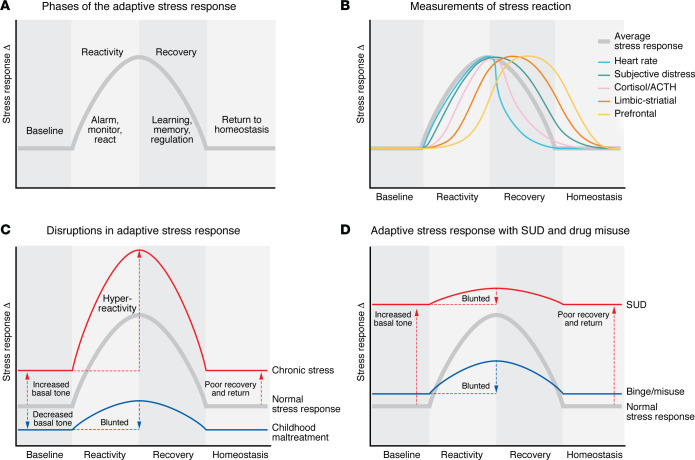
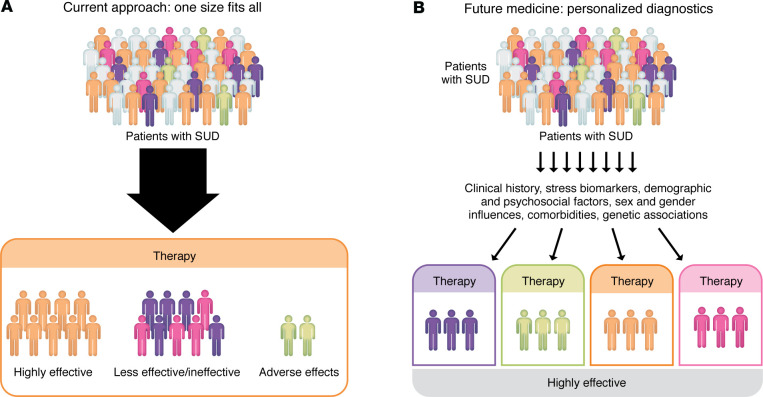
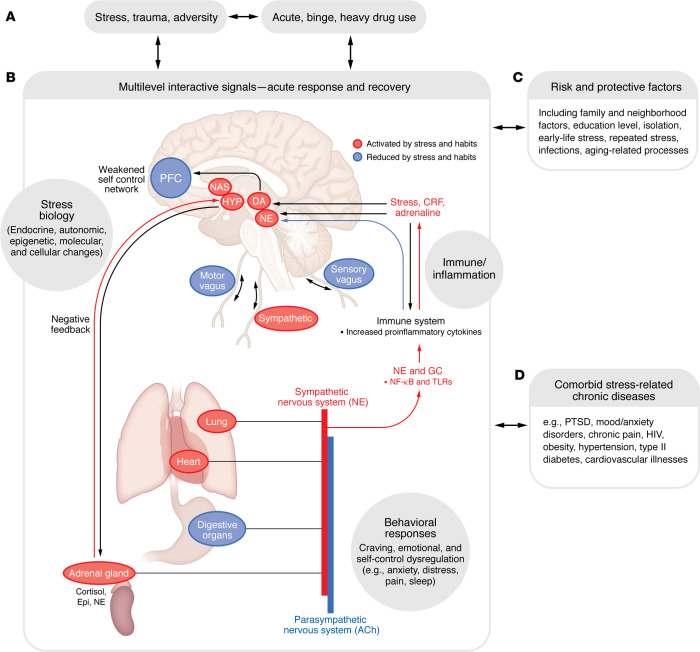
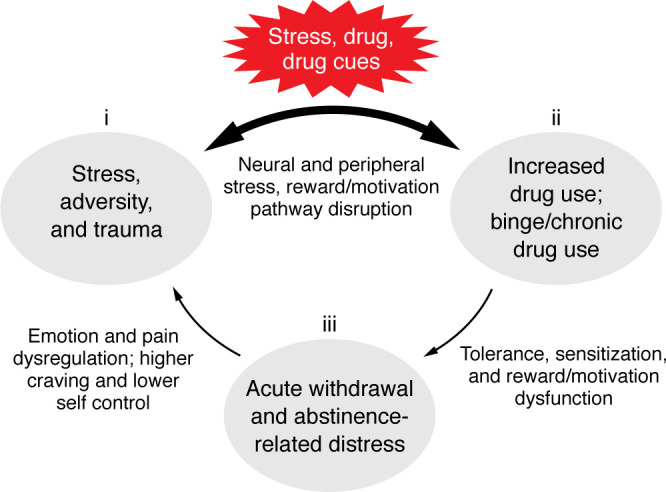
Stress has long been associated with substance misuse and substance use disorders (SUDs). The past two decades have seen a surge in research aimed at understanding the underlying mechanisms driving this association. This Review introduces a multilevel "adaptive stress response" framework, encompassing a stress baseline, acute reaction, and recovery with return-to-homeostasis phase that occurs at varying response times and across domains of analysis. It also discusses evidence showing the disruption of this adaptive stress response in the context of chronic and repeated stressors, trauma, adverse social and drug-related environments, as well as with acute and chronic drug misuse and with drug withdrawal and abstinence sequelae. Subjective, cognitive, peripheral, and neurobiological disruptions in the adaptive stress response phases and their link to inflexible, maladaptive coping; increased craving; relapse risk; and maintenance of drug intake are also presented. Finally, the prevention and treatment implications of targeting this "stress pathophysiology of addiction" are discussed, along with specific aspects that may be targeted in intervention development to rescue stress-related alterations in drug motivation and to improve SUD treatment outcomes.
压力一直与物质滥用和物质使用障碍(SUDs)有关。在过去的二十年中,人们进行了大量的研究,旨在了解导致这种关联的潜在机制。本综述引入了一个多层次的“适应性应激反应”框架,包括应激基线、急性反应和恢复以及返回到稳态的阶段,这在不同的反应时间和分析领域发生。它还讨论了证据表明,在慢性和反复的应激源、创伤、不良的社会和与药物相关的环境,以及急性和慢性药物滥用以及药物戒断和戒断后,这种适应性应激反应会被打乱。适应性应激反应阶段的主观、认知、外周和神经生物学的中断及其与不灵活、适应不良的应对方式;增加的渴望;复发风险;以及维持药物摄入也被提出。最后,还讨论了针对这种“成瘾的应激病理生理学”的预防和治疗意义,以及在干预措施的发展中可能针对的具体方面,以挽救与应激相关的药物动机改变,并改善 SUD 治疗结果。