Van Dam Nicholas T, Rando Kenneth, Potenza Marc N, Tuit Keri, Sinha Rajita
Department of Psychiatry, New York University School of Medicine, New York.
Department of Psychiatry, Yale University School of Medicine, New Haven, Connecticut.
JAMA Psychiatry. 2014 Aug;71(8):917-25. doi: 10.1001/jamapsychiatry.2014.680.
Substance use disorders (SUDs) are among the most common sequelae of childhood maltreatment, yet the independent contributions of SUDs and childhood maltreatment to neurobiological changes and the effect of the latter on relapse risk (a critical variable in addiction treatment) are relatively unknown.
To identify structural neural characteristics independently associated with childhood maltreatment (CM; a common type of childhood adversity), comparing a sample with SUD with a demographically comparable control sample, and to examine the relationship between CM-related structural brain changes and subsequent relapse.
DESIGN, SETTING, AND PARTICIPANTS: Structural magnetic resonance imaging study comparing 79 treatment-engaged participants with SUD in acute remission in inpatient treatment at a community mental health center vs 98 healthy control participants at an outpatient research center at an academic medical center. Both groups included individuals with a range of CM experiences. Participants with SUD were followed up prospectively for 90 days to assess relapse and relapse severity.
Standard 12-step, recovery-based, inpatient addiction treatment for all participants with SUD.
Gray matter volume (GMV), subsequent substance use relapse, days to relapse, and severity of relapse.
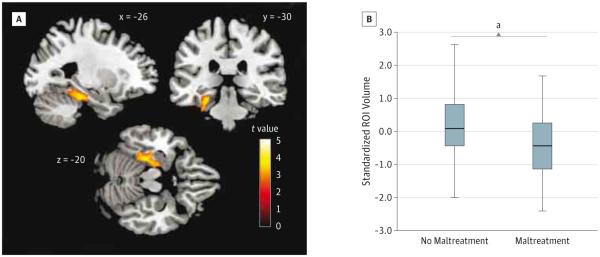
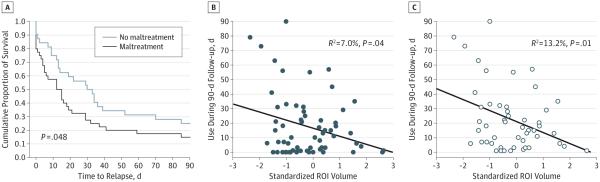
Controlling for SUD and psychiatric comorbidity, CM (dichotomously classified) was uniquely associated with lower GMV across all participants in the left hippocampus (cornu ammonis 1-3, dentate gyrus), parahippocampus (presubiculum, parasubiculum, prosubiculum, subiculum, and entorhinal cortex), and anterior fusiform gyrus (corrected P < .05; uncorrected P = .001). Among the sample with SUD, CM prospectively predicted a shorter relapse to use of any drug (P = .048), while CM-related GMV reductions predicted severity of substance use relapse (P = .04).
Findings indicate that CM was related to decreased GMV in limbic regions, which in turn predicted increased risk of relapse in SUD. These results suggest that CM may significantly affect the course of SUD treatment outcomes and that SUD treatment planning may benefit from identifying and addressing CM.
物质使用障碍(SUDs)是儿童期虐待最常见的后遗症之一,但SUDs和儿童期虐待对神经生物学变化的独立影响以及后者对复发风险(成瘾治疗中的关键变量)的影响相对未知。
识别与儿童期虐待(CM;一种常见的儿童期逆境类型)独立相关的神经结构特征,将一组患有SUD的样本与人口统计学上可比的对照样本进行比较,并研究与CM相关的脑结构变化与随后复发之间的关系。
设计、地点和参与者:一项结构磁共振成像研究,比较了社区心理健康中心住院治疗中79名处于急性缓解期的接受治疗的SUD参与者与学术医疗中心门诊研究中心98名健康对照参与者。两组都包括有一系列CM经历的个体。对患有SUD的参与者进行了90天的前瞻性随访,以评估复发情况和复发严重程度。
对所有患有SUD的参与者进行标准的基于12步康复的住院成瘾治疗。
灰质体积(GMV)、随后的物质使用复发、复发天数和复发严重程度。
在控制SUD和精神疾病共病的情况下,CM(二分法分类)与所有参与者左侧海马体(海马角1-3、齿状回)、海马旁回(前扣带回、副扣带回、前副扣带回、扣带回和内嗅皮质)和前梭状回中较低的GMV唯一相关(校正P<0.05;未校正P=0.001)。在患有SUD的样本中,CM前瞻性地预测了使用任何药物的复发时间较短(P=0.048),而与CM相关的GMV减少预测了物质使用复发的严重程度(P=0.04)。
研究结果表明,CM与边缘区域GMV减少有关,这反过来又预测了SUD复发风险增加。这些结果表明,CM可能会显著影响SUD治疗结果的进程,并且SUD治疗计划可能会受益于识别和解决CM问题。