United States Department of Agriculture, Agricultural Research Service (USDA, ARS), Crop Genetics Research Unit, Stoneville, Mississippi, United States of America.
USDA, ARS, Natural Products Utilization Research Unit, University of Mississippi, University, Mississippi, United States of America.
PLoS One. 2024 Aug 15;19(8):e0308489. doi: 10.1371/journal.pone.0308489. eCollection 2024.
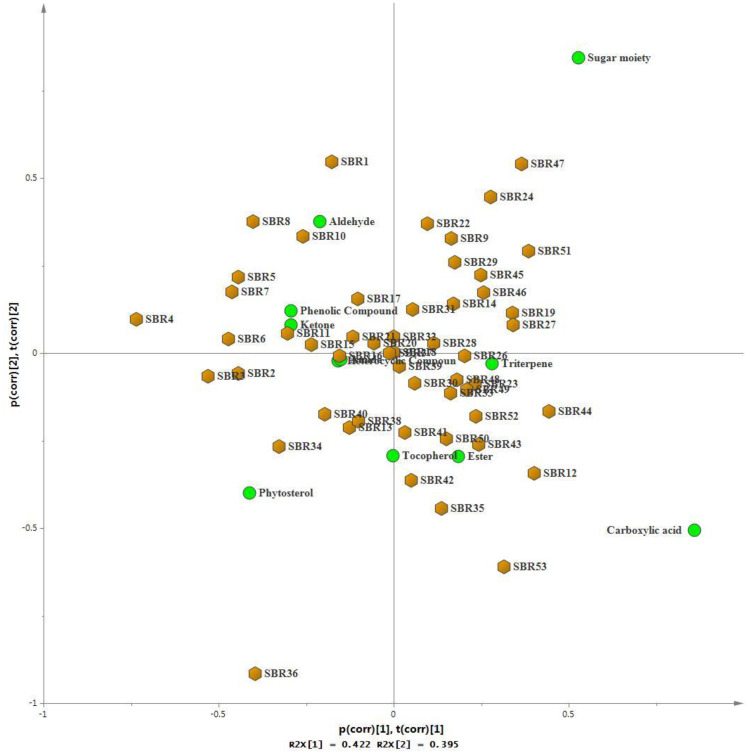
Soybean is one of the most economically important crops worldwide. However, soybean yield can be substantially decreased by many diseases. Soybean genotypes could have different reactions to pathogen infection. As a first step toward investigating the biochemical basis of soybean resistance and susceptibility to disease, phytochemicals in the seeds of 52 soybean genotypes previously reported to have different reactions to diseases of soybean rust (SBR), Phomopsis seed decay (PSD), and purple seed stain (PSS) were analyzed. Using GC-MS, a total of 46 compounds were tentatively identified which included 11 chemical groups. Among those, the major group was esters, followed by carboxylic acid, ketone, and sugar moieties. Compounds having reported antioxidant, anti-microbial, and anti-inflammatory activities were also identified. UHPLC-DAD/MS analysis indicated that there were five major isoflavone components presented in the samples, including daidzin, glycitin, genistin, malonyldaidzin, and malonylglycitin. Isoflavones have been reported to play an important role in defense from plant pathogens. Although there was variance in the isoflavone content among soybean genotypes, those with the SBR resistance Rpp6 gene (PI 567102B, PI 567104B, PI 567129) consistently exhibited the highest concentrations of daidzin, glycitin, genistin, and malonyldaidzin. The SBR resistant genotype, PI 230970 (Rpp2) had the greatest amount of genistin. The SBR resistant genotype, PI 200456 (Rpp5) resistant genotype uniquely contained glycitein, a compound that was absent in the other 51 genotypes examined. A PSD-resistant genotype PI 424324B had nearly four times the amount of stigmasterol as PI 556625, which was susceptible to SBR, PSD, and PSS in our previous tests. Results of this study provide useful information for further investigation of the biochemical basis of soybean resistance to diseases. The results may also aid in selection of soybean lines for breeding for resistance to soybean rust and other diseases.
大豆是全球最重要的经济作物之一。然而,许多疾病会严重降低大豆的产量。大豆基因型对病原体感染可能有不同的反应。为了研究大豆对锈病(SBR)、茎点枯病(PSD)和紫斑病(PSS)的生化抗性和易感性的生化基础,我们分析了 52 个大豆基因型种子中的植物化学物质,这些基因型先前被报道对大豆锈病、茎点枯病和紫斑病有不同的反应。使用 GC-MS,共鉴定出 46 种化合物,分为 11 个化学组。其中,酯类是主要成分,其次是羧酸、酮和糖基。还鉴定出具有抗氧化、抗菌和抗炎活性的化合物。UHPLC-DAD/MS 分析表明,样品中存在 5 种主要的异黄酮成分,包括大豆苷、大豆苷元、染料木苷、丙二酰大豆苷和丙二酰大豆苷元。异黄酮已被报道在植物病原体防御中发挥重要作用。尽管不同大豆基因型的异黄酮含量存在差异,但具有 SBR 抗性 Rpp6 基因(PI 567102B、PI 567104B、PI 567129)的基因型始终表现出最高浓度的大豆苷、大豆苷元、染料木苷和丙二酰大豆苷。SBR 抗性基因型 PI 230970(Rpp2)具有最大量的染料木苷。SBR 抗性基因型 PI 200456(Rpp5)独特地含有在之前检查的其他 51 个基因型中不存在的黄豆苷元。抗 PSD 的基因型 PI 424324B 的豆甾醇含量几乎是易感 SBR、PSD 和 PSS 的 PI 556625 的四倍。本研究的结果为进一步研究大豆对疾病的生化抗性的生化基础提供了有用的信息。这些结果也可能有助于选择用于培育大豆锈病和其他疾病抗性的大豆品系。