Guo Zhimin, Yuan Mengyao, Chai Jiannan
Department of Laboratory Medicine, Infectious Diseases and Pathogen Biology Center, The First Hospital of Jilin University, Changchun, 130021, China.
Department of Laboratory Medicine, The First Hospital of Jilin University, Changchun, 130021, China.
Heliyon. 2024 Jul 18;10(14):e34849. doi: 10.1016/j.heliyon.2024.e34849. eCollection 2024 Jul 30.
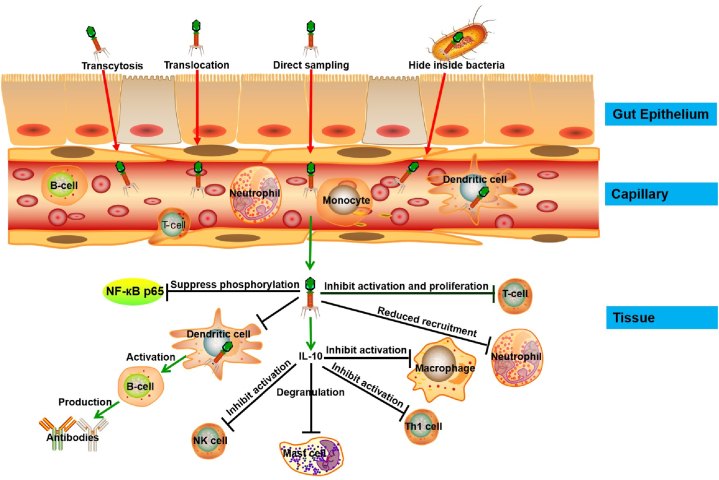
The overuse of antibiotics has caused the emergence of antibiotic-resistant strains, such as multidrug-resistant, extensively drug-resistant, and pandrug-resistant bacteria. The treatment of infections caused by such strains has become a formidable challenge. In the post-antibiotic era, phage therapy is an attractive solution for this problem and some successful phase 1 and 2 studies have demonstrated the efficacy and safety of phage therapy over the last decade. It is a form of evolutionary medicine, phages exhibit immunomodulatory and anti-inflammatory properties. However, phage therapy is limited by factors, such as the narrow spectrum of host strains, the special pharmacokinetics and pharmacodynamics , immune responses, and the development of phage resistance. The aim of this minireview was to compare the potencies of lytic phages and chemical antibiotics to treat bacterial infections. The advantages of phage therapy has fewer side effects, self-replication, evolution, bacterial biofilms eradication, immunomodulatory and anti-inflammatory properties compared with chemical antibiotics. Meanwhile, the disadvantages of phage therapy include the narrow spectrum of available host strains, the special pharmacokinetics and pharmacodynamics , immune responses, and phage resistance hurdles. Recently, some researchers continue to make efforts to overcome these limitations of phage therapy. Phage therapy will be a welcome addition to the gamut of options available for treating antibiotic-resistant bacterial infections. We focus on the advantages and limitations of phage therapy with the intention of exploiting the advantages and overcoming the limitations.
抗生素的过度使用导致了抗生素耐药菌株的出现,如多重耐药菌、广泛耐药菌和泛耐药菌。治疗由这些菌株引起的感染已成为一项艰巨的挑战。在抗生素后时代,噬菌体疗法是解决这一问题的一个有吸引力的方案,并且在过去十年中一些成功的1期和2期研究已经证明了噬菌体疗法的有效性和安全性。它是进化医学的一种形式,噬菌体具有免疫调节和抗炎特性。然而,噬菌体疗法受到多种因素的限制,如宿主菌株谱狭窄、特殊的药代动力学和药效学、免疫反应以及噬菌体耐药性的产生。这篇小型综述的目的是比较裂解性噬菌体和化学抗生素治疗细菌感染的效力。与化学抗生素相比,噬菌体疗法的优点是副作用更少、能自我复制、进化、根除细菌生物膜、具有免疫调节和抗炎特性。同时,噬菌体疗法的缺点包括可用宿主菌株谱狭窄、特殊的药代动力学和药效学、免疫反应以及噬菌体耐药性障碍。最近,一些研究人员继续努力克服噬菌体疗法的这些局限性。噬菌体疗法将是治疗抗生素耐药细菌感染的一系列可用选择中一个受欢迎的补充。我们关注噬菌体疗法的优点和局限性,旨在发挥其优势并克服其局限性。