Section of Microbiology, University of Copenhagen, Copenhagen, Denmark.
Department of Microbiology and Immunology, University of Otago, Dunedin, New Zealand.
Nature. 2023 Nov;623(7987):601-607. doi: 10.1038/s41586-023-06612-5. Epub 2023 Oct 18.
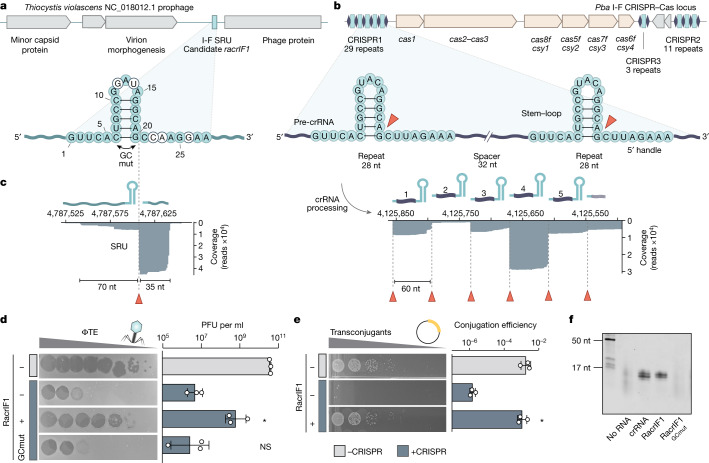
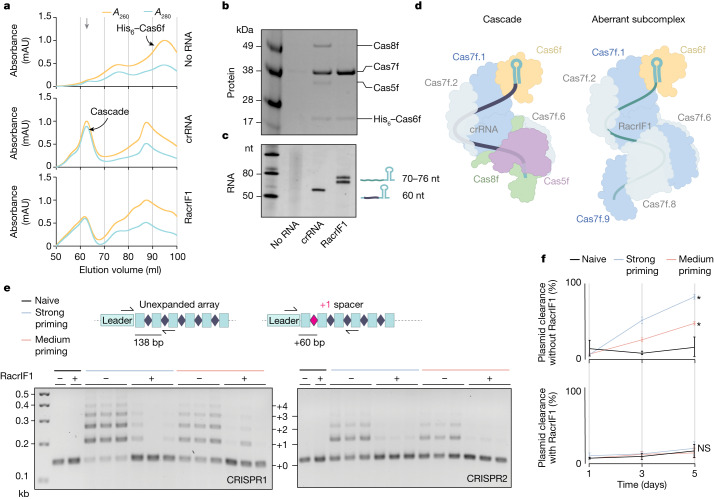
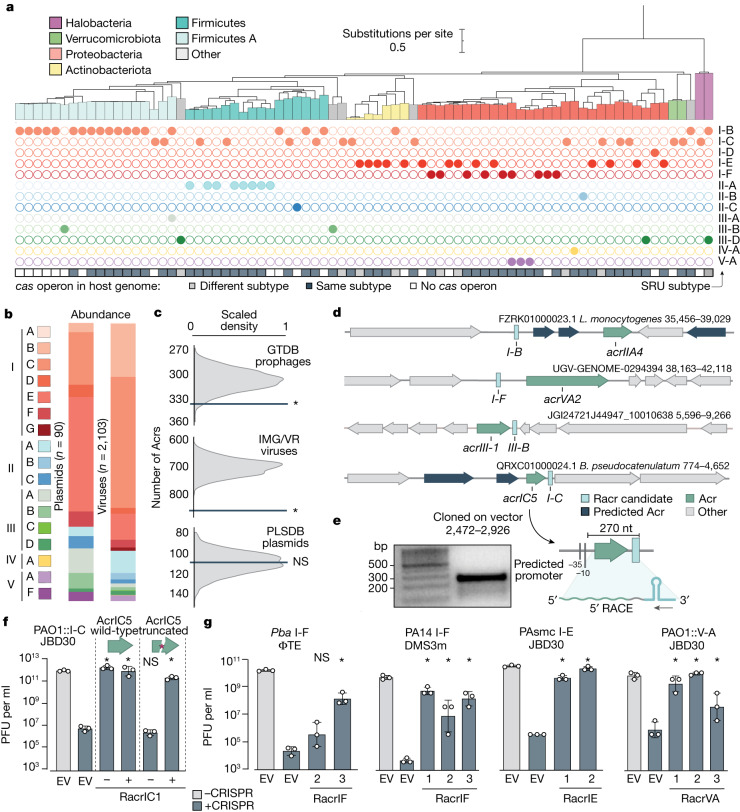
Many bacteria use CRISPR-Cas systems to combat mobile genetic elements, such as bacteriophages and plasmids. In turn, these invasive elements have evolved anti-CRISPR proteins to block host immunity. Here we unveil a distinct type of CRISPR-Cas Inhibition strategy that is based on small non-coding RNA anti-CRISPRs (Racrs). Racrs mimic the repeats found in CRISPR arrays and are encoded in viral genomes as solitary repeat units. We show that a prophage-encoded Racr strongly inhibits the type I-F CRISPR-Cas system by interacting specifically with Cas6f and Cas7f, resulting in the formation of an aberrant Cas subcomplex. We identified Racr candidates for almost all CRISPR-Cas types encoded by a diverse range of viruses and plasmids, often in the genetic context of other anti-CRISPR genes. Functional testing of nine candidates spanning the two CRISPR-Cas classes confirmed their strong immune inhibitory function. Our results demonstrate that molecular mimicry of CRISPR repeats is a widespread anti-CRISPR strategy, which opens the door to potential biotechnological applications.
许多细菌利用 CRISPR-Cas 系统来对抗移动遗传元件,如噬菌体和质粒。反过来,这些入侵元件进化出了抗 CRISPR 蛋白来阻断宿主免疫。在这里,我们揭示了一种基于小非编码 RNA 抗 CRISPR (Racrs)的独特的 CRISPR-Cas 抑制策略。Racrs 模拟 CRISPR 数组中的重复序列,并作为单独的重复单元编码在病毒基因组中。我们表明,一种噬菌体编码的 Racr 通过与 Cas6f 和 Cas7f 特异性相互作用,强烈抑制 I-F 型 CRISPR-Cas 系统,导致形成异常的 Cas 亚复合物。我们鉴定了几乎所有由多种病毒和质粒编码的 CRISPR-Cas 类型的 Racr 候选物,这些候选物通常存在于其他抗 CRISPR 基因的遗传背景中。跨越两种 CRISPR-Cas 类别的九个候选物的功能测试证实了它们强大的免疫抑制功能。我们的结果表明,CRISPR 重复序列的分子模拟是一种广泛存在的抗 CRISPR 策略,为潜在的生物技术应用开辟了道路。