Momin Noor, Pabel Steffen, Rudra Arnab, Kumowski Nina, Lee I-Hsiu, Mentkowski Kyle, Yamazoe Masahiro, Stengel Laura, Muse Charlotte G, Seung Hana, Paccalet Alexandre, Gonzalez-Correa Cristina, Jacobs Emily B, Grune Jana, Schloss Maximilian J, Sossalla Samuel, Wojtkiewicz Gregory, Iwamoto Yoshiko, McMullen Patrick, Mitchell Richard N, Ellinor Patrick T, Anderson Daniel G, Naxerova Kamila, Nahrendorf Matthias, Hulsmans Maarten
Center for Systems Biology, Massachusetts General Hospital and Harvard Medical School, Boston, MA, USA.
Department of Radiology, Massachusetts General Hospital and Harvard Medical School, Boston, MA, USA.
bioRxiv. 2024 Aug 10:2024.08.10.607461. doi: 10.1101/2024.08.10.607461.
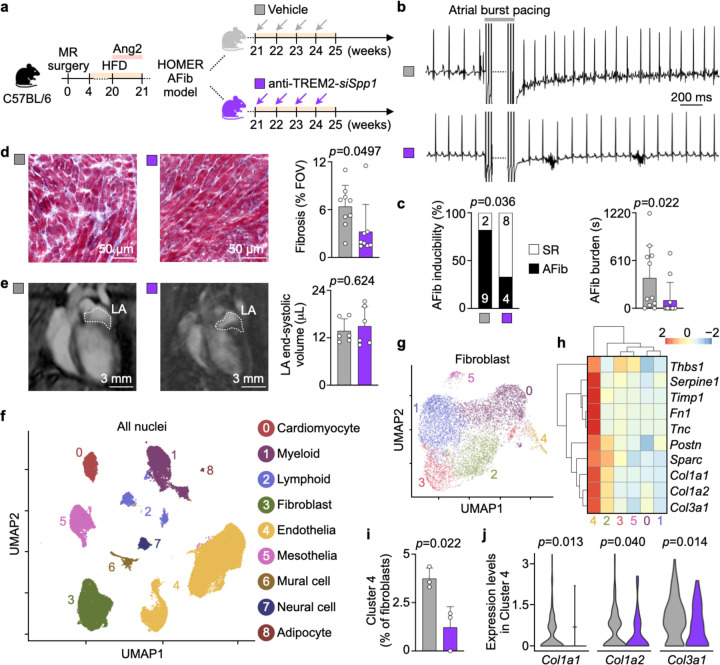
Atrial fibrillation (AFib) and the risk of its lethal complications are propelled by fibrosis, which induces electrical heterogeneity and gives rise to reentry circuits. Atrial TREM2 macrophages secrete osteopontin (encoded by ), a matricellular signaling protein that engenders fibrosis and AFib. Here we show that silencing in TREM2 cardiac macrophages with an antibody-siRNA conjugate reduces atrial fibrosis and suppresses AFib in mice, thus offering a new immunotherapy for the most common arrhythmia.
心房颤动(AFib)及其致命并发症的风险由纤维化推动,纤维化会导致电不均一性并产生折返环路。心房中的TREM2巨噬细胞分泌骨桥蛋白(由[具体基因]编码),这是一种促纤维化和AFib的基质细胞信号蛋白。在这里,我们表明,用抗体-小干扰RNA偶联物沉默TREM2心脏巨噬细胞中的[具体基因]可减少小鼠心房纤维化并抑制AFib,从而为这种最常见的心律失常提供了一种新的免疫疗法。