• 文献检索
  • 文档翻译
  • 深度研究
  • 学术资讯
  • Suppr Zotero 插件Zotero 插件
  • 邀请有礼
  • 套餐&价格
  • 历史记录
应用&插件
Suppr Zotero 插件Zotero 插件浏览器插件Mac 客户端Windows 客户端微信小程序
定价
高级版会员购买积分包购买API积分包
服务
文献检索文档翻译深度研究API 文档MCP 服务
关于我们
关于 Suppr公司介绍联系我们用户协议隐私条款
关注我们

Suppr 超能文献

核心技术专利:CN118964589B侵权必究
粤ICP备2023148730 号-1Suppr @ 2026

文献检索

告别复杂PubMed语法,用中文像聊天一样搜索,搜遍4000万医学文献。AI智能推荐,让科研检索更轻松。

立即免费搜索

文件翻译

保留排版,准确专业,支持PDF/Word/PPT等文件格式,支持 12+语言互译。

免费翻译文档

深度研究

AI帮你快速写综述,25分钟生成高质量综述,智能提取关键信息,辅助科研写作。

立即免费体验

深度风险:一种用于全基因组常见疾病风险评估的深度学习方法。

DeepRisk: A deep learning approach for genome-wide assessment of common disease risk.

作者信息

Peng Jiajie, Bao Zhijie, Li Jingyi, Han Ruijiang, Wang Yuxian, Han Lu, Peng Jinghao, Wang Tao, Hao Jianye, Wei Zhongyu, Shang Xuequn

机构信息

AI for Science Interdisciplinary Research Center, School of Computer Science, Northwestern Polytechnical University, Xi'an 710129, China.

Key Laboratory of Big Data Storage and Management, Northwestern Polytechnical University, Ministry of Industry and Information Technology, Xi'an 710129, China.

出版信息

Fundam Res. 2024 Mar 19;4(4):752-760. doi: 10.1016/j.fmre.2024.02.015. eCollection 2024 Jul.

DOI:10.1016/j.fmre.2024.02.015
PMID:39156563
原文链接:https://pmc.ncbi.nlm.nih.gov/articles/PMC11330112/
Abstract

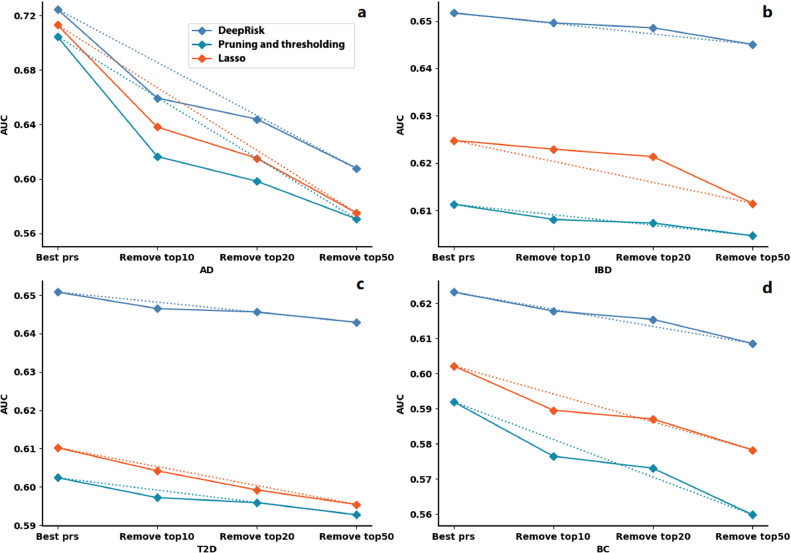
The potential for being able to identify individuals at high disease risk solely based on genotype data has garnered significant interest. Although widely applied, traditional polygenic risk scoring methods fall short, as they are built on additive models that fail to capture the intricate associations among single nucleotide polymorphisms (SNPs). This presents a limitation, as genetic diseases often arise from complex interactions between multiple SNPs. To address this challenge, we developed DeepRisk, a biological knowledge-driven deep learning method for modeling these complex, nonlinear associations among SNPs, to provide a more effective method for scoring the risk of common diseases with genome-wide genotype data. Evaluations demonstrated that DeepRisk outperforms existing PRS-based methods in identifying individuals at high risk for four common diseases: Alzheimer's disease, inflammatory bowel disease, type 2 diabetes, and breast cancer.

摘要

仅基于基因型数据就能识别高疾病风险个体的可能性引起了广泛关注。尽管传统的多基因风险评分方法得到了广泛应用,但它们存在不足,因为这些方法建立在加法模型之上,无法捕捉单核苷酸多态性(SNP)之间的复杂关联。这是一个局限性,因为遗传疾病通常源于多个SNP之间的复杂相互作用。为应对这一挑战,我们开发了DeepRisk,这是一种基于生物学知识的深度学习方法,用于对SNP之间的这些复杂非线性关联进行建模,以便为利用全基因组基因型数据对常见疾病风险进行评分提供一种更有效的方法。评估表明,在识别阿尔茨海默病、炎症性肠病、2型糖尿病和乳腺癌这四种常见疾病的高风险个体方面,DeepRisk优于现有的基于PRS的方法。

https://cdn.ncbi.nlm.nih.gov/pmc/blobs/9e4f/11330112/12599a99e32b/gr4.jpg
https://cdn.ncbi.nlm.nih.gov/pmc/blobs/9e4f/11330112/c720e2a32d76/ga1.jpg
https://cdn.ncbi.nlm.nih.gov/pmc/blobs/9e4f/11330112/7affb7f2f6d8/gr1.jpg
https://cdn.ncbi.nlm.nih.gov/pmc/blobs/9e4f/11330112/f751b118433b/gr2.jpg
https://cdn.ncbi.nlm.nih.gov/pmc/blobs/9e4f/11330112/aea9fbe09b86/gr3.jpg
https://cdn.ncbi.nlm.nih.gov/pmc/blobs/9e4f/11330112/12599a99e32b/gr4.jpg
https://cdn.ncbi.nlm.nih.gov/pmc/blobs/9e4f/11330112/c720e2a32d76/ga1.jpg
https://cdn.ncbi.nlm.nih.gov/pmc/blobs/9e4f/11330112/7affb7f2f6d8/gr1.jpg
https://cdn.ncbi.nlm.nih.gov/pmc/blobs/9e4f/11330112/f751b118433b/gr2.jpg
https://cdn.ncbi.nlm.nih.gov/pmc/blobs/9e4f/11330112/aea9fbe09b86/gr3.jpg
https://cdn.ncbi.nlm.nih.gov/pmc/blobs/9e4f/11330112/12599a99e32b/gr4.jpg

相似文献

1
DeepRisk: A deep learning approach for genome-wide assessment of common disease risk.深度风险:一种用于全基因组常见疾病风险评估的深度学习方法。
Fundam Res. 2024 Mar 19;4(4):752-760. doi: 10.1016/j.fmre.2024.02.015. eCollection 2024 Jul.
2
Improving the Utility of Polygenic Risk Scores as a Biomarker for Alzheimer's Disease.提高多基因风险评分作为阿尔茨海默病生物标志物的效用。
Cells. 2021 Jun 29;10(7):1627. doi: 10.3390/cells10071627.
3
Glioma survival prediction from whole-brain MRI without tumor segmentation using deep attention network: a multicenter study.基于深度注意网络的全脑 MRI 无肿瘤分割的脑胶质瘤生存预测:一项多中心研究。
Eur Radiol. 2022 Aug;32(8):5719-5729. doi: 10.1007/s00330-022-08640-7. Epub 2022 Mar 12.
4
Deep learning-based polygenic risk analysis for Alzheimer's disease prediction.基于深度学习的阿尔茨海默病预测多基因风险分析。
Commun Med (Lond). 2023 Apr 6;3(1):49. doi: 10.1038/s43856-023-00269-x.
5
Epistatic Features and Machine Learning Improve Alzheimer's Disease Risk Prediction Over Polygenic Risk Scores.遗传交互作用特征和机器学习可提高阿尔茨海默病风险预测的准确性,优于多基因风险评分。
J Alzheimers Dis. 2024;99(4):1425-1440. doi: 10.3233/JAD-230236.
6
Polygenic risk and hazard scores for Alzheimer's disease prediction.多基因风险和阿尔茨海默病预测的危害评分。
Ann Clin Transl Neurol. 2019 Feb 18;6(3):456-465. doi: 10.1002/acn3.716. eCollection 2019 Mar.
7
Robust SNP-based prediction of rheumatoid arthritis through machine-learning-optimized polygenic risk score.通过机器学习优化的多基因风险评分实现类风湿关节炎的稳健 SNP 预测。
J Transl Med. 2023 Feb 7;21(1):92. doi: 10.1186/s12967-023-03939-5.
8
Polygenic risk scores for the prediction of common cancers in East Asians: A population-based prospective cohort study.基于人群的前瞻性队列研究:东亚常见癌症的多基因风险评分预测。
Elife. 2023 Mar 27;12:e82608. doi: 10.7554/eLife.82608.
9
Haplotype function score improves biological interpretation and cross-ancestry polygenic prediction of human complex traits.单体型功能评分可改善人类复杂性状的生物学解释和跨血统多基因预测。
Elife. 2024 Apr 19;12:RP92574. doi: 10.7554/eLife.92574.
10
Polygenic Risk Scores in Alzheimer's Disease: Current Applications and Future Directions.阿尔茨海默病的多基因风险评分:当前应用与未来方向
Front Digit Health. 2020 Aug 11;2:14. doi: 10.3389/fdgth.2020.00014. eCollection 2020.

引用本文的文献

1
MetaGeno: a chromosome-wise multi-task genomic framework for ischaemic stroke risk prediction.MetaGeno:一种用于缺血性中风风险预测的染色体级多任务基因组框架。
Brief Bioinform. 2025 Jul 2;26(4). doi: 10.1093/bib/bbaf348.
2
VADEr: Vision Transformer-Inspired Framework for Polygenic Risk Reveals Underlying Genetic Heterogeneity in Prostate Cancer.VADEr:受视觉Transformer启发的多基因风险框架揭示前列腺癌潜在的遗传异质性
medRxiv. 2025 May 18:2025.05.16.25327672. doi: 10.1101/2025.05.16.25327672.
3
Deep learning-based polygenic scores enhance generalizability of psychiatric disorders prediction.

本文引用的文献

1
Tutorial: a guide to performing polygenic risk score analyses.教程:多基因风险评分分析操作指南。
Nat Protoc. 2020 Sep;15(9):2759-2772. doi: 10.1038/s41596-020-0353-1. Epub 2020 Jul 24.
2
Key steps for effective breast cancer prevention.有效预防乳腺癌的关键步骤。
Nat Rev Cancer. 2020 Aug;20(8):417-436. doi: 10.1038/s41568-020-0266-x. Epub 2020 Jun 11.
3
Association between inflammatory bowel disease and prostate cancer: A large-scale, prospective, population-based study.炎症性肠病与前列腺癌的相关性:一项大规模、前瞻性、基于人群的研究。
基于深度学习的多基因评分提高了精神疾病预测的泛化能力。
medRxiv. 2025 May 5:2025.05.05.25326794. doi: 10.1101/2025.05.05.25326794.
4
AI-powered precision medicine: utilizing genetic risk factor optimization to revolutionize healthcare.人工智能驱动的精准医学:利用遗传风险因素优化彻底改变医疗保健。
NAR Genom Bioinform. 2025 May 5;7(2):lqaf038. doi: 10.1093/nargab/lqaf038. eCollection 2025 Jun.
Int J Cancer. 2020 Nov 15;147(10):2735-2742. doi: 10.1002/ijc.33048. Epub 2020 May 29.
4
Physical activity and breast cancer risk: results from the UK Biobank prospective cohort.体力活动与乳腺癌风险:来自英国生物库前瞻性队列研究的结果。
Br J Cancer. 2020 Mar;122(5):726-732. doi: 10.1038/s41416-019-0700-6. Epub 2020 Jan 10.
5
A brief history of human disease genetics.人类疾病遗传学简史。
Nature. 2020 Jan;577(7789):179-189. doi: 10.1038/s41586-019-1879-7. Epub 2020 Jan 8.
6
International evaluation of an AI system for breast cancer screening.国际乳腺癌筛查人工智能系统评估。
Nature. 2020 Jan;577(7788):89-94. doi: 10.1038/s41586-019-1799-6. Epub 2020 Jan 1.
7
Homogeneity in the association of body mass index with type 2 diabetes across the UK Biobank: A Mendelian randomization study.英国生物库中体重指数与 2 型糖尿病关联的同质性:一项孟德尔随机化研究。
PLoS Med. 2019 Dec 10;16(12):e1002982. doi: 10.1371/journal.pmed.1002982. eCollection 2019 Dec.
8
Genomic Prediction of 16 Complex Disease Risks Including Heart Attack, Diabetes, Breast and Prostate Cancer.16 种复杂疾病风险的基因组预测,包括心脏病发作、糖尿病、乳腺癌和前列腺癌。
Sci Rep. 2019 Oct 25;9(1):15286. doi: 10.1038/s41598-019-51258-x.
9
Global burden of inflammatory bowel disease.炎症性肠病的全球负担。
Lancet Gastroenterol Hepatol. 2020 Jan;5(1):2-3. doi: 10.1016/S2468-1253(19)30358-9. Epub 2019 Oct 21.
10
A review of the diagnosis, prevention, and treatment methods of inflammatory bowel disease.炎症性肠病的诊断、预防及治疗方法综述
J Med Life. 2019 Apr-Jun;12(2):113-122. doi: 10.25122/jml-2018-0075.