Hu Yue, Shen Yongxing, Bao Hua
University of Michigan-Shanghai Jiao Tong University Joint Institute, Shanghai Jiao Tong University, Shanghai 200240, China.
Fundam Res. 2022 Jun 28;4(4):907-915. doi: 10.1016/j.fmre.2022.06.007. eCollection 2024 Jul.
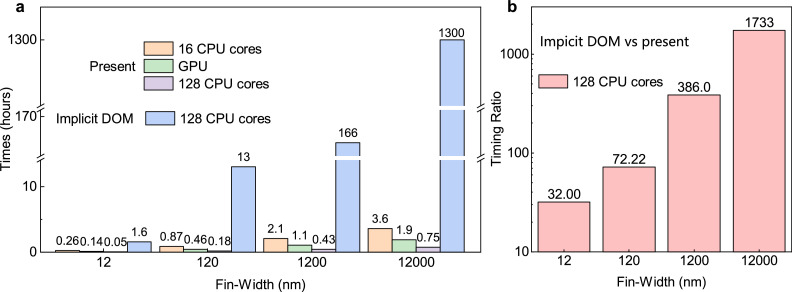
Understanding thermal transport at the submicron scale is crucial for engineering applications, especially in the thermal management of electronics and tailoring the thermal conductivity of thermoelectric materials. At the submicron scale, the macroscopic heat diffusion equation is no longer valid and the phonon Boltzmann transport equation (BTE) becomes the governing equation for thermal transport. However, previous thermal simulations based on the phonon BTE have two main limitations: relying on empirical parameters and prohibitive computational costs. Therefore, the phonon BTE is commonly used for qualitatively studying the non-Fourier thermal transport phenomena of toy problems. In this work, we demonstrate an ultra-efficient and parameter-free computational method of the phonon BTE to achieve quantitatively accurate thermal simulation for realistic materials and devices. By properly integrating the phonon properties from first-principles calculations, our method does not rely on empirical material properties input. It can be generally applicable for different materials and the predicted results can match well with experimental results. Moreover, by developing a suitable ensemble of advanced numerical algorithms, our method exhibits superior numerical efficiency. The full-scale (from ballistic to diffusive) thermal simulation of a 3-dimensional fin field-effect transistor with 13 million degrees of freedom, which is prohibitive for existing phonon BTE solvers even on supercomputers, can now be completed within two hours on a single personal computer. Our method makes it possible to achieve the predictive design of realistic nanostructures for the desired thermal conductivity. It also enables accurately resolving the temperature profiles at the transistor level, which helps in better understanding the self-heating effect of electronics.
理解亚微米尺度下的热输运对于工程应用至关重要,特别是在电子设备的热管理以及定制热电材料的热导率方面。在亚微米尺度下,宏观热扩散方程不再适用,声子玻尔兹曼输运方程(BTE)成为热输运的控制方程。然而,先前基于声子BTE的热模拟存在两个主要局限性:依赖经验参数且计算成本过高。因此,声子BTE通常用于定性研究简单问题的非傅里叶热输运现象。在这项工作中,我们展示了一种超高效且无参数的声子BTE计算方法,以实现对实际材料和器件的定量精确热模拟。通过适当地整合第一性原理计算得到的声子特性,我们的方法不依赖于经验材料特性输入。它可以普遍适用于不同材料,并且预测结果能够与实验结果很好地匹配。此外,通过开发一套合适的先进数值算法,我们的方法展现出卓越的数值效率。一个具有1300万个自由度的三维鳍式场效应晶体管的全尺度(从弹道到扩散)热模拟,即使在超级计算机上,现有声子BTE求解器也难以完成,而现在在一台个人计算机上两小时内即可完成。我们的方法使得实现具有所需热导率的实际纳米结构的预测设计成为可能。它还能够精确解析晶体管层面的温度分布,这有助于更好地理解电子设备的自热效应。