University of Muenster, Biomedical Technology Center, Muenster, Germany.
University of Valencia, Department of Optics, Optometry and Vision Science, Burjassot, Spain.
J Biomed Opt. 2024 Jun;29(Suppl 2):S22715. doi: 10.1117/1.JBO.29.S2.S22715. Epub 2024 Aug 19.
Digital holographic microscopy (DHM) is a label-free microscopy technique that provides time-resolved quantitative phase imaging (QPI) by measuring the optical path delay of light induced by transparent biological samples. DHM has been utilized for various biomedical applications, such as cancer research and sperm cell assessment, as well as for drug or toxicity testing. Its lensless version, digital lensless holographic microscopy (DLHM), is an emerging technology that offers size-reduced, lightweight, and cost-effective imaging systems. These features make DLHM applicable, for example, in limited resource laboratories, remote areas, and point-of-care applications.
In addition to the abovementioned advantages, in-line arrangements for DLHM also include the limitation of the twin-image presence, which can restrict accurate QPI. We therefore propose a compact lensless common-path interferometric off-axis approach that is capable of quantitative imaging of fast-moving biological specimens, such as living cells in flow.
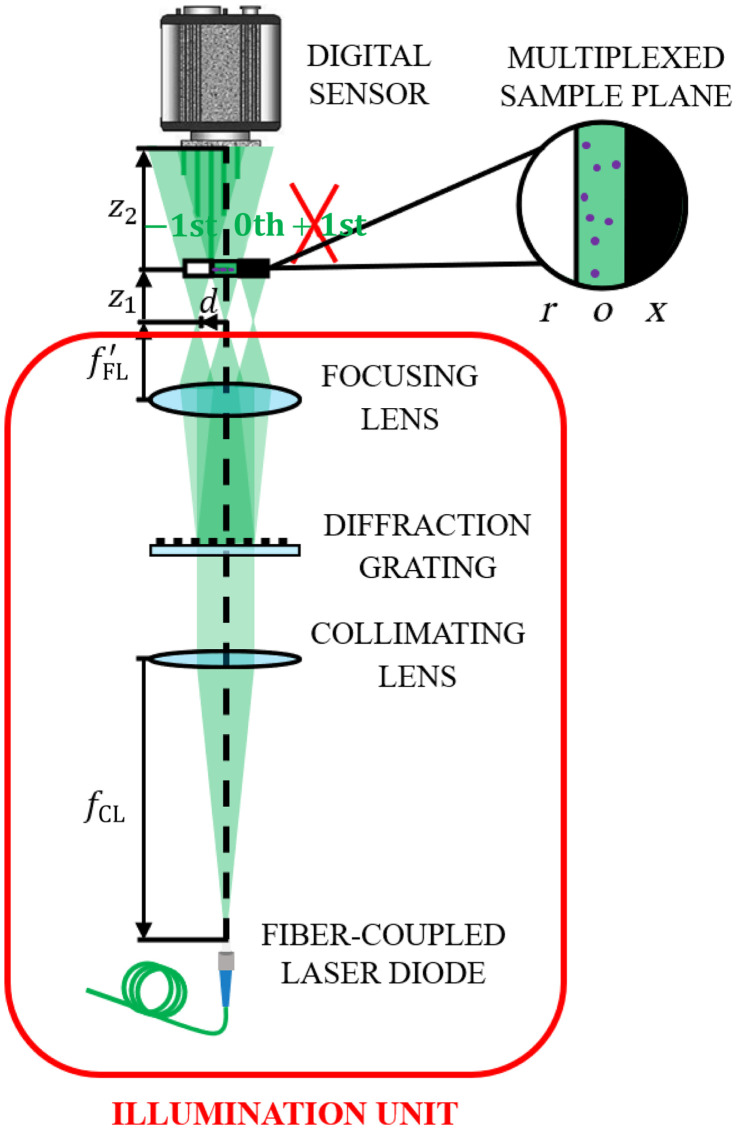
We suggest lensless spatially multiplexed interferometric microscopy (LESSMIM) as a lens-free variant of the previously reported spatially multiplexed interferometric microscopy (SMIM) concept. LESSMIM comprises a common-path interferometric architecture that is based on a single diffraction grating to achieve digital off-axis holography. From a series of single-shot off-axis holograms, twin-image free and time-resolved QPI is achieved by commonly used methods for Fourier filtering-based reconstruction, aberration compensation, and numerical propagation.
Initially, the LESSMIM concept is experimentally demonstrated by results from a resolution test chart and investigations on temporal stability. Then, the accuracy of QPI and capabilities for imaging of living adherent cell cultures is characterized. Finally, utilizing a microfluidic channel, the cytometry of suspended cells in flow is evaluated.
LESSMIM overcomes several limitations of in-line DLHM and provides fast time-resolved QPI in a compact optical arrangement. In summary, LESSMIM represents a promising technique with potential biomedical applications for fast imaging such as in imaging flow cytometry or sperm cell analysis.
数字全息显微镜 (DHM) 是一种无标记显微镜技术,通过测量透明生物样品引起的光的光程延迟来提供时间分辨定量相位成像 (QPI)。DHM 已用于各种生物医学应用,如癌症研究和精子细胞评估,以及药物或毒性测试。它的无透镜版本,数字无透镜全息显微镜 (DLHM),是一种新兴技术,提供了尺寸减小、重量轻和具有成本效益的成像系统。这些特点使得 DLHM 适用于例如资源有限的实验室、偏远地区和即时护理应用。
除了上述优点之外,DLHM 的在线配置还包括限制孪生像存在的限制,这可能会限制准确的 QPI。因此,我们提出了一种紧凑的无透镜共路离轴干涉方法,能够对快速移动的生物标本进行定量成像,例如流动中的活细胞。
我们建议使用无透镜空间复用干涉显微镜 (LESSMIM) 作为先前报道的空间复用干涉显微镜 (SMIM) 概念的无透镜变体。LESSMIM 包括基于单个衍射光栅的共路干涉架构,以实现数字离轴全息术。从一系列单次离轴全息图中,通过常用的基于傅里叶滤波的重建、像差补偿和数值传播方法,实现了无孪生像和时间分辨 QPI。
最初,通过分辨率测试图和时间稳定性研究的实验结果验证了 LESSMIM 概念。然后,表征了 QPI 的准确性和对贴壁细胞培养物成像的能力。最后,利用微流控通道评估了悬浮细胞在流动中的细胞计数。
LESSMIM 克服了在线 DLHM 的几个限制,并在紧凑的光学配置中提供了快速的时间分辨 QPI。总之,LESSMIM 是一种很有前途的技术,具有快速成像的潜在生物医学应用,例如在成像流动 cytometry 或精子细胞分析中。