Nagase Kenichi, Suzuki Sayaka, Kanazawa Hideko
Graduate School of Biomedical and Health Sciences, Hiroshima University, 1-2-3 Kasumi, Minami-ku, Hiroshima, 734-8553, Japan.
Faculty of Pharmacy, Keio University, 1-5-30 Shibakoen, Minato, Tokyo, 105-8512, Japan.
Heliyon. 2024 Jul 20;10(15):e34668. doi: 10.1016/j.heliyon.2024.e34668. eCollection 2024 Aug 15.
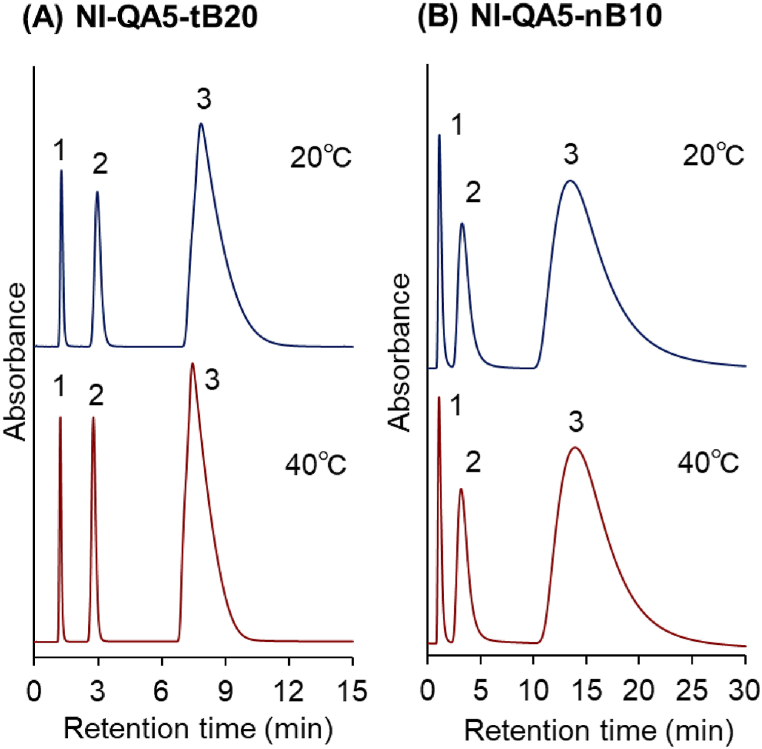
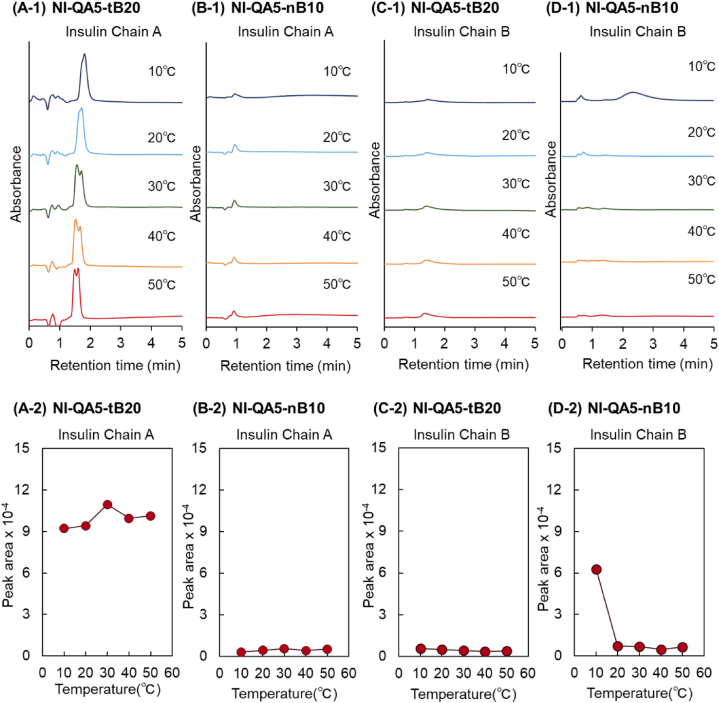
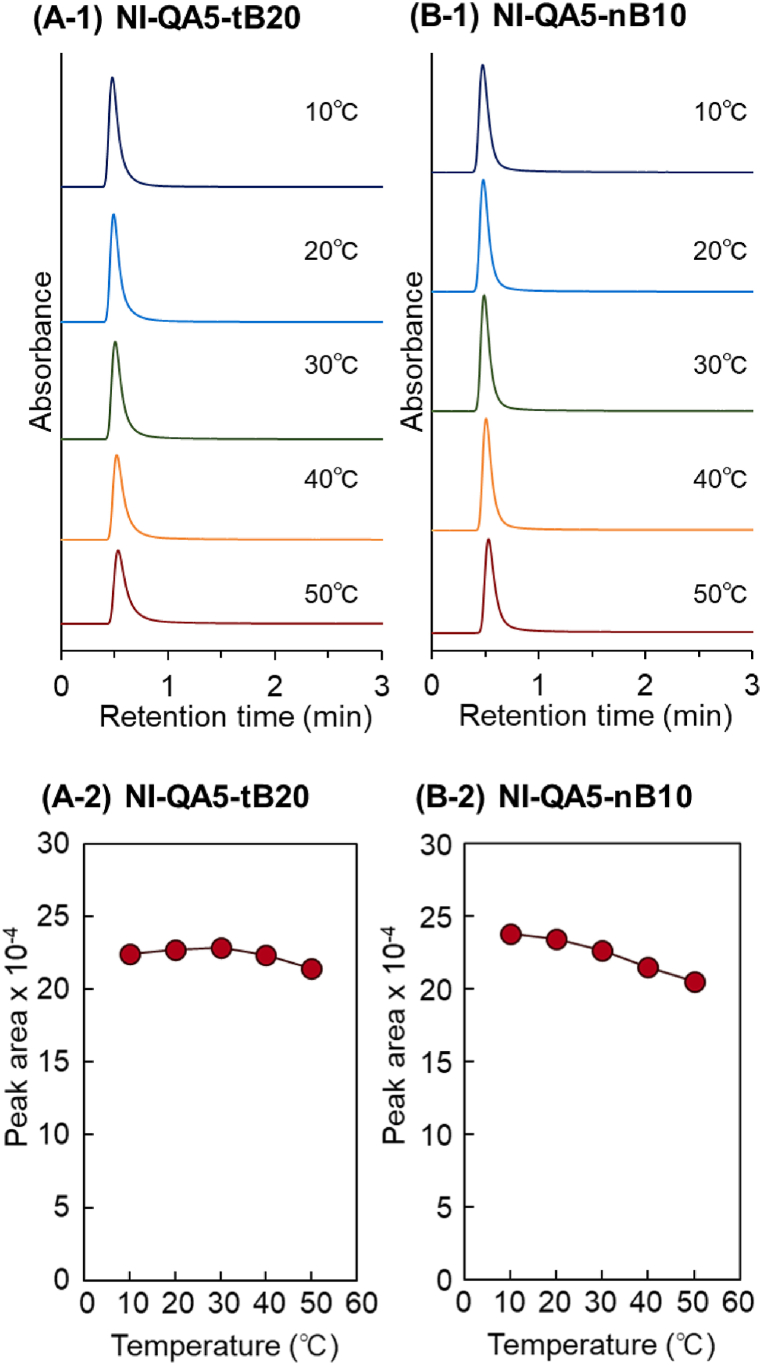
Thermoresponsive polymer brushes have attracted considerable research attention owing to their unique properties. Herein, we developed silica beads grafted with poly(-isopropylacrylamide (NIPAAm)--3-acrylamidopropyl trimethylammonium chloride (APTAC)---butyl acrylamide (tBAAm) and P(NIPAAm--APTAC---butyl methacrylate(nBMA)) brushes. The carbon, hydrogen, and nitrogen elemental analysis of the copolymer-grated silica beads revealed the presence of a large amount of the grafted copolymer on the silica beads. The electrostatic and hydrophobic interactions between biomolecules and prepared copolymer brushes were analyzed by observing their elution behaviors via high-performance liquid chromatography using the copolymer-brush-modified beads as the stationary phase. Adenosine nucleotides were retained in the bead-packed columns, which was attributed to the electrostatic interaction between the copolymers and adenosine nucleotides. Insulin was adsorbed on the copolymer brushes at high temperatures, which was attributed to its electrostatic and hydrophobic interactions with the copolymer. Similar adsorption behavior was observed in case of albumin. Further, at a low concentration of the phosphate buffer solution, albumin was adsorbed onto the copolymer brushes even at relatively low temperatures owing to its enhanced electrostatic interaction with the copolymer. These results indicated that the developed thermoresponsive strong cationic copolymer brushes can interact with peptides and proteins through a combination of electrostatic and temperature-modulated hydrophobic interactions. Thus, the developed copolymer brushes exhibits substantial potential for application in chromatographic matrices for the analysis and purification of peptides and proteins.
由于其独特的性质,热响应性聚合物刷已引起了相当多的研究关注。在此,我们制备了接枝有聚(N-异丙基丙烯酰胺(NIPAAm)-3-丙烯酰胺基丙基三甲基氯化铵(APTAC)-丁基丙烯酰胺(tBAAm))和聚(NIPAAm-APTAC-甲基丙烯酸丁酯(nBMA))刷的二氧化硅珠。对共聚物接枝的二氧化硅珠进行的碳、氢和氮元素分析表明,二氧化硅珠上存在大量接枝的共聚物。通过使用接枝有共聚物刷的珠子作为固定相,通过高效液相色谱观察生物分子与制备的共聚物刷之间的洗脱行为,分析了它们之间的静电和疏水相互作用。腺苷核苷酸保留在填充有珠子的柱中,这归因于共聚物与腺苷核苷酸之间的静电相互作用。胰岛素在高温下吸附在共聚物刷上,这归因于其与共聚物之间的静电和疏水相互作用。在白蛋白的情况下也观察到了类似的吸附行为。此外,在低浓度的磷酸盐缓冲溶液中,由于白蛋白与共聚物之间增强的静电相互作用,即使在相对较低的温度下,白蛋白也会吸附到共聚物刷上。这些结果表明,所开发的热响应性强阳离子共聚物刷可以通过静电和温度调节的疏水相互作用的组合与肽和蛋白质相互作用。因此,所开发的共聚物刷在用于肽和蛋白质分析与纯化的色谱基质中具有巨大的应用潜力。