Nelson Heather A, Banerjee Dipanwita, Novis Camille L, Deane Kevin D, Feser Marie L, Nandakumar Vijayalakshmi
ARUP Institute for Clinical and Experimental Pathology, Salt Lake City, UT, USA.
Department of Pathology, University of Utah School of Medicine, Salt Lake City, UT, USA.
Pract Lab Med. 2024 Jul 21;41:e00420. doi: 10.1016/j.plabm.2024.e00420. eCollection 2024 Aug.
Anti-citrullinated protein antibodies (ACPA) are a specific serological biomarker used in the diagnosis of rheumatoid arthritis (RA). In clinical practice ACPA can be identified using immunoassays targeting synthetic cyclic citrullinated peptides (CCP). The 3rd generation anti-CCP IgG antibody (CCP3) offers improved sensitivity compared to the earlier versions. Recently, CCP3.1, capable of detecting both IgG and IgA antibodies, was introduced to enhance sensitivity, especially in patients with early RA.
We assessed serum CCP3.1 against CCP3 in 331 subjects undergoing RA panel serology, comprising 136 patients with RA and 195 patients without RA. Sera were tested for anti-CCP IgG (CCP3) and anti-CCP IgG/IgA (CCP3.1) antibodies. Clinical performance of these tests was compared at manufacturer-suggested cutoffs. A separate set of 81 patients with a diagnosis of RA by 2010 criteria and whose samples were obtained from within 1-year of RA diagnosis was similarly assessed to evaluate assay performance in an independent clinical RA cohort.
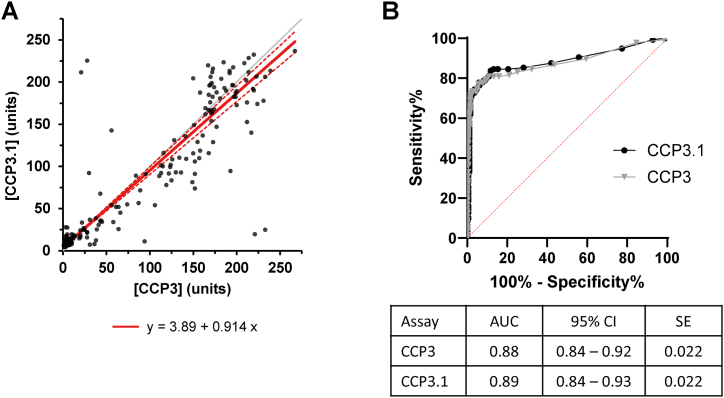
Overall diagnostic accuracy was similar; CCP3 had an area under the curve (AUC) of 0.88, CCP3.1 had an AUC of 0.89. Sensitivity, specificity, positive predictive value (PPV), and negative predictive value (NPV) for CCP3 were 79 %, 91 %, 86 %, and 86 %, respectively. For CCP3.1, sensitivity was 78 %, specificity 93 %, PPV 89 %, NPV 86 %. Both assays demonstrated excellent agreement; positive percent agreement of 94 % and negative percent agreement of 99 %.
Our findings indicate comparable diagnostic accuracy between CCP3 and CCP3.1 assays in these clinical cohorts.
抗瓜氨酸化蛋白抗体(ACPA)是用于类风湿关节炎(RA)诊断的一种特异性血清生物标志物。在临床实践中,可使用针对合成环瓜氨酸肽(CCP)的免疫测定法来鉴定ACPA。与早期版本相比,第三代抗CCP IgG抗体(CCP3)的敏感性有所提高。最近,能够检测IgG和IgA抗体的CCP3.1被引入以提高敏感性,尤其是在早期RA患者中。
我们在331名接受RA血清学检测的受试者中评估了血清CCP3.1与CCP3,其中包括136例RA患者和195例非RA患者。检测血清中的抗CCP IgG(CCP3)和抗CCP IgG/IgA(CCP3.1)抗体。在制造商建议的临界值下比较这些检测的临床性能。对另一组81例根据2010年标准诊断为RA且样本在RA诊断后1年内采集的患者进行了类似评估,以评估在独立临床RA队列中的检测性能。
总体诊断准确性相似;CCP3的曲线下面积(AUC)为0.88,CCP3.1的AUC为0.89。CCP3的敏感性、特异性、阳性预测值(PPV)和阴性预测值(NPV)分别为79%、91%、86%和86%。对于CCP3.1,敏感性为78%,特异性为93%,PPV为89%,NPV为86%。两种检测方法均显示出极好的一致性;阳性符合率为94%,阴性符合率为99%。
我们的研究结果表明,在这些临床队列中,CCP3和CCP3.1检测方法的诊断准确性相当。