From the Department of Orthopaedic Surgery, Oakland University William Beaumont School of Medicine, Auburn Hills, MI (Dr. Easthardt, Dr. Zakko, Dr. Jawad, and Dr. Park); the Department of Orthopaedic Surgery, Beaumont Health System - Royal Oak, MI (Dr. Easthardt, Dr. Zakko, Dr. Jawad, and Dr. Park); and the Michigan Orthopaedic Surgeons, Southfield, MI (Mr. Lee and Dr. Park).
J Am Acad Orthop Surg Glob Res Rev. 2024 Aug 19;8(8). doi: 10.5435/JAAOSGlobal-D-23-00161. eCollection 2024 Aug 1.
Biportal endoscopic spine surgery (BESS) has gained traction for lumbar laminectomy and diskectomy. To justify the transition to BESS, outcomes and the surgical learning curve should be known. This study evaluates rates of complications with BESS and how these rates change with increased surgeon experience.
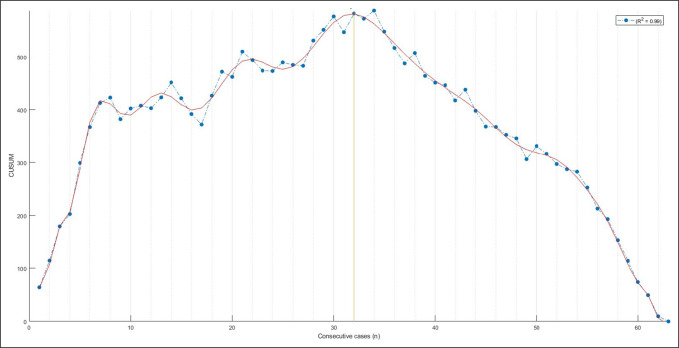
A single surgeon's consecutive patients who underwent BESS were evaluated. Patients older than 18 years who underwent BESS for lumbar laminectomy and diskectomy were included. Patients with previous spine surgery, multiple levels, or BESS for fusion were excluded. Demographics, length of surgery, intraoperative complications, postoperative complications, and revision surgery were recorded. The learning phase group and mastery phase group were based on a cumulative summation analysis based on surgical time.
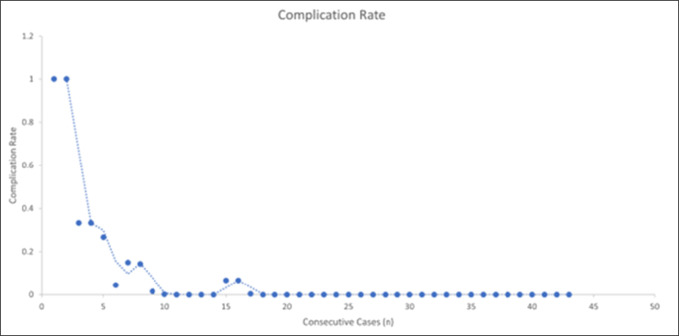
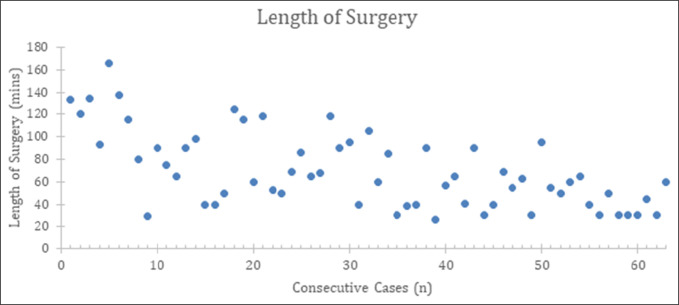
A total of 63 patients, with 31 and 32 patients in the learning and mastery group, respectively, were included. Surgical time decreased from 87 to 52 minutes in the mastery phase. Conversion to open decreased from 3 to 0 cases (P = 0.1803), intraoperative complications decreased from 3 to 0 (P = 0.1803), postoperative complications decreased from 7 to 2 (P = 0.017), and rates of revision surgery decreased from 4 to 1 (P = 0.4233).
This study suggests a learning curve of 31 cases for adequate performance of BESS for lumbar laminectomy and diskectomy.
双端口内窥镜脊柱手术(BESS)已在腰椎板切除术和椎间盘切除术方面得到广泛应用。为了证明向 BESS 过渡的合理性,应该了解其结果和手术学习曲线。本研究评估了 BESS 的并发症发生率,以及随着外科医生经验的增加,这些发生率如何变化。
评估了一位外科医生连续的 BESS 患者。纳入年龄大于 18 岁、接受 BESS 治疗腰椎板切除术和椎间盘切除术的患者。排除有既往脊柱手术史、多个节段或 BESS 融合术的患者。记录患者的人口统计学资料、手术时间、术中并发症、术后并发症和翻修手术情况。学习阶段组和掌握阶段组是基于基于手术时间的累积和分析来确定的。
共纳入 63 例患者,其中学习组和掌握组分别为 31 例和 32 例。掌握阶段的手术时间从 87 分钟减少到 52 分钟。从 3 例转为开放手术的病例数减少到 0 例(P = 0.1803),术中并发症从 3 例减少到 0 例(P = 0.1803),术后并发症从 7 例减少到 2 例(P = 0.017),翻修手术率从 4 例减少到 1 例(P = 0.4233)。
本研究表明,对于腰椎板切除术和椎间盘切除术,BESS 的学习曲线为 31 例。