THINKMD, 50 Lakeside Ave, Burlington, VT, 05401, USA.
eHealth Africa (eHA), 4-6 Independence Road, Kano, Nigeria.
BMC Health Serv Res. 2024 Aug 20;24(1):953. doi: 10.1186/s12913-024-11245-z.
The World Health Organization (WHO) Integrated Management of Childhood Illness (IMCI) guidelines established in 1992 to decrease preventable under-five child morbidity and mortality, was adopted by Nigeria in 1997. Over 20 years later, while under-five child mortality remains high, less than 25% of first level facilities have trained 60% of community health workers (CHW) who care for sick children with IMCI. This study investigated the impact in CHWs overall adherence to IMCI guidelines, particularly for critical danger signs, as well as usability and feasible following the implementation of THINKMD's IMCI-based digital clinical decision support (CDS) platform.
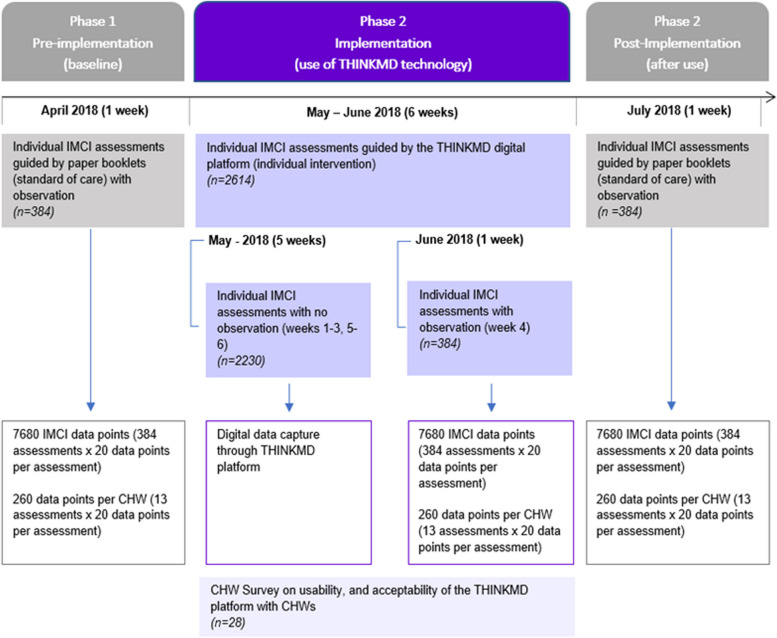
Adherence to IMCI guidelines was assessed by observational and digital data acquisition of key IMCI clinical data points by 28 CHWs, prior, during, and post CDS platform implementation. Change in IMCI adherence was determined for individual CHW and for the cohort by analyzing the number of IMCI data points acquired by each CHW per clinical evaluation. Consistency of adherence was also calculated by averaging the percentage of total evaluations each data point was observed. Usability and acceptability surveys were administered following use of the CDS platform.
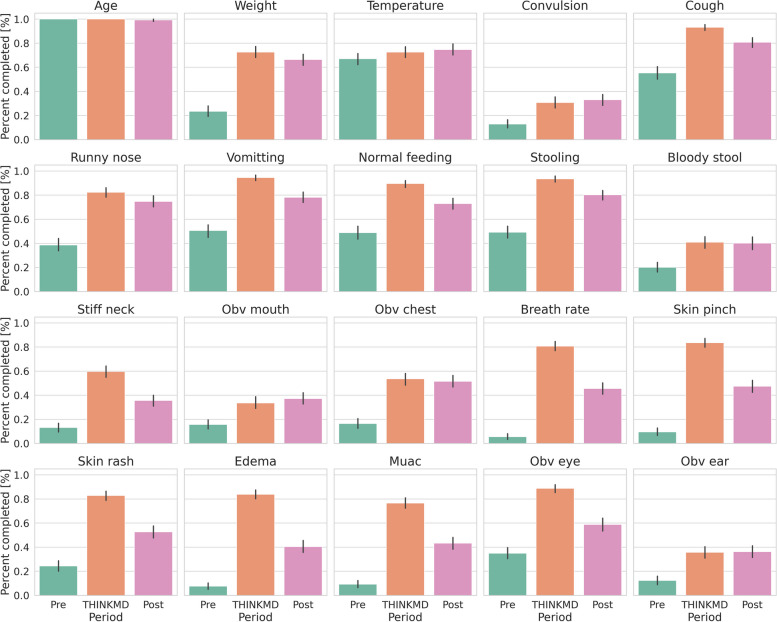
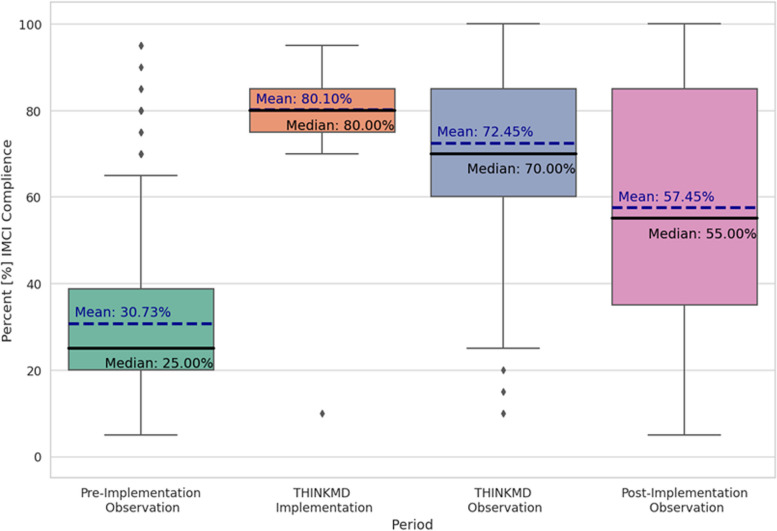
THINKMD CDS platform implementation notably enhanced the CHWs' ability to capture key IMCI clinical data elements. We observed a significant increase in the mean percentage of data points captured between the baseline period and during the CDS technology implementation (T-test, t = -31.399, p < 0.016, Holm-Bonferroni correction, two-sided), with the mean values going from 30.7% to 72.4%. Notably, even after the completion of the technology implementation phase, the mean percentage of IMCI elements captured by CHWs remained significantly elevated compared to the baseline, with a 26.72 percentage point increase (from 30.7% to 57.4%, T-test, t = -15.779, p < 0.05, Holm-Bonferroni correction, two-sided). Usability and feasibility of the platform was high. CHWs reported that the CDS platform was easy to learn and use (93%) and enabled them to identify sick children (100%).
These results demonstrate that utilization of a digital clinical decision support tool such as THINKMD's IMCI based CDS platform can significantly increase CHW adherence to IMCI guidelines over paper-based utilization, increase clinical quality and capacity, and improve identification of key danger signs for under-five children while being highly accepted and adopted.
世界卫生组织(WHO)于 1992 年制定了《儿童疾病综合管理(IMCI)》指南,旨在降低 5 岁以下儿童的可预防发病率和死亡率,该指南于 1997 年被尼日利亚采纳。20 多年后,尽管 5 岁以下儿童死亡率仍然很高,但不到 25%的一级医疗机构培训了照顾患有 IMCI 疾病的儿童的 60%社区卫生工作者(CHW)。本研究调查了 THINKMD 的基于 IMCI 的数字临床决策支持(CDS)平台实施后,CHW 对 IMCI 指南的总体依从性,特别是对关键危险信号的依从性,以及该平台的可用性和可行性。
通过 28 名 CHW 在 CDS 平台实施之前、期间和之后,对关键 IMCI 临床数据点进行观察和数字数据采集,评估 IMCI 指南的依从性。通过分析每位 CHW 每次临床评估中获得的 IMCI 数据点数量,确定单个 CHW 和整个队列的 IMCI 依从性变化。还通过平均每个数据点观察到的总评估百分比来计算依从性的一致性。在使用 CDS 平台后,进行了可用性和可接受性调查。
THINKMD CDS 平台的实施显著增强了 CHW 捕捉关键 IMCI 临床数据元素的能力。我们观察到,在基线期和 CDS 技术实施期间,数据点捕获的平均百分比有显著增加(T 检验,t=-31.399,p<0.016, Holm-Bonferroni 校正,双侧),平均值从 30.7%上升到 72.4%。值得注意的是,即使在技术实施阶段完成后,CHW 捕获的 IMCI 元素的平均百分比与基线相比仍显著升高,增加了 26.72 个百分点(从 30.7%到 57.4%,T 检验,t=-15.779,p<0.05, Holm-Bonferroni 校正,双侧)。该平台的可用性和可行性很高。CHW 报告称,该 CDS 平台易于学习和使用(93%),并使他们能够识别出患有疾病的儿童(100%)。
这些结果表明,利用数字临床决策支持工具,如 THINKMD 的基于 IMCI 的 CDS 平台,可以显著提高 CHW 对 IMCI 指南的依从性,而不是基于纸质的利用,从而提高临床质量和能力,并改善对 5 岁以下儿童关键危险信号的识别,同时得到高度接受和采用。