Nutrition and Lifestyle Program, George Institute for Global Health, Beijing, China.
The George Institute for Global Health, Faculty of Medicine, University of New South Wales, Sydney, Australia.
BMC Public Health. 2024 Aug 20;24(1):2261. doi: 10.1186/s12889-024-19732-y.
An mHealth-based school health education platform (EduSaltS) was promoted in real-world China to reduce salt intake among children and their families. This progress evaluation explores its implementation process and influencing factors using mixed methods.
The mixed-methods process evaluation employed the RE-AIM framework. Quantitative data were collected from a management website monitoring 54,435 third-grade students across two cities. Questionnaire surveys (n = 27,542) assessed pre- and post-education effectiveness. Mixed-effects models were used to control cluster effects. Qualitative interviews (23 individuals and 8 focus groups) identified program performance, facilitators, and barriers. Findings were triangulated using the RE-AIM framework.
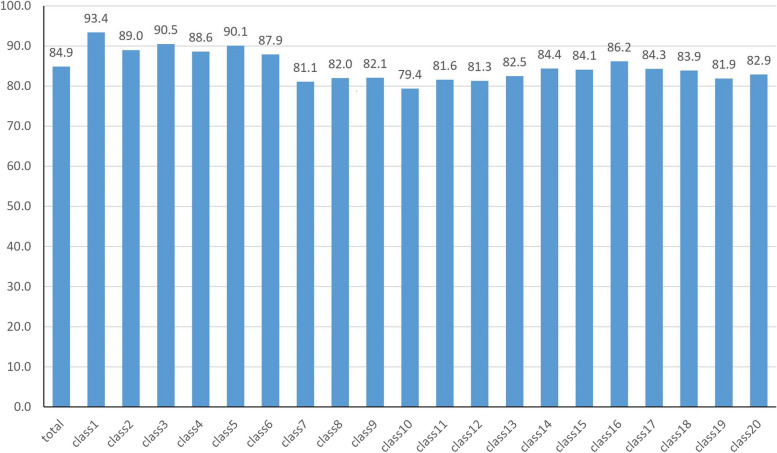
The program achieved 100% participation among all the third-grade classes of the 208 invited primary schools, with a 97.7% registration rate among all the 54,435 families, indicating high "Reach." Qualitative interviews revealed positive engagement from children and parents through the "small hands leading big hands" strategy. The high completion rate of 84.9% for each health cloud lesson and the significant improvement in salt reduction knowledge and behaviors scores from 75.0 (95%CI: 74.7-75.3) to 80.9 (95%CI: 80.6-81.2) out of 100 demonstrated the "Effect" of EduSaltS. The program's "Adoption" and "Implementation" were supported by attractive materials, reduced workload via auto-delivered lessons/activities and performance evaluation, and high fidelity to recommended activities, with medians 3.0 (IQR: 2.0-8.0)/class and 9.0 (IQR: 5.0-14.0)/school. Stable course completion rates (79.4%-93.4%) over one year indicated promising "Maintenance." Apart from the facilitating features praised by the interviewees, government support was the basis for the scaling up of EduSaltS. Barriers included the lack of smartphone skills among some parents and competing priorities for schools. Unhealthy off-campus environments, such as excessive use of salt in pre-packaged and restaurant foods, also hindered salt reduction efforts. The program's scalability was evident through its integration into existing health education, engagement of local governments and adaptation across various mobile devices.
The mHealth-based school health education program is scalable and effective for public salt reduction in China. Identified barriers and facilitators can inform future health program scale-ups. The program's successful implementation demonstrates its potential for broader application in public health initiatives aimed at reducing dietary salt intake.
在中国,一个基于移动医疗的学校健康教育平台(EduSaltS)被推广,以减少儿童及其家庭的盐摄入量。本进展评估采用混合方法探索其实施过程和影响因素。
混合方法过程评估采用了 RE-AIM 框架。从监测两个城市的 54435 名三年级学生的管理网站收集定量数据。问卷调查(n=27542)评估了教育前后的效果。使用混合效应模型控制聚类效应。定性访谈(23 人,8 个焦点小组)确定了计划的绩效、促进因素和障碍。使用 RE-AIM 框架对调查结果进行三角验证。
该计划实现了 208 所受邀小学所有三年级班级的 100%参与率,54435 个家庭的注册率达到了 97.7%,表明“可及性”很高。定性访谈显示,通过“小手牵大手”的策略,儿童和家长的参与度很高。每一节健康云课程的完成率高达 84.9%,盐摄入量知识和行为评分从 75.0(95%置信区间:74.7-75.3)显著提高到 80.9(95%置信区间:80.6-81.2),表明 EduSaltS 的“效果”显著。该计划的“采用”和“实施”得到了有吸引力的材料、自动提供课程/活动和绩效评估以减轻工作量以及对推荐活动的高度保真度的支持,每个班级的中位数为 3.0(IQR:2.0-8.0),每所学校的中位数为 9.0(IQR:5.0-14.0)。一年中稳定的课程完成率(79.4%-93.4%)表明有希望“维持”。除了受访者称赞的促进因素外,政府支持是 EduSaltS 扩大规模的基础。障碍包括一些家长缺乏智能手机技能和学校的优先事项竞争。校外不健康的环境,如预包装食品和餐馆食品中过量使用盐,也阻碍了减盐工作。该计划的可扩展性通过其融入现有的健康教育、地方政府的参与以及在各种移动设备上的适应性得到了证明。
基于移动医疗的学校健康教育计划在中国具有可扩展性和减少公共盐分的有效性。确定的障碍和促进因素可以为未来的卫生项目扩大规模提供信息。该计划的成功实施表明,它有可能在旨在减少饮食盐摄入量的公共卫生倡议中得到更广泛的应用。