Sun Yuewen, Luo Rong, Li Yuan, He Feng J, Tan Monique, MacGregor Graham A, Liu Hueiming, Zhang Puhong
The George Institute for Global Health, Peking University Health Science Center, Beijing, China.
Faculty of Medicine, University of New South Wales, Sydney, Australia.
JMIR Res Protoc. 2021 Feb 10;10(2):e19430. doi: 10.2196/19430.
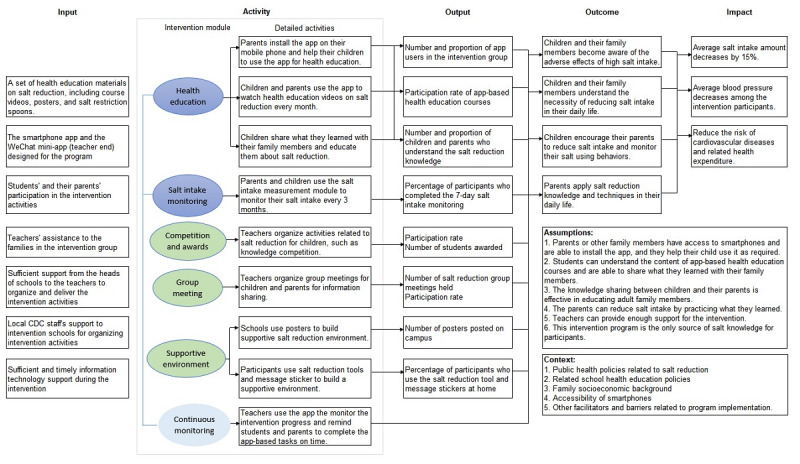
The app-based salt reduction intervention program in school children and their families (AppSalt) is a multicomponent mobile health (mHealth) intervention program, which involves multiple stakeholders, including students, parents, teachers, school heads, and local health and education authorities. The complexity of the AppSalt program highlights the need for process evaluation to investigate how the implementation will be achieved at different sites.
This paper presents a process evaluation protocol of the AppSalt program, which aims to monitor the implementation of the program, explain its causal mechanisms, and provide evidence for scaling up the program nationwide.
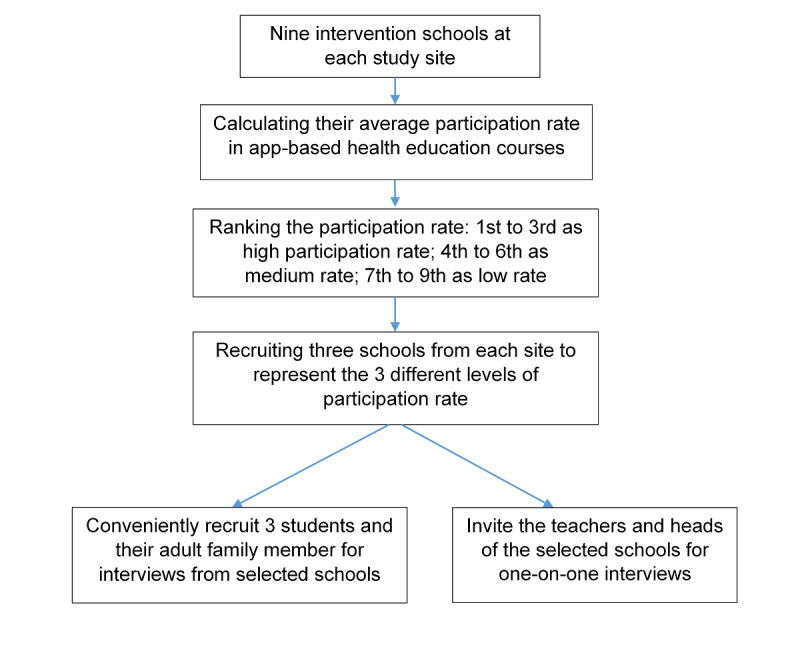
A mixed methods approach will be used to collect data relating to five process evaluation dimensions: fidelity, dose delivered, dose received, reach, and context. Quantitative data, including app use logs, activity logs, and routine monitoring data, will be collected alongside the intervention process to evaluate the quantity and quality of intervention activities. The quantitative data will be summarized as medians, means, and proportions as appropriate. Qualitative data will be collected through semistructured interviews of purposely selected intervention participants and key stakeholders from local health and education authorities. The thematic analysis technique will be used for analyzing the qualitative data with the support of NVivo 12. The qualitative data will be triangulated with the quantitative data during the interpretation phase to explain the 5 process evaluation dimensions.
The intervention activities of the AppSalt program were initiated at 27 primary schools in three cities since October 2018. We have completed the 1-year intervention of this program. The quantitative data for this study, including app use log, activity logs, and the routine monitoring data, were collected and organized during the intervention process. After completing the intervention, we conducted semistructured interviews with 32 students, 32 parents, 9 teachers, 9 school heads, and 8 stakeholders from local health and education departments. Data analysis is currently underway.
Using mHealth technology for salt reduction among primary school students is an innovation in China. The findings of this study will help researchers understand the implementation of the AppSalt program and similar mHealth interventions in real-world settings. Furthermore, this process evaluation will be informative for other researchers and policy makers interested in replicating the AppSalt program and designing their salt reduction intervention.
INTERNATIONAL REGISTERED REPORT IDENTIFIER (IRRID): DERR1-10.2196/19430.
针对学童及其家庭的基于应用程序的减盐干预项目(AppSalt)是一项多组件移动健康(mHealth)干预项目,涉及多个利益相关者,包括学生、家长、教师、学校领导以及当地卫生和教育部门。AppSalt项目的复杂性凸显了进行过程评估的必要性,以调查该项目在不同地点将如何实施。
本文介绍了AppSalt项目的过程评估方案,旨在监测该项目的实施情况,解释其因果机制,并为在全国范围内扩大该项目提供证据。
将采用混合方法收集与五个过程评估维度相关的数据:保真度、提供的剂量、接受的剂量、覆盖范围和背景。在干预过程中,将收集定量数据,包括应用程序使用日志、活动日志和常规监测数据,以评估干预活动的数量和质量。定量数据将酌情汇总为中位数、均值和比例。定性数据将通过对特意挑选的干预参与者以及当地卫生和教育部门的关键利益相关者进行半结构化访谈来收集。将使用主题分析技术在NVivo 12的支持下分析定性数据。在解释阶段,定性数据将与定量数据进行三角互证,以解释五个过程评估维度。
自2018年10月以来,AppSalt项目的干预活动已在三个城市的27所小学启动。我们已完成该项目为期1年的干预。在干预过程中收集并整理了本研究的定量数据,包括应用程序使用日志、活动日志和常规监测数据。干预结束后,我们对32名学生、32名家长、9名教师、9名校领导以及8名来自当地卫生和教育部门的利益相关者进行了半结构化访谈。目前正在进行数据分析。
在中国,使用移动健康技术减少小学生的盐摄入量是一项创新举措。本研究结果将有助于研究人员了解AppSalt项目以及类似移动健康干预措施在现实环境中的实施情况。此外,这一过程评估将为其他有兴趣复制AppSalt项目并设计其减盐干预措施的研究人员和政策制定者提供信息。
国际注册报告识别号(IRRID):DERR1-10.2196/19430。