Sumiya Alberto, Tenani Carla Fabiana, de Almeida Carlos Podalirio Borges, Macêdo Juliberta Alves, Pavesi Eloisa, Reis Rafael de Menezes, Spengler Julia, Locks Junior Fabiano Silva, Trelha Celita Salmaso
Departamento de Ciências Morfológicas (MOR), Universidade Federal de Santa Catarina (UFSC), Curitibanos, SC, Brazil.
Faculdade de Odontologia, Universidade Estadual de Campinas, Campinas, SP, Brazil.
Rev Bras Med Trab. 2024 Aug 5;22(1):e2022968. doi: 10.47626/1679-4435-2022-968. eCollection 2024 Jan-Mar.
The COVID-19 pandemic brought about an important discussion about the health of primary health care workers who are subject to physical and psychological distress, which may initially be expressed by fatigue and change in quality of life.
To verify the correlation between fatigue and quality of life of primary health care workers during the COVID-19 pandemic in Brazil inland.
Cross-sectional, quantitative study, with the application of three questionnaires: social and demographic; Fatigue Perception Questionnaire; World Health Organization Quality of Life instrument-Abbreviated version. Statistical analysis comparing two or more groups and correlation adopting a significance level of p < 0.05.
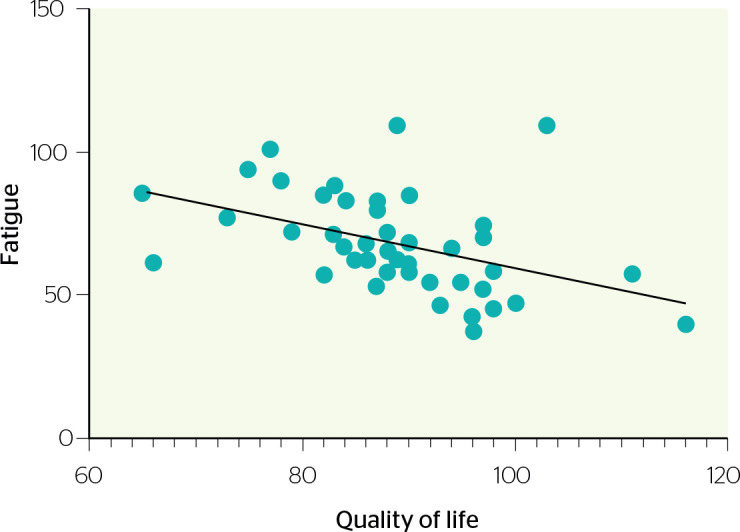
It included 50 professionals with a mean age of 40.7 ± 9.6 years. High fatigue was evidenced (68.2 ± 17.2 points), and married individuals had a higher level of fatigue than single individuals (p = 0.003). There was also a high general average score in quality of life (85.27 ± 9.6 points), especially in workers with higher education (p = 0.03), as well as in non-smoking professionals (p = 0.02), with higher household income (p = 0.04) and in singles (p = 0.01). Therefore, the correlation was inverse and moderate between fatigue and quality of life (R = -0.44).
We found a high level of fatigue and quality of life and an inverse correlation. The results show convergences and divergences with the scientific literature, indicating the need for more studies with primary health care workers.
新冠疫情引发了一场关于基层医疗工作者健康状况的重要讨论,这些工作者面临身体和心理压力,最初可能表现为疲劳和生活质量的变化。
验证巴西内陆地区新冠疫情期间基层医疗工作者疲劳与生活质量之间的相关性。
采用横断面定量研究,应用三份问卷:社会人口学问卷;疲劳感知问卷;世界卫生组织生活质量量表简版。采用p < 0.05的显著性水平进行两组或多组比较的统计分析及相关性分析。
研究纳入50名专业人员,平均年龄为40.7 ± 9.6岁。结果显示疲劳程度较高(68.2 ± 17.2分),已婚个体的疲劳水平高于单身个体(p = 0.003)。生活质量的总体平均得分也较高(85.27 ± 9.6分),尤其是受过高等教育的工作者(p = 0.03)、不吸烟的专业人员(p = 0.02)、家庭收入较高的人员(p = 0.04)以及单身人士(p = 0.01)。因此,疲劳与生活质量之间呈负向且中等程度的相关性(R = -0.44)。
我们发现疲劳水平和生活质量较高,且二者呈负相关。研究结果与科学文献既有趋同之处,也有差异,表明需要对基层医疗工作者开展更多研究。