Fadrus Pavel, Vybihal Vaclav, Roskova Ivana, Selingerova Iveta, Smrcka Martin, Jancalek Radim, Sana Jiri, Slaby Ondrej, Pospisil Petr, Hynkova Ludmila, Garcic Jan, Belanova Renata, Kristek Jan, Sprlakova-Pukova Andrea, Mackerle Zdenek, Juran Vilem, Sova Marek, Neuman Eduard, Valekova Hana, Lakomy Radek, Holanek Milos, Hrstka Roman, Svajdova Michaela, Polachova Katerina, Kolouskova Ivana, Slampa Pavel, Kazda Tomas
Department of Neurosurgery, University Hospital Brno, Czech Republic.
Department of Neurosurgery, Faculty of Medicine, Masaryk University, Brno, Czech Republic.
Rep Pract Oncol Radiother. 2024 Mar 18;29(1):30-41. doi: 10.5603/rpor.99362. eCollection 2024.
The aim of this retrospective study is to analyze a consecutive cohort of brain metastasis (BM) patients treated off clinical trials through combination of surgery and radiotherapy over the last 15 years in a tertiary neurooncology center.
All BM patients operated between 2007-2019 received adjuvant linac-based radiotherapy categorized to whole brain radiotherapy (WBRT) and tumor bed stereotactic radiotherapy. Survival outcomes and local control was analyzed.
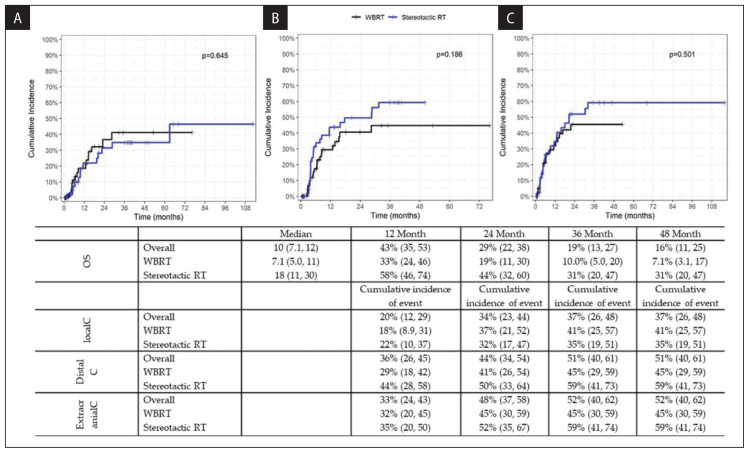
In total, 118 patients were enrolled, those with stereotactic radiotherapy (41%) had better baseline characteristics mirrored in longer overall survival (OS) [18 . 7.1 months, p < 0.001; hazard ratio (HR) 0.47, p = 0.004] with median follow-up of 58 months. Cumulative incidence for local, distant, and extracranial control was not significantly different between groups, with 12-month cumulative control of 22% . 18%, 44% . 29%, and 35% . 32% for stereotactic and WBRT group, respectively. WBRT was an independent factor for better distal brain control.
Real world data demonstrating significantly better overall survival in patients treated with postoperative targeted radiotherapy compared with postoperative WBRT is presented, with no significant difference in cumulative incidence for local or distant brain control. The majority of patients with targeted radiotherapy had a fractionated dose schedule with outcomes comparable to single-dose radiation trials of postoperative targeted radiotherapy.
本回顾性研究的目的是分析在一家三级神经肿瘤中心过去15年中通过手术和放疗联合治疗的一组连续性脑转移(BM)患者,这些患者未参加临床试验。
对2007年至2019年间接受手术的所有BM患者进行辅助直线加速器放疗,分为全脑放疗(WBRT)和瘤床立体定向放疗。分析生存结果和局部控制情况。
共纳入118例患者,接受立体定向放疗的患者(41%)具有更好的基线特征,总体生存期(OS)更长[18.7.1个月,p<0.001;风险比(HR)0.47,p=0.004],中位随访时间为58个月。两组之间局部、远处和颅外控制的累积发生率无显著差异,立体定向放疗组和WBRT组的12个月累积控制率分别为22%.18%、44%.29%和35%.32%。WBRT是更好的远端脑控制的独立因素。
本文展示了真实世界的数据,表明与术后WBRT相比,术后靶向放疗患者的总体生存期显著更好,局部或远处脑控制的累积发生率无显著差异。大多数接受靶向放疗的患者采用分次剂量方案,其结果与术后靶向放疗的单剂量放疗试验相当。