Li Gen, Wu Nienju, Zhang Jiong, Song Yanyan, Ye Tingjun, Zhang Yin, Zhao Dahang, Yu Pei, Wang Lei, Zhuang Chengyu
Department of Orthopedics, Ruijin Hospital, Shanghai JiaoTong University School of Medicine, 197 Ruijin 2nd Road, Shanghai, 200025, PR China.
Department of Biostatistics, Clinical research institute, Shanghai JiaoTong University School of medicine, Shanghai, PR China.
Heliyon. 2024 Jul 31;10(15):e35451. doi: 10.1016/j.heliyon.2024.e35451. eCollection 2024 Aug 15.
Patients with fractures of the proximal humerus often local complications and failures attributed to osteoporosis. Currently, there is a lack of straight forward screening methods for assessing the extent of local osteoporosis in the proximal humerus. This study utilizes machine learning techniques to establish a diagnostic approach for evaluating local osteoporosis by analyzing the patient's demographic data, bone density, and X-ray ratio of the proximal humerus.
A cohort comprising a total of 102 hospitalized patients admitted during the period spanning from 2021 to 2023 underwent random selection procedures. Resulting in exclusion of 5 patients while enrolling 97 patients for analysis encompassing patient demographics, shoulder joint anteroposterior radiographs, and bone density information. Using the modified Tingart index methodology involving multiple measurements denoted as M1 through M4 obtained from humeral shafts. Within this cohort comprised 76 females (78.4 %) and 21 males (21.6 %), with an average age of 73.0 years (range: 43-98 years). There were 25 cases with normal bone density, 35 with osteopenia, and 37 with osteoporosis. Machine learning techniques were used to randomly divide the 97 cases into training (n = 59) and validation (n = 38) sets with a ratio of 6:4 using stratified random sampling. A decision tree model was built in the training set, and significant diagnostic indicators were selected, with the performance of the decision tree evaluated using the validation set. Multinomial logistic regression methods were used to verify the strength of the relationship between the selected indicators and osteoporosis.
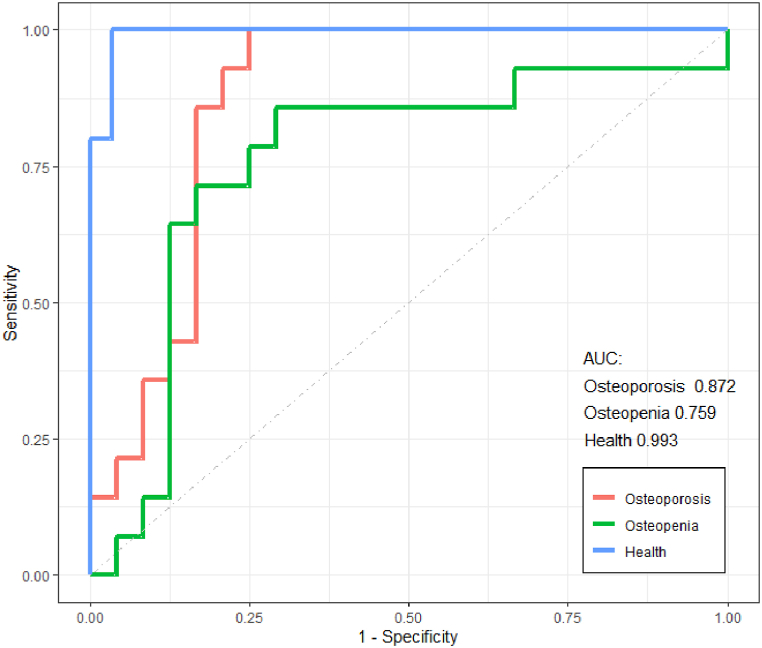
The decision tree identified significant diagnostic indicators as the humeral shaft medullary cavity ratio M2/M4, age, and gender. M2/M4 ≥ 1.13 can be used as an important screening criterion; M2/M4 < 1.13 was predicted as local osteoporosis; M2/M4 ≥ 1.13 and age ≥83 years were also predicted as osteoporosis. M2/M4 ≥ 1.13 and age <64 years or males aged between 64 and 83 years were predicted as the normal population; M2/M4 ≥ 1.13 and females aged between 64 and 83 years were predicted as having osteopenia. The decision tree's accuracy in the training set was 0.7627 (95 % CI (0.6341, 0.8638)), and its accuracy in the test set was 0.7895 (95 % CI (0.6268, 0.9045)). Multinomial logistic regression results showed that humeral shaft medullary cavity ratios M2/M4, age, and gender in X-ray images were significantly associated with the occurrence of osteoporosis.
Utilizing X-ray data of the proximal humerus in conjunction with demographic information such as gender and age enable the prediction of localized osteoporosis, facilitating physicians' rapid comprehension of osteoporosis in patients and optimization of clinical treatment plans.
Level IV retrospective case study.
肱骨近端骨折患者常出现局部并发症及因骨质疏松导致的治疗失败。目前,缺乏直接的筛查方法来评估肱骨近端局部骨质疏松的程度。本研究利用机器学习技术,通过分析患者的人口统计学数据、骨密度和肱骨近端X线比值,建立一种评估局部骨质疏松的诊断方法。
对2021年至2023年期间共102例住院患者进行随机选择。排除5例患者,纳入97例患者进行分析,内容包括患者人口统计学资料、肩关节前后位X线片及骨密度信息。采用改良的廷加特指数方法,对肱骨干进行多次测量,记为M1至M4。该队列包括76名女性(78.4%)和21名男性(21.6%),平均年龄73.0岁(范围:43 - 98岁)。骨密度正常25例,骨量减少35例,骨质疏松37例。利用机器学习技术,采用分层随机抽样,将97例病例按6:4的比例随机分为训练集(n = 59)和验证集(n = 38)。在训练集中构建决策树模型,选择显著的诊断指标,并使用验证集评估决策树的性能。采用多项逻辑回归方法验证所选指标与骨质疏松之间关系的强度。
决策树确定的显著诊断指标为肱骨干髓腔比值M2/M4、年龄和性别。M2/M4≥1.13可作为重要的筛查标准;M2/M4 < 1.13预测为局部骨质疏松;M2/M4≥1.13且年龄≥83岁也预测为骨质疏松。M2/M4≥1.13且年龄<64岁或64至83岁的男性预测为正常人群;M2/M4≥1.13且64至83岁的女性预测为骨量减少。决策树在训练集中的准确率为0.7627(95%CI(0.6341, 0.8638)),在测试集中的准确率为0.7895(95%CI(0.6268, 0.9045))。多项逻辑回归结果显示,X线图像中的肱骨干髓腔比值M2/M4、年龄和性别与骨质疏松的发生显著相关。
利用肱骨近端X线数据结合性别和年龄等人口统计学信息能够预测局部骨质疏松,有助于医生快速了解患者的骨质疏松情况并优化临床治疗方案。
IV级回顾性病例研究。