Laboratory of Technological Innovation in Health (LAIS), Natal, RN, Brazil.
Advanced Nucleus of Technological Innovation (NAVI), Federal Institute of Rio Grande do Norte (IFRN), Natal, RN, Brazil.
Sci Rep. 2023 Aug 8;13(1):12865. doi: 10.1038/s41598-023-40104-w.
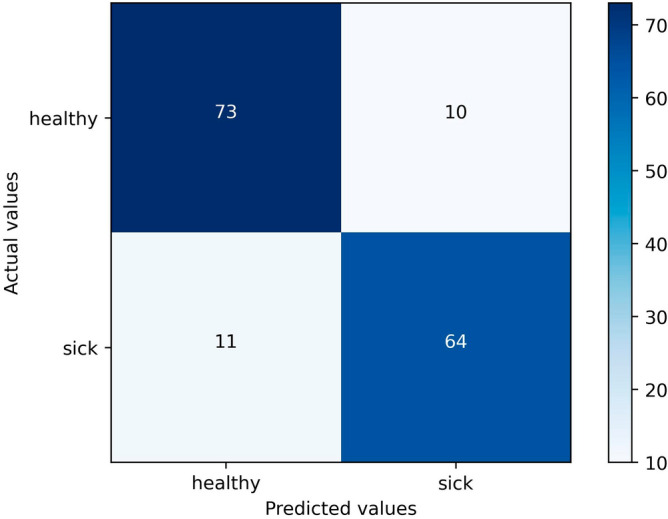
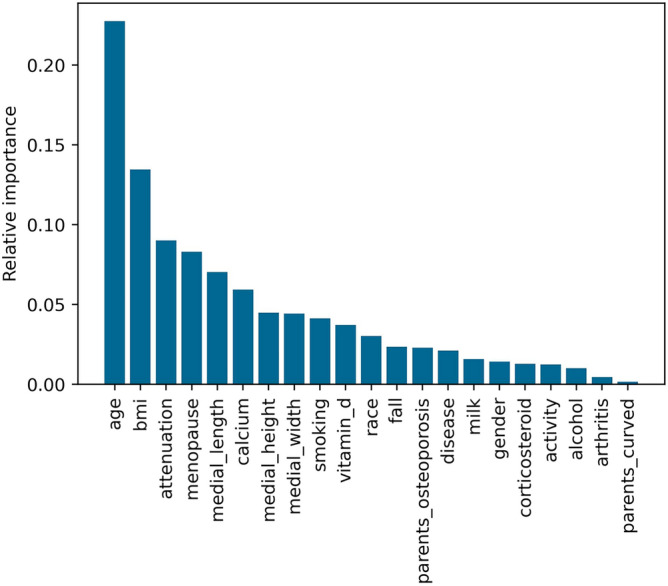
Osteoporosis is a disease characterized by impairment of bone microarchitecture that causes high socioeconomic impacts in the world because of fractures and hospitalizations. Although dual-energy X-ray absorptiometry (DXA) is the gold standard for diagnosing the disease, access to DXA in developing countries is still limited due to its high cost, being present only in specialized hospitals. In this paper, we analyze the performance of Osseus, a low-cost portable device based on electromagnetic waves that measures the attenuation of the signal that crosses the medial phalanx of a patient's middle finger and was developed for osteoporosis screening. The analysis is carried out by predicting changes in bone mineral density using Osseus measurements and additional common risk factors used as input features to a set of supervised classification models, while the results from DXA are taken as target (real) values during the training of the machine learning algorithms. The dataset consisted of 505 patients who underwent osteoporosis screening with both devices (DXA and Osseus), of whom 21.8% were healthy and 78.2% had low bone mineral density or osteoporosis. A cross-validation with k-fold = 5 was considered in model training, while 20% of the whole dataset was used for testing. The obtained performance of the best model (Random Forest) presented a sensitivity of 0.853, a specificity of 0.879, and an F1 of 0.859. Since the Random Forest (RF) algorithm allows some interpretability of its results (through the impurity check), we were able to identify the most important variables in the classification of osteoporosis. The results showed that the most important variables were age, body mass index, and the signal attenuation provided by Osseus. The RF model, when used together with Osseus measurements, is effective in screening patients and facilitates the early diagnosis of osteoporosis. The main advantages of such early screening are the reduction of costs associated with exams, surgeries, treatments, and hospitalizations, as well as improved quality of life for patients.
骨质疏松症是一种以骨微结构损伤为特征的疾病,由于骨折和住院治疗,给世界带来了巨大的社会经济影响。尽管双能 X 射线吸收法(DXA)是诊断这种疾病的金标准,但由于其成本高,发展中国家获得 DXA 的机会仍然有限,只能在专门的医院使用。在本文中,我们分析了基于电磁波的低成本便携式设备 Osseus 的性能,该设备通过测量穿过患者中指中节指骨的信号衰减来进行骨质疏松症筛查。通过使用 Osseus 测量值和其他常见的风险因素作为输入特征来预测骨密度的变化,将其输入到一组监督分类模型中,同时将 DXA 的结果作为机器学习算法的目标(真实)值来进行分析。该数据集包含 505 名同时接受 DXA 和 Osseus 筛查的患者,其中 21.8%为健康人群,78.2%为骨密度低或骨质疏松患者。在模型训练中考虑了 k 折交叉验证(k-fold=5),同时使用整个数据集的 20%进行测试。最佳模型(随机森林)的获得性能为:敏感性为 0.853,特异性为 0.879,F1 值为 0.859。由于随机森林(RF)算法可以对其结果进行一定程度的解释(通过杂质检查),因此我们能够确定分类骨质疏松症的最重要变量。结果表明,最重要的变量是年龄、体重指数和 Osseus 提供的信号衰减。RF 模型与 Osseus 测量值一起使用时,可有效对患者进行筛查,有助于早期诊断骨质疏松症。早期筛查的主要优点是降低与检查、手术、治疗和住院相关的成本,并提高患者的生活质量。