Division of Advanced Materials and Healthcare Technologies, School of Pharmacy, University of Nottingham, Nottingham NG7 2RD, U.K.
Departament de Farmacologia, Toxicologia i Química Terapèutica, Facultat de Farmàcia i Ciències de l'Alimentació, Universitat de Barcelona (UB), Av. Joan XXIII 27-31, 08028 Barcelona, Spain.
ACS Biomater Sci Eng. 2024 Sep 9;10(9):5689-5700. doi: 10.1021/acsbiomaterials.4c00849. Epub 2024 Aug 21.
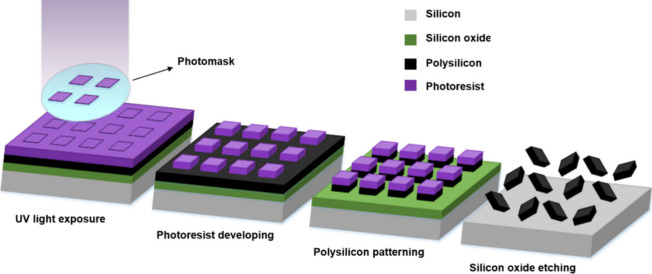
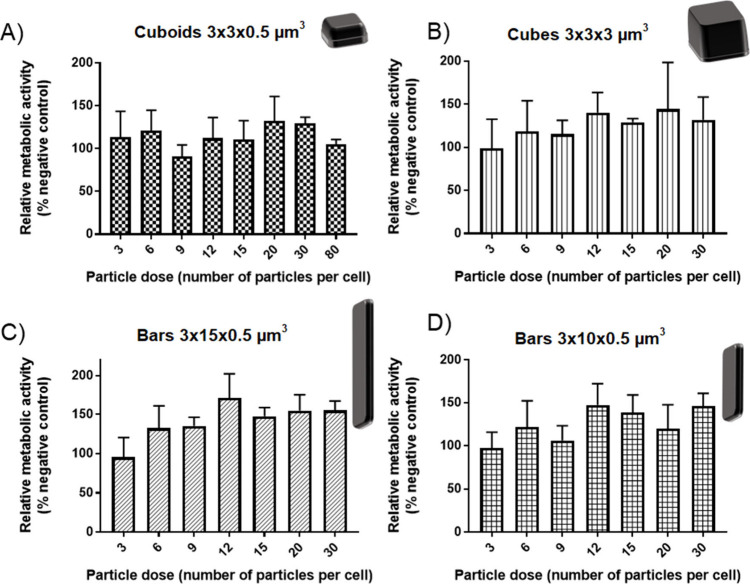
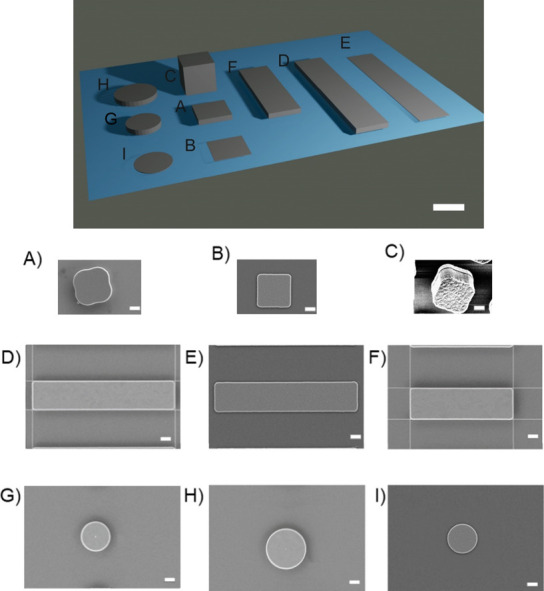
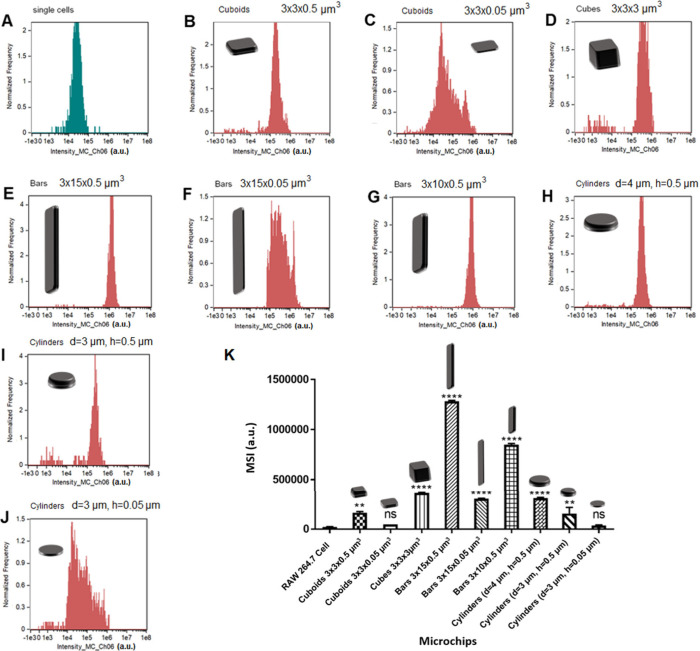
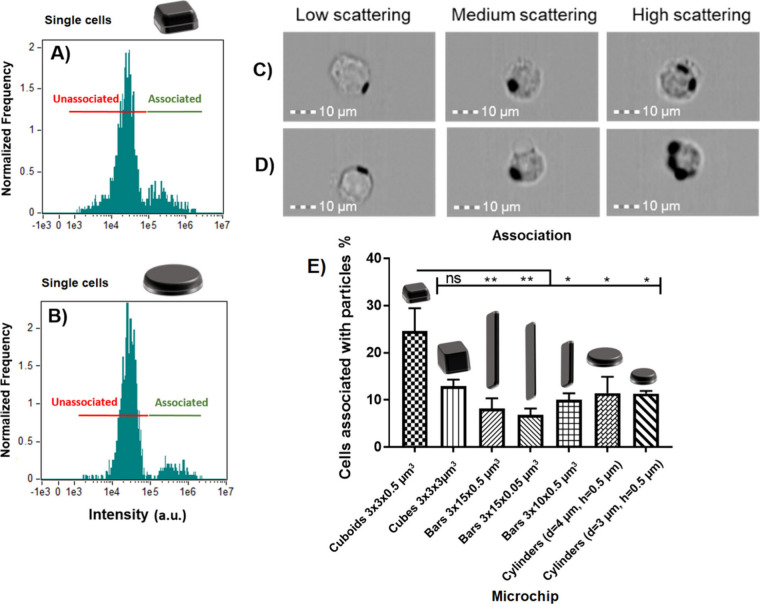
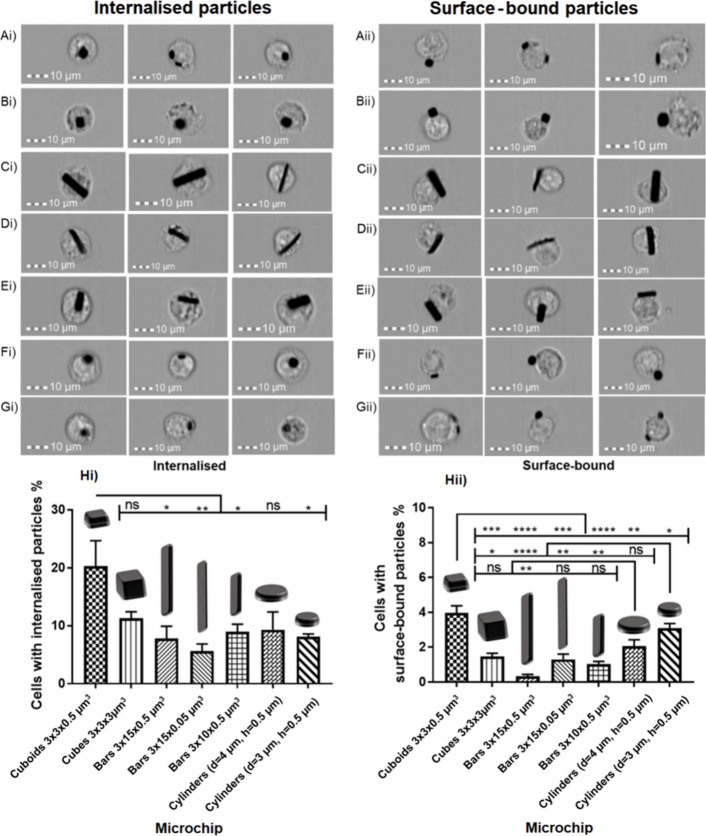
Drug delivery advances rely on using nano- and microsized carriers to transfer therapeutic molecules, although challenges persist in increasing the availability of new and even approved pharmaceutical products. Particle shape, a critical determinant in how these carriers distribute within the body after administration, raises opportunities of using, for instance, micrometer-sized nonspherical particles for vascular targeting and thereby creating new prospects for precise drug delivery to specific targeted areas. The versatility of polycrystalline silicon microfabrication allows for significant variation in the size and shape of microchips, and so, in the current work, photolithography was employed to create differently shaped polysilicon microchips, including cuboids, cubes, bars, and cylinders, to explore the influence of particle shape on cellular interactions. These microchips with different shapes and lateral dimensions, accounting for surface areas in the range of ca. 15 to 120 μm and corresponding total volumes of 0.4 to 27 μm, serve as ideal models for investigating their interactions with macrophages with diameters of ca. 20 μm. Side-scattering imaging flow cytometry was employed for studying the interaction of label-free prepared microchips with RAW 264.7 macrophages. Using a dose of 3 microchips per cell, results show that cuboids exhibit the highest cellular association (ca. 25%) and uptake (ca. 20%), suggesting their potential as efficient carriers for targeted drug delivery to macrophages. Conversely, similarly sized cylinders and bar-shaped microchips exhibit lower uptakes of about 8% and about 6%, respectively, indicating potential benefits in evading macrophage recognition. On average, 1-1.5 microchips were internalized, and ca. 1 microchip was surface-bound per cell, with cuboids showing the higher values overall. Macrophages respond to microchips by increasing their metabolic activity and releasing low levels of intracellular enzymes, indicating reduced toxicity. Interestingly, increasing the particle dose enhances macrophage metabolic activity without significantly affecting enzyme release.
药物输送的进展依赖于使用纳米和微米级载体来传递治疗分子,尽管在增加新的甚至已批准的药物产品的供应方面仍然存在挑战。颗粒形状是这些载体在给药后在体内分布的关键决定因素,它为使用例如微米级的非球形颗粒进行血管靶向提供了机会,从而为将药物精确输送到特定靶向区域创造了新的前景。多晶硅微加工的多功能性允许微芯片的尺寸和形状发生很大变化,因此,在当前的工作中,采用光刻技术来制造不同形状的多晶硅微芯片,包括长方体、立方体、棒和圆柱,以探索颗粒形状对细胞相互作用的影响。这些具有不同形状和横向尺寸的微芯片,其表面积在约 15 到 120 μm 范围内,总体积在 0.4 到 27 μm 范围内,可用作研究其与直径约为 20 μm 的巨噬细胞相互作用的理想模型。侧向散射成像流动细胞术用于研究无标记制备的微芯片与 RAW 264.7 巨噬细胞的相互作用。使用每个细胞 3 个微芯片的剂量,结果表明长方体表现出最高的细胞相关性(约 25%)和摄取(约 20%),表明它们作为靶向巨噬细胞药物输送的有效载体的潜力。相反,具有相似尺寸的圆柱和棒状微芯片的摄取量分别约为 8%和 6%,表明在逃避巨噬细胞识别方面具有潜在的益处。平均每个细胞内化 1-1.5 个微芯片,每个细胞表面结合约 1 个微芯片,长方体总体上显示出更高的值。巨噬细胞通过增加其代谢活性和释放低水平的细胞内酶来响应微芯片,表明毒性降低。有趣的是,增加颗粒剂量会增强巨噬细胞的代谢活性,而不会显著影响酶的释放。