Texas Biomedical Device Center, Richardson, USA.
School of Behavioral and Brain Sciences, Richardson, USA.
Sci Rep. 2024 Aug 21;14(1):19448. doi: 10.1038/s41598-024-70091-5.
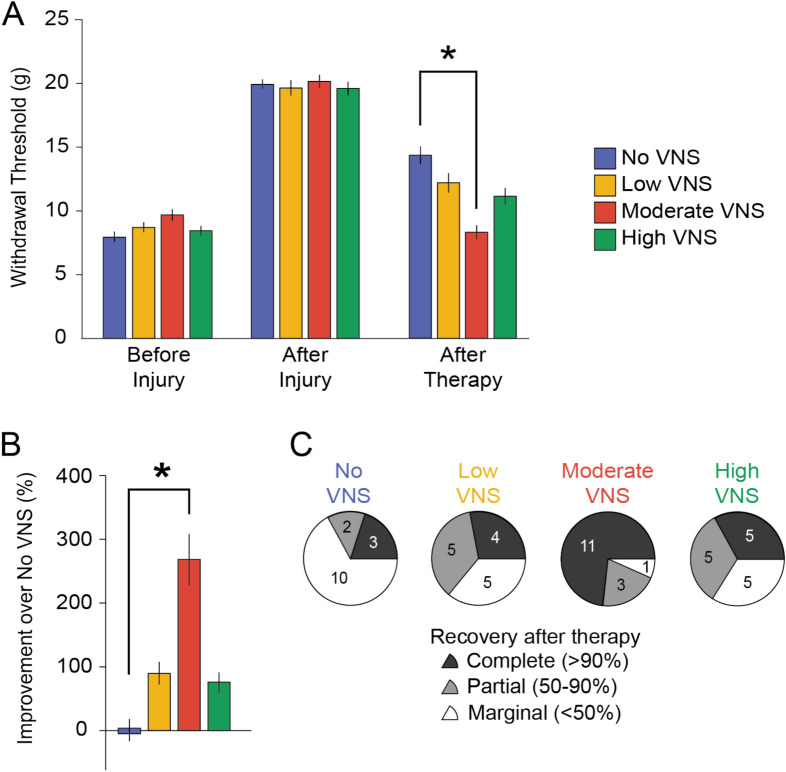
Impairments in somatosensory function are a common and often debilitating consequence of neurological injury, with few effective interventions. Building on success in rehabilitation for motor dysfunction, the delivery of vagus nerve stimulation (VNS) combined with tactile rehabilitation has emerged as a potential approach to enhance recovery of somatosensation. In order to maximize the effectiveness of VNS therapy and promote translation to clinical implementation, we sought to optimize the stimulation paradigm and identify neural mechanisms that underlie VNS-dependent recovery. To do so, we characterized the effect of tactile rehabilitation combined with VNS across a range of stimulation intensities on recovery of somatosensory function in a rat model of chronic sensory loss in the forelimb. Consistent with previous studies in other applications, we find that moderate intensity VNS yields the most effective restoration of somatosensation, and both lower and higher VNS intensities fail to enhance recovery compared to rehabilitation without VNS. We next used the optimized, moderate intensity to evaluate the mechanisms that underlie recovery. We find that moderate intensity VNS enhances transcription of Arc, a canonical mediator of synaptic plasticity, in the cortex, and that transcript levels were correlated with the degree of somatosensory recovery. Moreover, we observe that blocking plasticity by depleting acetylcholine in the cortex prevents the VNS-dependent enhancement of somatosensory recovery. Collectively, these findings identify neural mechanisms that subserve VNS-dependent somatosensation recovery and provide a basis for selecting optimal stimulation parameters in order to facilitate translation of this potential intervention.
躯体感觉功能障碍是神经损伤的常见且常使人衰弱的后果,目前干预手段有限。在运动功能障碍康复取得成功的基础上,迷走神经刺激(VNS)与触觉康复相结合已成为增强躯体感觉恢复的一种潜在方法。为了最大限度地提高 VNS 治疗的效果并促进其向临床应用转化,我们试图优化刺激方案并确定 VNS 依赖性恢复的神经机制。为此,我们在一种慢性前肢感觉丧失的大鼠模型中,研究了触觉康复与 VNS 联合应用的一系列刺激强度对躯体感觉功能恢复的影响。与其他应用中的先前研究一致,我们发现中等强度的 VNS 产生最有效的躯体感觉恢复效果,与没有 VNS 的康复相比,较低和较高的 VNS 强度都不能增强恢复。接下来,我们使用优化的中等强度来评估恢复的潜在机制。我们发现,中等强度的 VNS 增强了大脑皮层中 Arc 的转录,Arc 是突触可塑性的典型介质,而转录水平与躯体感觉恢复的程度相关。此外,我们观察到,通过耗竭皮层中的乙酰胆碱来阻止可塑性,可防止 VNS 依赖性躯体感觉恢复的增强。综上所述,这些发现确定了支持 VNS 依赖性躯体感觉恢复的神经机制,并为选择最佳刺激参数提供了基础,以促进这种潜在干预措施的转化。